
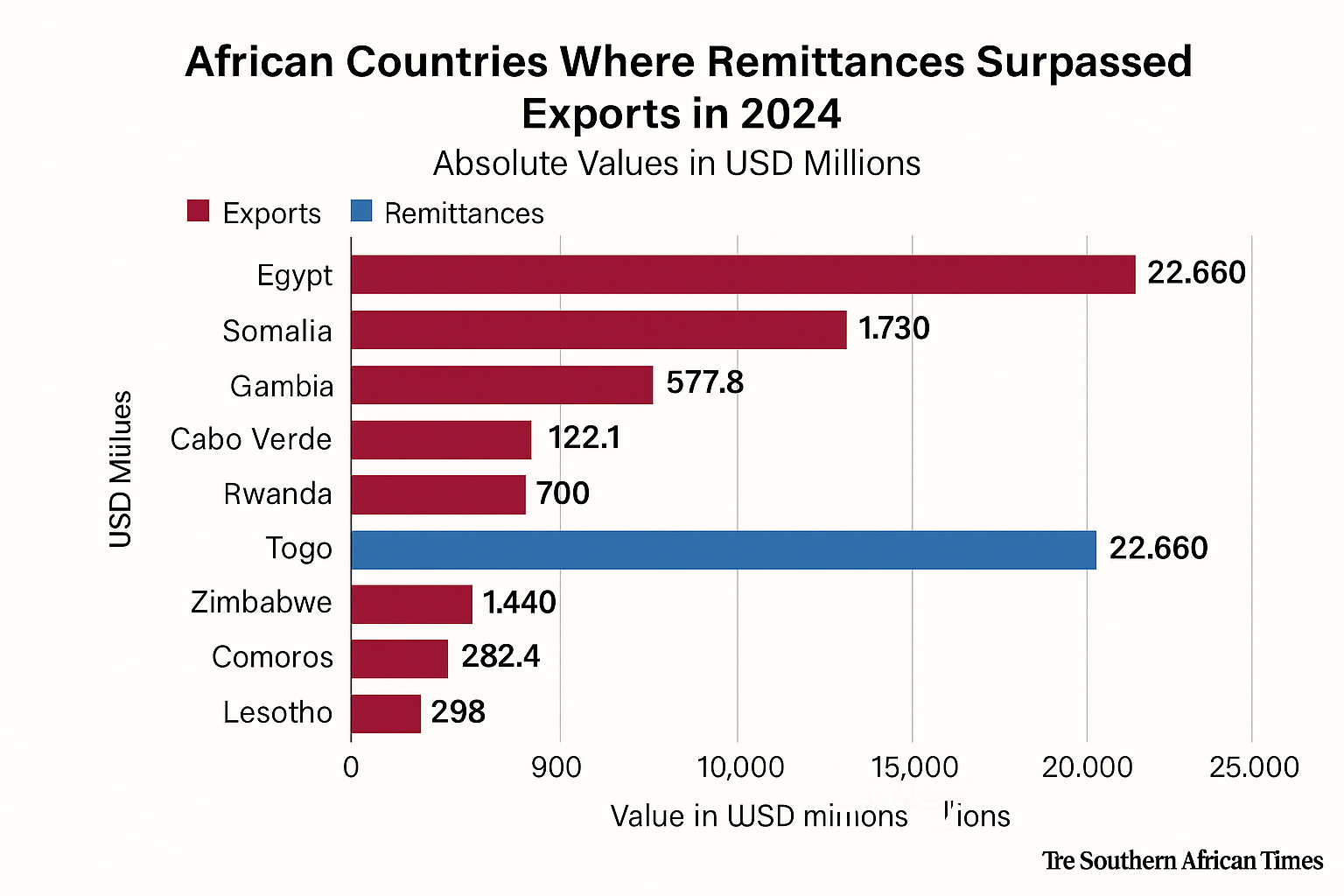
In 2024, remittances from Africans abroad overtook export revenues in at least ten African countries, underscoring the central role of diaspora contributions in sustaining national economies. Data compiled by RemitScope and the International Trade Centre (ITC) reveal a growing reliance on remittances as a stabilising source of foreign income.
Africa collectively received over $95 billion in remittances in 2024, according to World Bank estimates, with inflows surpassing export earnings in countries such as The Gambia, Comoros, Somalia, Egypt, Cabo Verde, Rwanda, Kenya, Togo, Zimbabwe, and Lesotho. This shift demonstrates how migration patterns and transnational family support now shape the macroeconomic landscape across the continent.
In The Gambia, remittances of $575.8 million dwarfed groundnut exports of $15.9 million, amounting to more than thirty-six times the value of the country’s principal export. Comoros recorded $282.4 million in remittances compared with $21.4 million from cloves, while Somalia received $1.73 billion in remittances against livestock exports of $269.9 million.



Larger economies also illustrate the scale of diaspora dependency. Egypt’s petroleum oils and related products generated $3.54 billion, yet remittances from its global diaspora reached $22.66 billion, more than six times higher. In Cabo Verde, prepared fish exports were valued at $57.6 million, while remittances amounted to $324 million. Rwanda’s ratio was 4.5, with diaspora inflows greatly exceeding coffee exports, while Zimbabwe recorded a narrower margin of 1.2, still signalling the structural weight of external inflows.
Kenya and Togo likewise illustrate how remittances contribute to national stability, often cushioning economies from global commodity price volatility. Unlike exports, which are vulnerable to market shifts, remittances tend to remain steady and may even increase during crises, as observed during the COVID-19 pandemic and recent inflationary spikes.
This trend highlights a broader economic reality: in several African countries, remittances are no longer supplementary but have become economic pillars. They finance household consumption, education, healthcare, and small-scale enterprises, while governments remain challenged to translate this flow into formalised investment. At the same time, remittance transfers remain encumbered by high costs and fragmented regulatory frameworks, leading many families to continue relying on informal channels despite associated risks.
Nigeria remains Africa’s largest remittance recipient in absolute terms, with Ghana, Kenya, and Senegal also receiving substantial inflows. Yet the countries where remittances outweigh exports are often smaller economies or those with long-standing diasporas dispersed across Europe, North America, and the Middle East.
Table: African Countries Where Remittances Surpassed Exports in 2024
| Country | Main Export (2024) | Export Earnings (USD) | Remittances (USD) | Ratio (Remittances : Exports) |
| The Gambia | Groundnuts | 15.9 million | 575.8 million | 36.2 |
| Comoros | Cloves | 21.4 million | 282.4 million | 13.2 |
| Somalia | Livestock | 269.9 million | 1.73 billion | 6.4 |
| Egypt | Petroleum oils | 3.54 billion | 22.66 billion | 6.4 |
| Cabo Verde | Prepared fish | 57.6 million | 324 million | 5.6 |
| Rwanda | Coffee | 122.1 million* | 550 million* | 4.5 |
| Kenya | Tea and cut flowers | 1.44 billion* | 5.77 billion* | 4.0 |
| Togo | Phosphates | 194 million | 700 million* | 3.6 |
| Zimbabwe | Tobacco | 1.2 billion | 1.44 billion* | 1.2 |
| Lesotho | Textiles | 298 million | 400 million* | 1.3 |

Data approximated from World Bank, ITC, and country-specific trade reports (2024).
 The prominence of diaspora remittances raises fundamental policy questions for African states. While these inflows provide resilience, their heavy reliance underscores structural vulnerabilities. Without greater diversification of economies, many states risk becoming overly dependent on external remittance streams that are shaped by global labour dynamics beyond their control.
Ultimately, diaspora contributions affirm the transnational bonds of African societies, where families, livelihoods, and communities stretch across borders. Yet the challenge remains: how to leverage these vast inflows not merely as household lifelines but as sustainable engines for development, industrialisation, and long-term economic sovereignty.