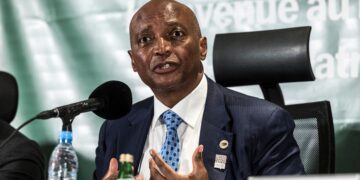
The Fédération Internationale de Football Association (FIFA) officially inaugurated its Africa office on Saturday, 27 July 2025, at the Mohammed VI Football Complex in Salé, Morocco. The occasion was presided over by FIFA President Gianni Infantino and attended by several prominent figures in global and African football governance, including Confederation of African Football (CAF) President Patrice Motsepe and Royal Moroccan Football Federation (FRMF) President Fouzi Lekjaa.
The inauguration marks a pivotal milestone in the evolution of African football governance and infrastructure. The establishment of the FIFA Africa office in Morocco is the result of an agreement signed in December 2024 in Marrakech, during the CAF Awards ceremony. The tripartite accord involved Morocco’s Head of Government Aziz Akhannouch, FIFA President Infantino, and FRMF President Lekjaa.




Speaking at the ceremony, Infantino underscored the symbolic and operational significance of the new office. “This is a historic moment, a festive and joyful day that will be etched in golden letters in the history of FIFA and African football, in Morocco, and across the world,” he stated. He attributed this development to the proactive engagement of King Mohammed VI, whose sustained investment in sport has, according to Infantino, established Morocco as a central actor in African football development.
The Mohammed VI Complex, inaugurated in 2019, now hosts the FIFA Africa office. According to Infantino, the facility has evolved into a critical nerve centre for the advancement of football on the continent. He noted, “What we are inaugurating today is not just a FIFA Africa office. It’s a global FIFA centre that will have a worldwide impact on the game.” This development aligns with Morocco’s growing international football role, as it prepares to host the 2025 Africa Cup of Nations (AFCON) and serve as a co-host, alongside Spain and Portugal, for the 2030 FIFA World Cup.


The FIFA President also highlighted Morocco’s hosting of the upcoming editions of the FIFA U-17 Women’s World Cup, and drew attention to the Women’s Africa Cup of Nations final between Morocco and Nigeria held in Rabat the same evening. Infantino praised the enthusiasm of Moroccan supporters and described the occasion as emblematic of the continent’s increasing embrace of women’s football.
CAF President Patrice Motsepe lauded the decision to locate the FIFA Africa office in Morocco, stating, “There could not be a better place to establish this office.” He acknowledged King Mohammed VI’s contribution to elevating African football and argued that the continent is now positioned to achieve excellence on the global stage. Referencing Morocco’s historic semi-final performance at the 2022 FIFA World Cup in Qatar, Motsepe suggested that Africa’s footballing future appears increasingly promising.

FRMF President Fouzi Lekjaa echoed these sentiments, crediting the Mohammed VI Complex to the monarch’s long-term vision of social and athletic development. He framed the complex as part of a comprehensive national strategy aimed at harnessing sport as a tool for youth empowerment. “This vision aspires to make Morocco a welcoming hub for talent from around the world,” Lekjaa remarked. He also reiterated Morocco’s tradition of openness and multiculturalism, positioning the new FIFA office as a reflection of the country’s inclusive values.
The establishment of this office is widely seen as a testament to FIFA’s renewed commitment to African football, not only as a sport but as a vehicle for social transformation, youth development, and international cooperation. As such, it represents both a symbolic and functional cornerstone for the game’s future on the continent.