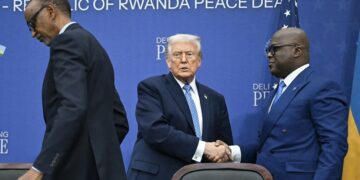
In a dramatic performance that conjures echoes of a bygone imperial theatre, US President Donald Trump hosted five African leaders representing Gabon, Guinea-Bissau, Liberia, Mauritania and Senegal from 10 to 12 July in Washington DC for what was formally billed as a summit on trade, investment and security. Yet, beneath the diplomatic choreography and pronouncements of partnership, the meeting was less a symphony of sovereign equals than a monologue of power dressed in modern garments.
The three-day summit marked a distinct recalibration of American rhetoric toward the continent. Trump’s declaration that US policy would shift “from aid to trade” presented itself as a panacea to the age-old dependency narrative. However, as history teaches us, and as several analysts and regional observers have pointed out, such transitions in language often belie deeper continuities of structural inequity. Africa, once a pawn in Cold War stratagems and then a beneficiary of neoliberal structural adjustment programmes, is now positioned anew as a crucible of minerals essential to America’s industrial and digital future. What has changed is not the logic of extraction, but the vocabulary.
The nations represented at the summit share not only regional proximity but economic vulnerability. Each faces a looming 10 percent tariff on exports to the United States. The convening in Washington therefore took on an unmistakable air of coercive diplomacy. Far from negotiating improved bilateral terms, these states found themselves navigating a labyrinth of conditionalities: from trade imbalances to the forced repatriation of migrants, many of whom face criminal allegations and detention histories.



This forced repatriation policy, reinvigorated under the Trump administration, mirrors what historian Mahmood Mamdani would categorise as the politics of naming and shaming – an attempt to moralise one’s own policy failures through the convenient scapegoating of others. Reports indicate that South Sudan has already received deportees, while Nigeria has publicly rebuffed Washington’s attempts, citing the impossibility of absorbing individuals who may constitute national security risks. The Nigerian Foreign Minister, Yusuf Tuggar, articulated a view shared across much of the continent: such externalisation of responsibility is both ethically dubious and structurally unsustainable.
Beyond policy, the tone and tenor of the summit betrayed a discomforting indifference to diplomatic protocol. Trump’s remarks to Liberian President Joseph Boakai – praising his “beautiful English” and inquiring whether it had been learned “in Liberia” – reflect more than an innocent faux pas. They represent a historically rooted epistemic violence: the persistent assumption that Africans exist outside the bounds of modernity, literacy and global sophistication. Liberia, as any student of post-abolition geopolitics would know, was founded in the 19th century by freed African-American slaves, with English as its official language and an education system modelled on American institutions. To feign surprise at the eloquence of its president is to ignore this legacy and to reinforce the fiction that Africa remains the perennial Other.

Equally performative was Trump’s physical staging of the summit. A now-viral photograph depicts the African leaders standing in deference while the US President sits imperiously at the Oval Office desk, a visual reminiscent of colonial tableaux where European potentates received native emissaries. This imagery, far from incidental, is integral to what Edward Said described in Orientalism as the production of knowledge through domination. Africa is not a participant in global affairs but a subject to be spoken of, spoken at and spoken for.

While some commentators have sought to frame the summit as a transactional engagement within the bounds of realpolitik, it is essential to probe the asymmetries embedded within such transactions. Gabon, for instance, holds nearly 25 percent of the world’s manganese reserves – essential for steel and battery production. Senegal is rapidly emerging as a hydrocarbon power with oil and natural gas deposits offshore, while Mauritania possesses vast uranium deposits critical to the nuclear and green energy sectors. In this light, the summit was less about enhancing Africa’s economic capacities and more about securing US access to the building blocks of its own industrial renaissance.
There is precedent for such mineral-fuelled diplomacy. During the Eisenhower era, American interests in Congolese uranium directly fed the Manhattan Project. Later, in the 1980s, Washington’s alignment with Mobutu Sese Seko of Zaire was shaped less by ideological affinity than by the strategic imperative of cobalt and copper procurement. The Trump summit then is neither novel nor aberrational. It is a reprise of a long-standing strategy cloaked in new verbiage.
That African leaders accepted the invitation, even under constrained terms, speaks to the continent’s enduring structural disadvantage in global forums. The lack of a coordinated African Union policy on US trade negotiations leaves individual states susceptible to divide-and-rule tactics, a fragmentation that continues to plague pan-African diplomacy. Scholars such as Achille Mbembe have long argued that Africa’s geopolitical marginalisation is not merely external but internalised through fragmented sovereignties and the absence of a unified strategic vision.
Yet, even in this context, there are signs of resistance. Nigeria’s rejection of deportee repatriation sets an important precedent. Civil society responses across West Africa – particularly in Liberia and Senegal – have been swift in calling out the patronising discourse that underpinned the summit. Online platforms, once mere echo chambers, are evolving into arenas of political education and mobilisation, challenging dominant narratives and asserting African agency.
To characterise the summit as a failure would be reductive. It was, in truth, a revelation – a clarifying moment in which the architecture of global power was rendered visible. The promise of trade not aid must be interrogated not only in terms of its economic metrics but its moral and historical lineage. True partnership demands more than market access or mineral contracts. It demands mutual respect, historical consciousness and a reimagining of diplomacy not as theatre, but as dialogue.
As the dust settles in Washington, African leaders must confront an imperative that has loomed since the end of formal colonialism: the necessity of collective bargaining, rooted not in paternalistic aid frameworks but in continental unity, economic sovereignty and intellectual emancipation. Anything less risks reducing Africa once again to a passive supplier of raw materials in another man’s industrial tale.
Written by the Political Editorial Team: James Reeve, Mabutho Mushinga and Farai Ian Muvuti