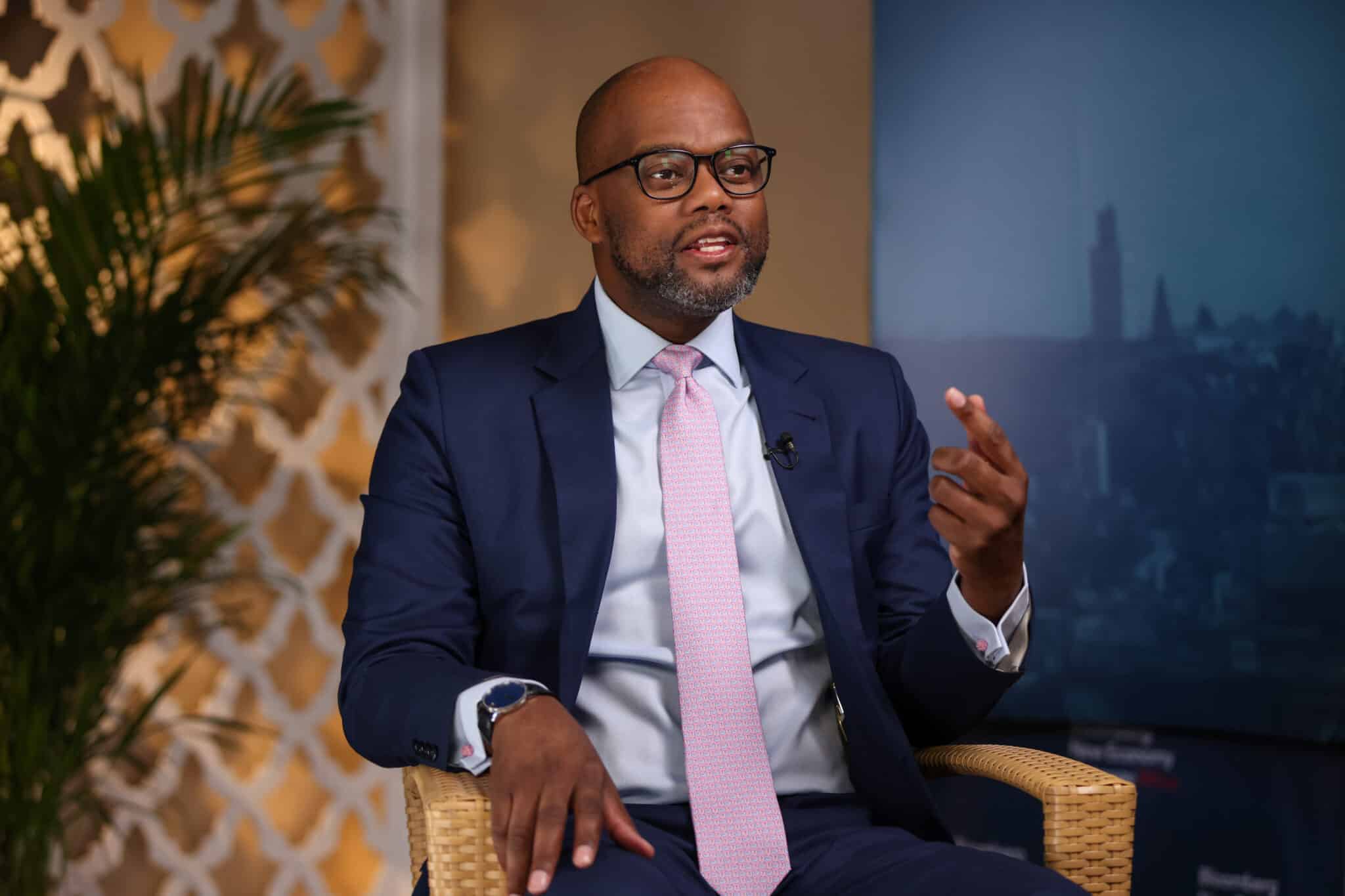
The Secretary General of the African Continental Free Trade Area (AfCFTA), Wamkele Mene, has voiced his discontent regarding South Africa’s reluctance to ratify the Pan-African Payment and Settlement System (PAPSS), a move designed to mitigate trade costs and enhance economic integration across the continent.
PAPSS, developed in conjunction with the African Union, aims to revolutionise intra-African transactions by allowing businesses to operate in any of Africa’s 42 currencies without recourse to a third-party currency such as the US dollar. This innovation holds the potential to save up to $5 billion annually, according to estimates. The system has already garnered participation from 115 commercial banks and 15 central banks.
Mene, in an interview with CNBC Africa, expressed surprise and regret over South Africa’s absence from the PAPSS initiative, suggesting that its reluctance may be influenced by political and economic considerations. “I regret that South Africa has not yet adopted the Pan-African Payment and Settlement System because I think it is a political economy question,” Mene remarked. He added, “I must confess, I am surprised that not more countries have joined PAPSS.”



The Secretary General emphasised that South Africa, as Africa’s largest economy with more than 80 per cent of manufactured goods trade on the continent, stands to gain significantly from the reduced transaction costs and enhanced intra-Africa trade afforded by PAPSS. The Africa Export-Import Bank estimates that over 80 per cent of intra-African payments are currently processed through Europe or the United States, reflecting the lingering influence of colonial histories and the dominance of Western economies. PAPSS is designed to diminish this dependence and restore autonomy to Africa’s trade relations.
Mene highlighted the comparative advantages of PAPSS, noting the substantial cost disparity between its system and traditional methods. “If you look at the cost of a transaction across regions of the continent, if your goods cost you $500, we charge you $2 to transact on PAPSS. If you use SWIFT, you will pay $60 or $70. And it is instantaneous. It is a digital platform, instantaneous. So I think that it is in Africa’s advantage,” he explained.
Launched in January 2021, the Africa Continental Free Trade Agreement is the youngest and largest trading bloc globally, aiming to create a unified market with a combined gross domestic product (GDP) of $3.4 trillion, projected to grow to $16.5 trillion by 2035, as per the World Bank. So far, 48 of Africa’s 54 territories have ratified the agreement, with Eritrea expected to join shortly.

Mene underscored the broader implications of the PAPSS initiative, framing it not merely as an economic tool but as a symbol of African sovereignty. “This question is not just about addressing the trade deficit in Africa; it is also about the sovereignty of the continent of Africa, the payment sovereignty of the African continent,” he said. “If today you upset somebody in Washington or in London, you could be excluded from SWIFT and thus unable to transact with the rest of the world. So it is not just about easing payments; it is also about political sovereignty. It is a political economy question.”
The Africa Export-Import Bank anticipates that most of Africa’s central banks will be participants in PAPSS by next year, marking a pivotal step towards increasing intra-African trade, which currently stands at a modest 20 per cent compared to 68 per cent in Europe, 59 per cent in Asia, and 30.6 per cent in Northern America, as reported by UN Trade and Development.
The unfolding dynamics of PAPSS underscore the critical role of financial systems in shaping economic integration and sovereignty in Africa, marking a significant moment in the continent’s evolving trade landscape.