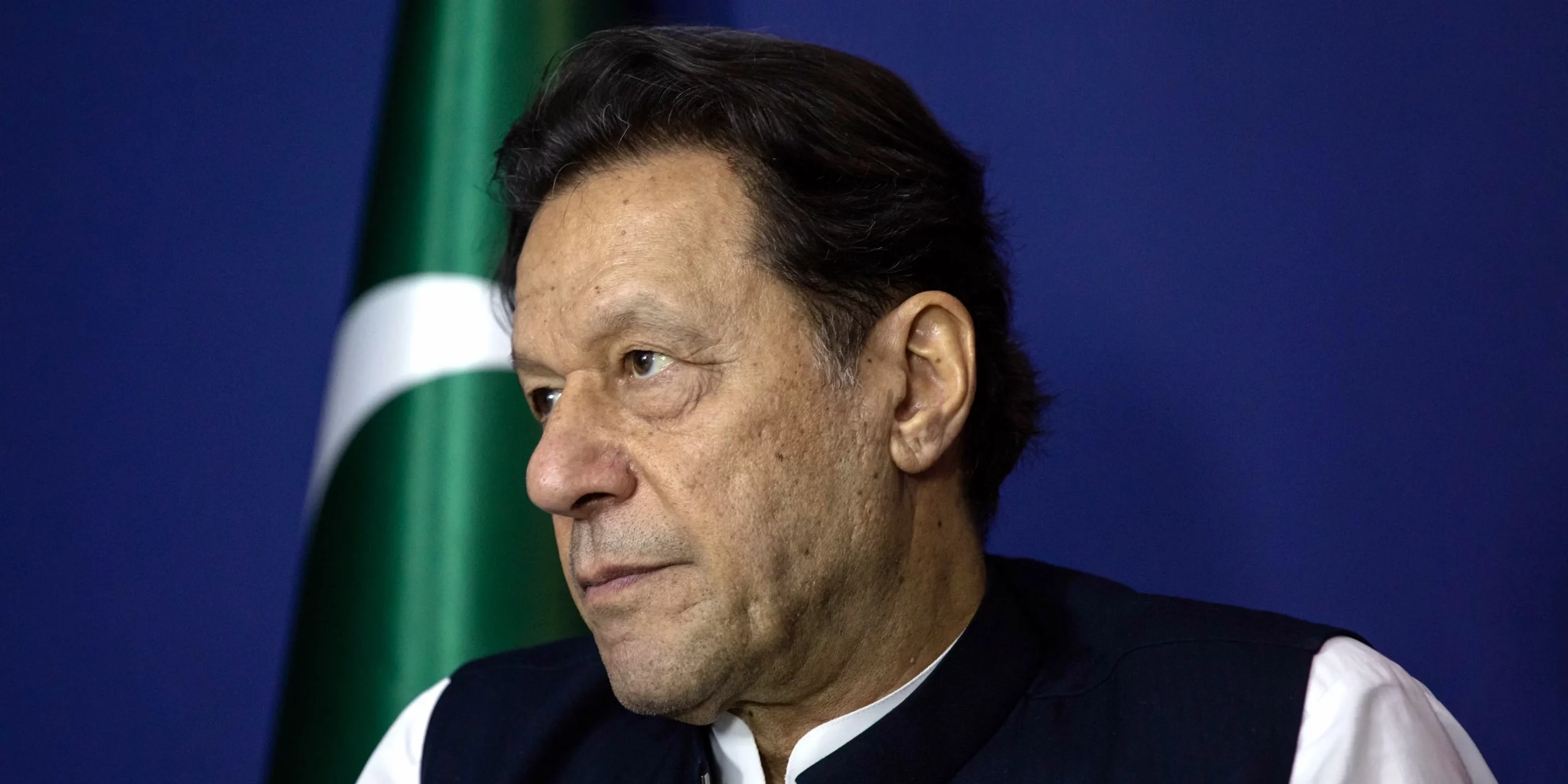
In a classified document leaked to The Intercept, new revelations have emerged regarding the alleged involvement of the U.S. State Department in the removal of Imran Khan as Pakistan’s Prime Minister. The document, obtained from an anonymous source within the Pakistani military, offers insights into a diplomatic meeting held on March 7, 2022, between Pakistani Ambassador to the U.S. Asad Majeed Khan and Assistant Secretary of State for the Bureau of South and Central Asian Affairs Donald Lu. The discussions centered on Pakistan’s response to the Russian invasion of Ukraine and its implications for international relations.
The leaked “cypher” document, labeled “Secret,” provides a rare glimpse into diplomatic negotiations and the delicate interplay between international actors and domestic politics. In this specific case, it sheds light on the U.S. State Department’s concerns about Imran Khan’s perceived neutrality on the Russia-Ukraine conflict, which Washington interpreted as a challenge to the global consensus against Russian aggression.
Assistant Secretary Lu’s frank comments during the meeting have fueled speculations about the extent of U.S. influence on Pakistan’s internal affairs. According to the document, Lu expressed dissatisfaction with Pakistan’s stance, suggesting that Khan’s purportedly neutral position on the Ukraine conflict was seen as “aggressively neutral” by observers. The cable also quotes Lu raising the issue of a potential no-confidence vote, hinting that the U.S. might reconsider its approach should Khan be removed from power.



The leaked document has stirred a storm of controversy within Pakistan, where political opponents and Khan’s supporters have locked horns over the authenticity and implications of the cable’s contents. Critics of Khan argue that the U.S.’s interest in his removal points to deeper concerns about his leadership and the direction of Pakistan’s foreign policy, particularly given the global consensus against Russia’s actions in Ukraine.
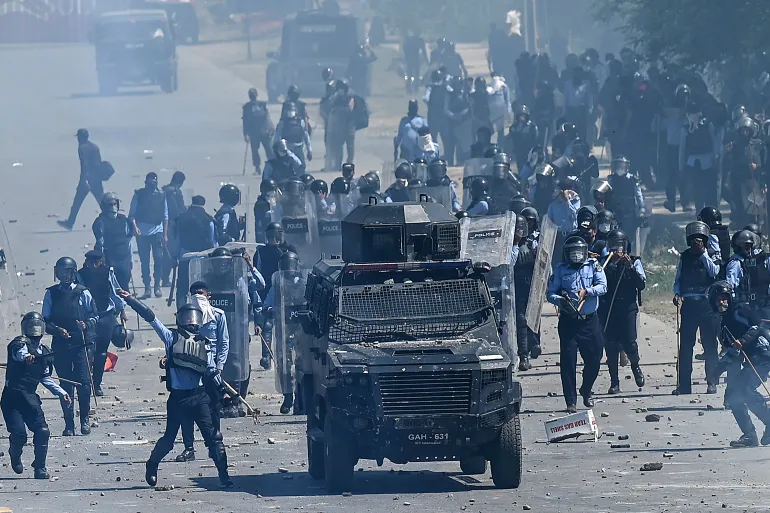
Khan’s defenders argue that the U.S. played an inadvertent role in bolstering the Pakistani military’s efforts to curtail his political influence. His supporters claim that Khan’s ousting, combined with his subsequent imprisonment on corruption charges, signifies a calculated effort to silence a popular political figure and quell dissent. The leaked document, they argue, substantiates their concerns about collusion between external actors and the military establishment.
The revelations contained in the document have also laid bare the complexities of U.S.-Pakistan relations and the uneasy balance between sovereign decision-making and international diplomacy. The U.S. State Department’s interest in Khan’s stance on the Ukraine conflict serves as a reminder that global political dynamics often influence the domestic decisions of nations, especially those in strategically significant regions like South Asia.
However, while the leaked document has provided insights into diplomatic maneuvering, the U.S. State Department has consistently denied the allegations of interference. The State Department spokesperson, Matthew Miller, emphasized that the U.S. refrains from taking sides in the politics of other countries, regardless of the circumstances. This assertion, however, has done little to quell the fervent debate surrounding the authenticity and implications of the document.
In the aftermath of Khan’s removal from power, Pakistan has found itself grappling with a multifaceted crisis. The subsequent clampdown on dissent, the restriction of press freedom, and the erosion of civil liberties have cast a shadow on the nation’s democratic foundations. Khan’s allegations of a military-engineered ousting, corroborated by the leaked document, have further ignited discussions about the military’s role as a power broker within Pakistan’s political landscape.
The leaked document has spurred introspection among Pakistanis about the nation’s sovereignty and the degree to which external actors influence its internal affairs. The controversy has also raised broader questions about the implications of foreign involvement in democratic processes worldwide. The U.S.’s purported role in Khan’s removal serves as a microcosm of the intricate dance between global superpowers and smaller nations, as well as the ethical considerations associated with such diplomatic interactions.
As Pakistan grapples with the fallout of these revelations, the role of the military in shaping the nation’s political trajectory has come under renewed scrutiny. Observers note that Khan’s removal reflects a pattern of political upheaval orchestrated by the military, raising concerns about the erosion of democratic norms. The leaked document has thus become a focal point for discussions about the broader challenges facing Pakistan’s democratic institutions and civil society.
The leaked classified document has brought to the fore a contentious debate over the role of foreign powers in shaping Pakistan’s internal politics. The revelations regarding the U.S. State Department’s concerns about Imran Khan’s neutrality on the Russia-Ukraine conflict have ignited discussions about the influence of global superpowers on domestic decision-making. While the document’s authenticity remains a subject of debate, its contents have shed light on the complex dynamics of international diplomacy and their impact on a nation’s democratic processes.
March 7, 2022 Pakistani Diplomatic Cypher (Transcription)
The Southern African Times is publishing the body of the cable below as presented byThe Intercept correcting minor typos in the text because such details can be used to watermark documents and track their dissemination. The Intercept has removed classification markings and numerical elements that could be used for tracking purposes. Labeled “Secret,” the cable includes an account of the meeting between State Department officials, including Assistant Secretary of State for the Bureau of South and Central Asian Affairs Donald Lu, and Asad Majeed Khan, who at the time was Pakistan’s ambassador to the U.S.
I had a luncheon meeting today with Assistant Secretary of State for South and Central Asia, Donald Lu. He was accompanied by Deputy Assistant Secretary of State Les Viguerie. DCM, DA and Counsellor Qasim joined me.
At the outset, Don referred to Pakistan’s position on the Ukraine crisis and said that “people here and in Europe are quite concerned about why Pakistan is taking such an aggressively neutral position (on Ukraine), if such a position is even possible. It does not seem such a neutral stand to us.” He shared that in his discussions with the NSC, “it seems quite clear that this is the Prime Minister’s policy.” He continued that he was of the view that this was “tied to the current political dramas in Islamabad that he (Prime Minister) needs and is trying to show a public face.” I replied that this was not a correct reading of the situation as Pakistan’s position on Ukraine was a result of intense interagency consultations. Pakistan had never resorted to conducting diplomacy in public sphere. The Prime Minister’s remarks during a political rally were in reaction to the public letter by European Ambassadors in Islamabad which was against diplomatic etiquette and protocol. Any political leader, whether in Pakistan or the U.S., would be constrained to give a public reply in such a situation.
I asked Don if the reason for a strong U.S. reaction was Pakistan’s abstention in the voting in the UNGA. He categorically replied in the negative and said that it was due to the Prime Minister’s visit to Moscow. He said that “I think if the no-confidence vote against the Prime Minister succeeds, all will be forgiven in Washington because the Russia visit is being looked at as a decision by the Prime Minister. Otherwise, I think it will be tough going ahead.” He paused and then said “I cannot tell how this will be seen by Europe but I suspect their reaction will be similar.” He then said that “honestly I think isolation of the Prime Minister will become very strong from Europe and the United States.” Don further commented that it seemed that the Prime Minister’s visit to Moscow was planned during the Beijing Olympics and there was an attempt by the Prime Minister to meet Putin which was not successful and then this idea was hatched that he would go to Moscow.
I told Don that this was a completely misinformed and wrong perception. The visit to Moscow had been in the works for at least few years and was the result of a deliberative institutional process. I stressed that when the Prime Minister was flying to Moscow, Russian invasion of Ukraine had not started and there was still hope for a peaceful resolution. I also pointed out that leaders of European countries were also traveling to Moscow around the same time. Don interjected that “those visits were specifically for seeking resolution of the Ukraine standoff while the Prime Minister’s visit was for bilateral economic reasons.” I drew his attention to the fact that the Prime Minister clearly regretted the situation while being in Moscow and had hoped for diplomacy to work. The Prime Minister’s visit, I stressed, was purely in the bilateral context and should not be seen either as a condonation or endorsement of Russia’s action against Ukraine. I said that our position is dictated by our desire to keep the channels of communication with all sides open. Our subsequent statements at the UN and by our Spokesperson spelled that out clearly, while reaffirming our commitment to the principle of UN Charter, non-use or threat of use of force, sovereignty and territorial integrity of States, and pacific settlement of disputes.
I also told Don that Pakistan was worried of how the Ukraine crisis would play out in the context of Afghanistan. We had paid a very high price due to the long-term impact of this conflict. Our priority was to have peace and stability in Afghanistan, for which it was imperative to have cooperation and coordination with all major powers, including Russia. From this perspective as well, keeping the channels of communication open was essential. This factor was also dictating our position on the Ukraine crisis. On my reference to the upcoming Extended Troika meeting in Beijing, Don replied that there were still ongoing discussions in Washington on whether the U.S. should attend the Extended Troika meeting or the upcoming Antalya meeting on Afghanistan with Russian representatives in attendance, as the U.S. focus right now was to discuss only Ukraine with Russia. I replied that this was exactly what we were afraid of. We did not want the Ukraine crisis to divert focus away from Afghanistan. Don did not comment.

I told Don that just like him, I would also convey our perspective in a forthright manner. I said that over the past one year, we had been consistently sensing reluctance on the part of the U.S. leadership to engage with our leadership. This reluctance had created a perception in Pakistan that we were being ignored and even taken for granted. There was also a feeling that while the U.S. expected Pakistan’s support on all issues that were important to the U.S., it did not reciprocate and we do not see much U.S. support on issues of concern for Pakistan, particularly on Kashmir. I said that it was extremely important to have functioning channels of communication at the highest level to remove such perception. I also said that we were surprised that if our position on the Ukraine crisis was so important for the U.S., why the U.S. had not engaged with us at the top leadership level prior to the Moscow visit and even when the UN was scheduled to vote. (The State Department had raised it at the DCM level.) Pakistan valued continued high-level engagement and for this reason the Foreign Minister sought to speak with Secretary Blinken to personally explain Pakistan’s position and perspective on the Ukraine crisis. The call has not materialized yet. Don replied that the thinking in Washington was that given the current political turmoil in Pakistan, this was not the right time for such engagement and it could wait till the political situation in Pakistan settled down.
I reiterated our position that countries should not be made to choose sides in a complex situation like the Ukraine crisis and stressed the need for having active bilateral communications at the political leadership level. Don replied that “you have conveyed your position clearly and I will take it back to my leadership.”

I also told Don that we had seen his defence of the Indian position on the Ukraine crisis during the recently held Senate Sub-Committee hearing on U.S.-India relations. It seemed that the U.S. was applying different criteria for India and Pakistan. Don responded that the U.S. lawmakers’ strong feelings about India’s abstentions in the UNSC and UNGA came out clearly during the hearing. I said that from the hearing, it appeared that the U.S. expected more from India than Pakistan, yet it appeared to be more concerned about Pakistan’s position. Don was evasive and responded that Washington looked at the U.S.-India relationship very much through the lens of what was happening in China. He added that while India had a close relationship with Moscow, “I think we will actually see a change in India’s policy once all Indian students are out of Ukraine.”
I expressed the hope that the issue of the Prime Minister’s visit to Russia will not impact our bilateral ties. Don replied that “I would argue that it has already created a dent in the relationship from our perspective. Let us wait for a few days to see whether the political situation changes, which would mean that we would not have a big disagreement about this issue and the dent would go away very quickly. Otherwise, we will have to confront this issue head on and decide how to manage it.”
We also discussed Afghanistan and other issues pertaining to bilateral ties. A separate communication follows on that part of our conversation.
Assessment
Don could not have conveyed such a strong demarche without the express approval of the White House, to which he referred repeatedly. Clearly, Don spoke out of turn on Pakistan’s internal political process. We need to seriously reflect on this and consider making an appropriate demarche to the U.S. Cd’ A a.i in Islamabad.