Monday, June 29, 2026
  • Login
The Southern African Times
  • Home
  • Southern Africa
  • Business
    • African Start ups
    • African Continental Free Trade Area
  • Technology
    • Lifestyle
      • Health
      • Culture
      • Food and Drink
      • Entertainment
  • Opinion
  • Sports
  • SAT Jobs
    • Events
  • About Us
    • Advertise with Us
    • Contact Us
No Result
View All Result
  • Home
  • Southern Africa
  • Business
    • African Start ups
    • African Continental Free Trade Area
  • Technology
    • Lifestyle
      • Health
      • Culture
      • Food and Drink
      • Entertainment
  • Opinion
  • Sports
  • SAT Jobs
    • Events
  • About Us
    • Advertise with Us
    • Contact Us
No Result
View All Result
The Southern African Times
No Result
View All Result
Home Opinion

Empowering African women to shape the continent’s future

by SAT Reporter
March 10, 2022
in Opinion
0
Empowering African women to shape the continent’s future

With the right opportunities, women can play a critical role in the social and economic development of Africa. But what interventions are most effective at empowering more African women to seize such opportunities?

When women have more say in their own social and economic choices, their well-being and that of their households and communities improves. Their families show progress on nearly all development indicators.

For example, a study by the African Economic Research Consortium in Kenya examining the impact of policies to empower women on household nutritional outcomes found that the percentage of underweight children under 5 years old dropped from 19 percent to 12 percent between 2003 and 2014. In Nigeria, a survey of farming households revealed that gender parity significantly reduced household food insecurity. And an analysis of data from nine African countries linked women’s empowerment with improvements in children’s cognitive development, growth, and nutrition.


ADVERTISEMENT

These household-level benefits trickle up. A 2018 report by the International Monetary Fund associated greater gender equality with increased economic resilience, higher GDP per capita, lower income inequality, and higher labor productivity.

An investment in effective, evidence-based policies that empower women thus is an investment in a country’s overall economic future. But when African governments and their partners commit to invest in women’s empowerment, they first must understand which approaches produce sustained results. Recent evaluations of several programs provide some insights into the best way to set women on a path to long-term self-reliance and improved well-being.

The Empowerment and Livelihood for Adolescents (ELA) model offers young women a combination of life skills and vocational training. It uses peer mentors to provide information on reproduction and sexual health and instruction in financial literacy and business management. So far, ELA has reached over 200,000 adolescent girls and young women across Uganda, Sierra Leone, South Sudan, Nepal, Liberia, and Tanzania.

A randomized controlled trial in Uganda found that young girls in communities with ELA programs were “48 percent more likely to engage in income generating activity,” primarily self-employment. These villages also benefited from a 34 percent reduction in teen pregnancy and a 62 percent reduction in early marriage or cohabitation.
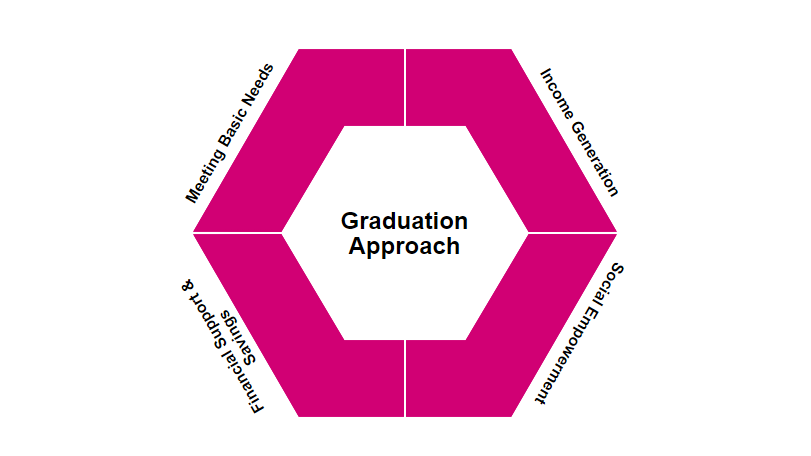
Graphics on BRAC’s website explaining the Graduation approach to address extreme poverty. /BRAC Ultra-Poor Graduation Initiative

Another model is Graduation, which takes a multi-pronged approach to addressing extreme poverty. The program meets participants’ basic needs, often through connecting them to existing safety net schemes, and then provides assets for income generation and instruction on how to manage them. Participants also receive instruction on financial literacy and life skills training. And all program components are adapted to the local context and implemented through in-person coaching.

A growing body of evidence suggests that this model, by combining support such as cash transfers with more comprehensive initiatives, can have broader and longer-lasting effects than cash transfers alone. Research in South Sudan found that both cash transfers and Graduation had positive effects on consumption, but Graduation also had a longer-term effect on participants’ overall wealth. Similarly, a study in Uganda showed that Graduation led to greater improvement in income, consumption, nutrition, and subjective well-being compared to cash alone.

In Ghana, researchers studied the long-term effects of Graduation by comparing program participants to others who received only a transfer of assets (goats, in this case). The Graduation program provided agricultural jobs and training, health and nutrition information, enrollment in national health insurance, savings accounts, and weekly coaching by program staff, in addition to cash transfers. After three years, the value of Graduation participants’ assets, consumption, and income was higher than those who received only the goats.

Through the Graduation approach, women in Kenya have been able to participate in the economy, send their children to school, improve gender relations, and become leaders in their communities. And in Uganda, young people have learned to increase their savings, boost their productivity, and improve food security for their entire households.

Partnerships between non-governmental organizations, researchers, and governments are critical to bring innovative projects from the pilot stage to full implementation. In the case of Graduation, research partnerships were crucial to the program’s expansion. Researchers monitored the program in various contexts to ensure that government officials understood its effectiveness. Internal and external evaluations also helped improve Graduation over time, as program staff used the data to adapt its design.

The education, social inclusion, and economic integration of African women will shape the future of the continent. NGOs, researchers, and governments must work together to expand programs that have been shown to work and to develop new ways to encourage women’s empowerment and self-reliance. Africa’s future depends on it.

Ruth Okowa is the director of Africa region at BRAC International. Munshi Sulaiman is the regional research lead in Africa at BRAC International. 

Previous Post

UK imposes asset freezes on Abramovich, Rosneft boss Sechin

Next Post

Kenya’s Raila Odinga endorsed to run for presidency

SAT Reporter

Related Posts

The Insurance Hack More Drivers Should Know
Opinion

The Insurance Hack More Drivers Should Know

by Times Reporter
June 22, 2026
Southern African Times Announces Brendan Amadi as Recipient of the 2026 Editorial Recognition of the Year Award
The Editorial Board

Southern African Times Announces Brendan Amadi as Recipient of the 2026 Editorial Recognition of the Year Award

by The Editorial Board
June 19, 2026
LONG READ | No Longer the World’s Dustbin: China’s Waste Ban and Africa’s Circular Economy Moment
Opinion

LONG READ | No Longer the World’s Dustbin: China’s Waste Ban and Africa’s Circular Economy Moment

by Times Reporter
June 12, 2026
OPINION | The Investors Southern Africa Refuses to See
Opinion

OPINION | The Investors Southern Africa Refuses to See

by Times Reporter
June 14, 2026
Faith, Miracles and the Crisis of Religious Authenticity
Opinion

Faith, Miracles and the Crisis of Religious Authenticity

by Brendan Amadi
June 10, 2026
Next Post
Kenya’s Raila Odinga endorsed to run for presidency

Kenya's Raila Odinga endorsed to run for presidency

Browse by Category

  • Africa AI
  • African Continental Free Trade Area
  • African Debt
  • African Start ups
  • Agriculture
  • AI Africa
  • Algeria
  • All News
  • Analysis
  • Angola
  • Arts / Culture
  • Asia
  • Botswana
  • BOTSWANA
  • BREAKING NEWS
  • BRICS
  • Burkina Faso
  • Burundi
  • Business
  • Business
  • Business Wire
  • Cameroon
  • Central Africa
  • Chad
  • China
  • Climate Change
  • Climate Changev
  • Community
  • Congo Republic
  • Conservation
  • Côte d’Ivoire
  • COVID 19
  • CRYPTOCURRENCY
  • Culture
  • Democratic Republic of Congo
  • Diplomacy
  • Eastern Africa
  • Economic Development
  • Economy
  • Education
  • Egypt
  • Elections 2024
  • Energy
  • Entertainment
  • Environment
  • Eritrea
  • Ethiopia
  • Europe
  • Fashion
  • Feature
  • Finance
  • Financial Inclusion
  • Food
  • Food and Drink
  • Foods
  • GABON
  • Ghana
  • Global
  • Global Africa
  • Guinea
  • Health
  • Humanitarian Aid
  • Immigration
  • in Southern Africa
  • International news
  • International Relations
  • Investment
  • Ivory Coast
  • Just In
  • Kenya
  • Lesotho
  • Libya
  • Life Style
  • Lifestyle
  • Literature
  • Malawi
  • Malawi
  • Mali
  • Markets
  • Mauritius
  • Middle East
  • Mining in Africa
  • Morocco
  • Mozambique
  • Namibia
  • Niger
  • niger
  • Nigeria
  • North Africa
  • North-Eastern Africa
  • Obituaries
  • Obituary
  • Opinion
  • PARTNER CONTENT
  • Politics
  • Property
  • Racism
  • Rwanda
  • Rwanda
  • SADC
  • SAT Interviews
  • SAT Investigation
  • SAT Jobs
  • Saudi Arabia
  • Senegal
  • Seychelles
  • Somaliland
  • South Africa
  • South Sudan
  • Sports
  • Startup Africa
  • STOCK EXCHANGE
  • Sudan
  • Sustainability
  • Sustainablity
  • Tanzania
  • Technology
  • Telecommunications
  • The Editorial Board
  • The Power Of She
  • Togo
  • Trade
  • Travel
  • Travel
  • Tunisia
  • Uganda
  • Uncategorized
  • Wealth
  • West Africa
  • World
  • World
  • Zambia
  • ZAMBIA
  • ZIMBABWE
  • Zimbabwe

Browse by Tags

#NewsUpdate #SouthAfrica #SouthernAfricanTimes #TheSouthernAfricanTimes AfCFTA africa African Continental Free Trade Area African development African Development Bank African economies African economy African Union Agriculture Angola Botswana China Climate change Cyril Ramaphosa Economic Development economic growth energy transition fiscal policy governance industrialisation Inflation Infrastructure Infrastructure Development International relations Investment Kenya Mozambique Namibia news Nigeria Regional Integration renewable energy Rwanda SADC South Africa Southern Africa sustainable development Tanzania United States Zambia Zimbabwe
ADVERTISEMENT

WHO WE ARE

The Southern African Times is a regional bloc digital newspaper that covers Southern African and world news. The paper also gives a nuanced analysis on news and covers a wide range of reporting which include sports, entertainment, foreign affairs, arts and culture.

Welcome Back!

Login to your account below

Forgotten Password?

Retrieve your password

Please enter your username or email address to reset your password.

Log In
  • Home
  • Southern Africa
  • Business
    • African Start ups
    • African Continental Free Trade Area
  • Technology
    • Lifestyle
      • Health
      • Culture
      • Food and Drink
      • Entertainment
  • Opinion
  • Sports
  • SAT Jobs
    • Events
  • About Us
    • Advertise with Us
    • Contact Us
Not enough quota to unlock this post
Unlock left : 0
Are you sure want to cancel subscription?