Thursday, July 2, 2026
  • Login
The Southern African Times
  • Home
  • Southern Africa
  • Business
    • African Start ups
    • African Continental Free Trade Area
  • Technology
    • Lifestyle
      • Health
      • Culture
      • Food and Drink
      • Entertainment
  • Opinion
  • Sports
  • SAT Jobs
    • Events
  • About Us
    • Advertise with Us
    • Contact Us
No Result
View All Result
  • Home
  • Southern Africa
  • Business
    • African Start ups
    • African Continental Free Trade Area
  • Technology
    • Lifestyle
      • Health
      • Culture
      • Food and Drink
      • Entertainment
  • Opinion
  • Sports
  • SAT Jobs
    • Events
  • About Us
    • Advertise with Us
    • Contact Us
No Result
View All Result
The Southern African Times
No Result
View All Result
Home Opinion

A lesson for Ukraine: Afghanistan out of the limelight but still a ‘worthy victim’

by SAT Reporter
March 10, 2022
in Opinion
0
A lesson for Ukraine: Afghanistan out of the limelight but still a ‘worthy victim’

Compared to “blue-eyed” Ukraine, Afghanistan seems less likely to be a “worthy victim.” As a case in point, you couldn’t find Taliban or Al-Qaeda merchandise for sale on Amazon but you can buy the Ukrainian army’s neo-Nazi Azov Battalion’s merchandise sporting their logo which artistically combines the SS bolts with a swastika.

This contradiction alone should be enough to jolt the same virtue signaling bovine masses, who righteously jeered on the invasion of Afghanistan to question more. However, most will happily follow the herd repeating the “party line,” as they did for Afghanistan, that the West is protecting human rights and freedom while remaining blissfully ignorant to the interweaving geopolitical complexities purposely hidden from public consciousness.

For Afghans, with their different customs and physical appearance, except for the rallying call to women’s rights and the protection of children, there were few “worthy victims.” This was necessary considering it was the West who invaded. Too many “worthy victims” become a liability, for selling a war, when one is carpet-bombing a country or causing a refugee crisis in Afghanistan.


ADVERTISEMENT

Some people, vis-a-vis Iraq, see Afghanistan as the “good war” which had good intentions although being a strategic mistake. However, from the view of the military-industrial complex 20 years of war profiteering meant the quagmire of Afghanistan was a strategic stroke of “evil-genius” with no good intention.

For Ukraine, it is widely accepted that it is unwinnable as NATO escalation could easily lead to “nuclear Armageddon.” At the same time, it would be difficult for Ukraine to defeat Russia. What NATO can do though is arm Ukraine which could lead to a protracted war.

Noting this impasse there is a contradiction between the jingoistic human rights discourse and realpolitik. How would human rights look in Ukraine if peace isn’t established? Looking at history, Afghanistan provides a historical lesson.

A recent report by the United Nations High Commissioner for Human Rights entitled “Situation of human rights in Afghanistan, and technical assistance achievements in the field of human rights” shows that after 20 years even the human rights of Afghanistan’s “worthy victims” – like women and children – remain in a dire situation.

The report, covering the period from January to November 2021, found that women and children made up nearly half of the 8,300 civilian casualties. Many of those killed and maimed came from leftover explosives; suicide bombers, and crossfire from the Taliban and U.S.-sponsored Afghan government forces.
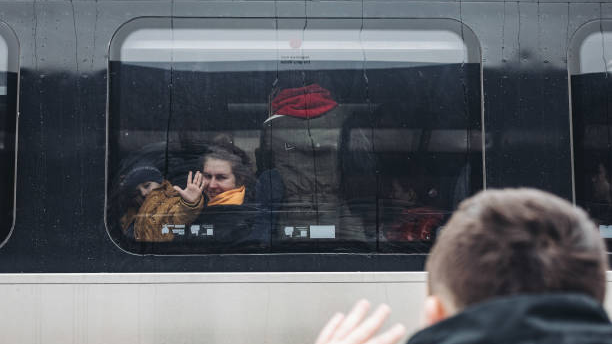
A father bids farewell to his wife and son at the Kyiv train station, Kyiv, Ukraine, March 1, 2022. /Getty

Despite these sizable figures the horrors presented in the report never made the corporate media. One could argue that this boils down to race where brown eyes are less worthy than blue eyes. However, war profiteering, along with its strategic aims, is color blind. If Ukraine was populated by a melanin-rich populace with a different culture then the multicultural card would have been played by the corporate media who advertise war and who, like all good advertisers, sell to our emotions, not our logic.

While the Afghan citizens were never “worthy victims,” the fact that they are now yesterday’s profits means even the human rights atrocities against the former worthy victims are now inconsequential to the media. Even the eight reported cases of rape against children consisting of one girl and seven boys, detailed in the UN report, received no attention.

Seven of the eight rapes were carried out by the U.S.-supported Afghan National Army and Afghan National Police. However, the U.S. army where told to “look the other way.” This type of unprincipled attitude no doubt explains the acceptance of Ukraine’s neo-Nazis today.

After 20 years of war, Afghanistan has been destroyed and, as the report shows, poverty remains the main barrier for ensuring the human rights of children and women which had always been lacking even at the height of U.S. control. Thus, the urgent question is, if the aim of invading Afghanistan was to protect human rights and freedom, was the trillions spent over 20 years good use of Western taxpayer’s money? Without a shadow of a doubt, this was among one of the greatest human rights disasters of the 21st century.

Today, as a European living close to Ukraine; as someone who believes in development, not war, and as a human who sees our fellow humanity in all eye colors I fear that without learning the lessons of Afghanistan and seeking peace, what awaits in Ukraine is yet another 20-year long human rights disaster.

Under this scenario, an “optimistic” outlook would be that only Ukraine is destroyed. Under a more pessimistic outlook, it could pull all of Europe into hostilities and then, at worst, consume the world which risks the annihilation of us all.

A “worthy victim” essentially gives us permission to understand and empathize with others. As such, we the people must resist those who work as gatekeepers defining who we can and cannot empathize with, as it is only through understanding and empathizing with all that we can even begin to tread down the path towards peace.

Keith Lamb is a University of Oxford graduate with a Master of Science in Contemporary Chinese Studies. His primary research interests are China’s international relations and “socialism with Chinese characteristics.” The article reflects the author’s opinions and not necessarily the views of The Southern African Times.

Previous Post

Vladimir Putin announces massive compensation for Russian military personnel.

Next Post

Kenya, Zimbabwe sign seven bilateral agreements

SAT Reporter

Related Posts

LONG READ | The Oldest Alibi: South Africa’s Xenophobia and the Economic Ruin It Presages
Opinion

LONG READ | The Oldest Alibi: South Africa’s Xenophobia and the Economic Ruin It Presages

by Times Reporter
June 30, 2026
President Cyril Ramaphosa’s Opinion: How South Africa’s Natural Splendour Can Drive Inclusive Growth
Opinion

Op-Ed by President Ramaphosa | Protest Is Both a Right and a Responsibility

by Times Reporter
June 29, 2026
The Insurance Hack More Drivers Should Know
Opinion

The Insurance Hack More Drivers Should Know

by Times Reporter
June 22, 2026
Southern African Times Announces Brendan Amadi as Recipient of the 2026 Editorial Recognition of the Year Award
The Editorial Board

Southern African Times Announces Brendan Amadi as Recipient of the 2026 Editorial Recognition of the Year Award

by The Editorial Board
June 19, 2026
LONG READ | No Longer the World’s Dustbin: China’s Waste Ban and Africa’s Circular Economy Moment
Opinion

LONG READ | No Longer the World’s Dustbin: China’s Waste Ban and Africa’s Circular Economy Moment

by Times Reporter
June 12, 2026
Next Post
Kenya, Zimbabwe sign seven bilateral agreements

Kenya, Zimbabwe sign seven bilateral agreements

Browse by Category

  • Africa AI
  • African Continental Free Trade Area
  • African Debt
  • African Start ups
  • Agriculture
  • AI Africa
  • Algeria
  • All News
  • Analysis
  • Angola
  • Arts / Culture
  • Asia
  • Botswana
  • BOTSWANA
  • BREAKING NEWS
  • BRICS
  • Burkina Faso
  • Burundi
  • Business
  • Business
  • Business Wire
  • Cameroon
  • Central Africa
  • Chad
  • China
  • Climate Change
  • Climate Changev
  • Community
  • Congo Republic
  • Conservation
  • Côte d’Ivoire
  • COVID 19
  • CRYPTOCURRENCY
  • Culture
  • Democratic Republic of Congo
  • Diplomacy
  • Eastern Africa
  • Economic Development
  • Economy
  • Education
  • Egypt
  • Elections 2024
  • Energy
  • Entertainment
  • Environment
  • Eritrea
  • Ethiopia
  • Europe
  • Fashion
  • Feature
  • Finance
  • Financial Inclusion
  • Food
  • Food and Drink
  • Foods
  • GABON
  • Ghana
  • Global
  • Global Africa
  • Guinea
  • Health
  • Humanitarian Aid
  • Immigration
  • in Southern Africa
  • International news
  • International Relations
  • Investment
  • Ivory Coast
  • Just In
  • Kenya
  • Lesotho
  • Libya
  • Life Style
  • Lifestyle
  • Literature
  • Malawi
  • Malawi
  • Mali
  • Markets
  • Mauritius
  • Middle East
  • Mining in Africa
  • Morocco
  • Mozambique
  • Namibia
  • Niger
  • niger
  • Nigeria
  • North Africa
  • North-Eastern Africa
  • Obituaries
  • Obituary
  • Opinion
  • PARTNER CONTENT
  • Politics
  • Property
  • Racism
  • Rwanda
  • Rwanda
  • SADC
  • SAT Interviews
  • SAT Investigation
  • SAT Jobs
  • Saudi Arabia
  • Senegal
  • Seychelles
  • Somaliland
  • South Africa
  • South Sudan
  • Sports
  • Startup Africa
  • STOCK EXCHANGE
  • Sudan
  • Sustainability
  • Sustainablity
  • Tanzania
  • Technology
  • Telecommunications
  • The Editorial Board
  • The Power Of She
  • Togo
  • Trade
  • Travel
  • Travel
  • Tunisia
  • Uganda
  • Uncategorized
  • Wealth
  • West Africa
  • World
  • World
  • ZAMBIA
  • Zambia
  • ZIMBABWE
  • Zimbabwe

Browse by Tags

#NewsUpdate #SouthAfrica #SouthernAfricanTimes #TheSouthernAfricanTimes AfCFTA africa African Continental Free Trade Area African development African Development Bank African economies African economy African Union Agriculture Angola Botswana China Climate change critical minerals Cyril Ramaphosa Economic Development economic growth energy transition governance industrialisation Inflation Infrastructure Infrastructure Development International relations Investment Kenya Mozambique Namibia news Nigeria Regional Integration renewable energy Rwanda SADC South Africa Southern Africa sustainable development Tanzania United States Zambia Zimbabwe
ADVERTISEMENT

WHO WE ARE

The Southern African Times is a regional bloc digital newspaper that covers Southern African and world news. The paper also gives a nuanced analysis on news and covers a wide range of reporting which include sports, entertainment, foreign affairs, arts and culture.

Welcome Back!

Login to your account below

Forgotten Password?

Retrieve your password

Please enter your username or email address to reset your password.

Log In
  • Home
  • Southern Africa
  • Business
    • African Start ups
    • African Continental Free Trade Area
  • Technology
    • Lifestyle
      • Health
      • Culture
      • Food and Drink
      • Entertainment
  • Opinion
  • Sports
  • SAT Jobs
    • Events
  • About Us
    • Advertise with Us
    • Contact Us
Not enough quota to unlock this post
Unlock left : 0
Are you sure want to cancel subscription?