More than half of all employed people worldwide work off the books. And that number is expected to climb over the next decade.
“Estimates are that the informal economy around the world is [worth] about $10 trillion a year,” says journalist Robert Neuwirth. “That’s an astounding figure because what it means, basically, is that if the informal economy was combined in one country, it would be the second-largest economy on Earth, rivaling the United States economy.”
Neuwirth details how globalization has helped the growth of the informal off-the-books economy in his new book, Stealth of Nations. He traveled to places like Brazil and Nigeria to see firsthand how the underground economy works.



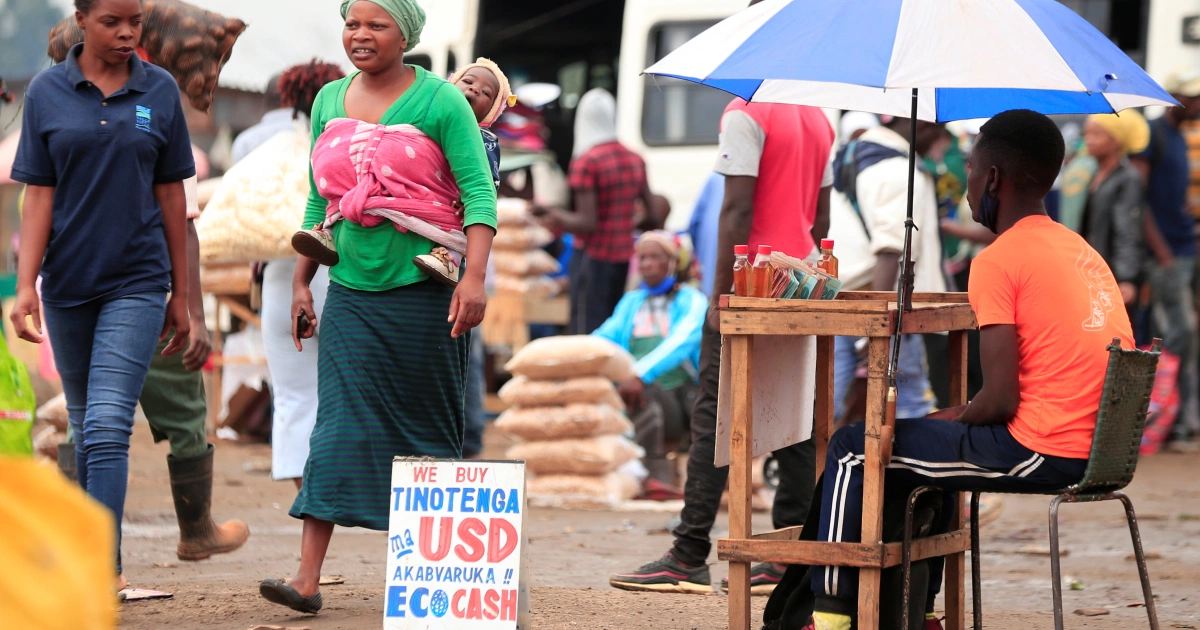
In Lagos, Nigeria, he describes a bustling, hyper-entrepreneurial environment where almost everybody is doing business without oversight or support.
“About 80 percent of the workforce is part of the informal economy, and that runs the gamut from people selling vegetables at the side of the road to major corporations like mobile phone companies that do all of their business through informal kiosks that are stands at the side of the road,” he tells Fresh Air‘s Dave Davies. “It’s huge.”
The underground electronics market in Lagos is now a multimillion-dollar industry. Sellers import their cellphones and other products from China, and have scaled their businesses up as the markets improve.
“What they are doing is futzing with their manifests or smuggling in contraband of pirated goods through other ports,” he says. “They’ll bring their fake Nokia phones or fake Panasonic stereos in the neighboring country of Benin, and then truck them into Lagos.”
The government, he says, looks the other way.
“Nigeria has oil wealth, and that has meant that the government is fairly flush and they don’t really worry about a lot of this stuff,” he says. “As a result, there’s a lot of porousness in the system, which these informal merchants exploit.”
The informal economy in Nigeria is about two-thirds the size of its formal economy. It’s largely composed of people distributing goods from other countries — rather than producing their own marketable goods.
“There’s no way to dismiss that as unimportant economic development and important to people’s economic survival,” he says. “[But] it’s important to come up with systematic approaches to systems like infrastructure, because those are the ones that are going to determine whether there’s going to be more sustained production [in Nigeria] as opposed to distribution.”
In order for Nigeria to have its own production system, he says, the country would have to improve its infrastructure and electrical grid. But that doesn’t mean those who rely on the underground economy would be forced out, he says.
“There are in-between structures that would not drive these folks out of business and drive these markets out of business, and put a lot of people out of work that would nonetheless begin to bridge the gap and create infrastructure,” he says. “In Nigeria, there are market courts to air grievances between buyers and sellers. If someone buys a TV that doesn’t work, they can take it back. These things are the beginning of cooperative relationships between buyers and sellers, and maybe this can then be enhanced to engage the process between the sellers and the government.”
He says Nigerians are now traveling in droves to China in order to produce the products they sell back home. Guangzhou, a city in southern China, is one of the key trading points in the region.
“When you journey to the train station [in Guangzhou], you feel like you’re in Africa because there’s so many Africans located there,” he says. “It’s become the world’s trading point for manufactured goods, and the Africans have embedded themselves in society there in very direct ways, and there’s a huge back channel of trade in China and Africa. … It’s tremendously vibrant and tremendously exciting.”
Robert Neuwirth is also the author of Shadow Cities: A Billion Squatters, A New Urban World.


Interview Highlights
On discount stores trying to enter the market
“The big stores want to take a place in that market. They’re trying to very actively come into Latin America and try to establish themselves. The big stores are worried about this small-store distribution system.”

On taxation
“Taxation is based on a kind of social contract, which is that there will be some kind of benefit that you will see. It seems to be that because governments in the post-colonial reality have particularly ignored that contract — where it seems like the first road that gets paved is the one that leads to the president’s house and not the one that most needs paving — in those situations, the government has to show that it’s willing to be transparent and not corrupt — and to show the markets where all this money that could be recouped in taxes could be made, that concrete benefits are going to be given to the market. It’s incumbent on government right now — since people don’t believe that the government can do anything in their benefit — to show that they do, that they work for the benefit of the people. … Every merchant I talked to told me they would be willing to pay taxes. … They are happy to do so as long as they get benefits.”
On the informal economy in the U.S.
“It’s actually percentage-wise small but dollars-wise huge in the United States. It’s all over the place, from the guys you see waiting around for construction jobs at Home Depot and Lowe’s, to folks selling food on the street, to swap meets where people are selling goods from kiosks. … It’s an incubator. Many of the major businesses in the United States started out [this way.] … This has always been the case in the United States, and we have to look at it as a kind of incubator sector in our economy.”