Monday, May 25, 2026
  • Login
The Southern African Times
  • Home
  • Southern Africa
  • Business
    • African Start ups
    • African Continental Free Trade Area
  • Technology
    • Lifestyle
      • Health
      • Culture
      • Food and Drink
      • Entertainment
  • Opinion
  • Sports
  • SAT Jobs
    • Events
  • About Us
    • Advertise with Us
    • Contact Us
No Result
View All Result
  • Home
  • Southern Africa
  • Business
    • African Start ups
    • African Continental Free Trade Area
  • Technology
    • Lifestyle
      • Health
      • Culture
      • Food and Drink
      • Entertainment
  • Opinion
  • Sports
  • SAT Jobs
    • Events
  • About Us
    • Advertise with Us
    • Contact Us
No Result
View All Result
The Southern African Times
No Result
View All Result
Home Opinion

Backsliding on maternal mortality

by SAT Reporter
May 28, 2023
in Opinion
0
Backsliding on maternal mortality

In 2020, an estimated 287,000 women died in pregnancy, childbirth, or soon after delivering, according to the latest data from the United Nations Maternal Mortality Estimation Inter-Agency Group, which includes the United Nations Population Fund (UNFPA), where I am executive director. This figure is roughly equivalent to the death toll of the 2004 Indian Ocean tsunami or the 2010 earthquake in Haiti, two of the deadliest natural disasters in modern history.

Human devastation on this scale is usually met with weeks of news coverage, an outpouring of public support, and calls for urgent action. Yet the staggering number of women dying every year in the act of giving life remains largely a silent crisis. Even more worrying, the group found that progress on reducing maternal deaths has ground to a halt.

How many of us know someone who died, or came close to dying, during pregnancy or childbirth? Perhaps the pervasiveness of suffering is part of the problem – maternal deaths may seem inevitable. Yet the vast majority are preventable with simple interventions that save money in the long run.

ADVERTISEMENT

One of the most cost-effective ways to reduce maternal mortality globally is to invest in community-based care, including the education and deployment of midwives. Achieving this will require scaling up the workforce substantially – the world is currently facing a shortage of 900,000 midwives – and countering persistent gender norms that devalue the contributions of a predominantly female field.
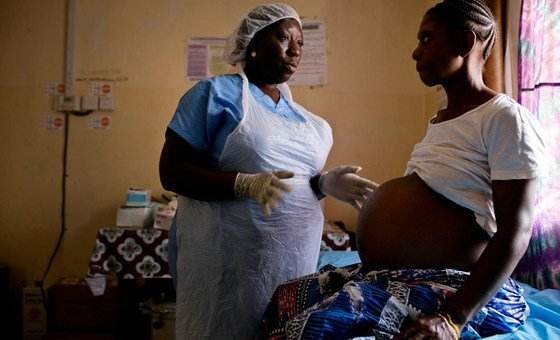
UNICEF/Kate Holt A midwife examines a pregnant woman at a health clinic near Moyamba, Sierra Leone.

Lowering the high number of unintended pregnancies is another crucial step toward reducing maternal mortality. UNFPA research shows that nearly half of all pregnancies are unintended, more than 60 percent of unintended pregnancies end in abortion, and an estimated 45 percent of all abortions are unsafe, making them a leading cause of maternal death. Policymakers know how to address this issue: increase access to quality contraceptives, improve comprehensive sexuality education, and protect a woman’s right to decide whether, when, and with whom to have children.

World leaders have made significant progress when called upon to save women’s lives. In 2000, governments agreed to the Millennium Development Goals, which aimed for a 75 percent reduction in the global maternal mortality rate by 2015. The 44 percent decrease in deaths over that period was a meaningful accomplishment – even if it ultimately fell short of the goal.

In 2015, with the UN’s 17 Sustainable Development Goals, countries once again committed to reducing the maternal death ratio, this time to below 70 deaths per 100,000 live births by 2030. Yet, eight years on, we are nowhere near achieving that target, and progress has stalled. The maternal mortality rate has increased in two regions – Europe and Northern America, and Latin America and the Caribbean – since 2016, and these estimates, which end in 2020, don’t account for the full impact of the COVID-19 pandemic on health systems.

Underinvestment in addressing persistent racial and ethnic disparities in the delivery of maternal health care is one factor contributing to this stagnation. In the United States, for example, the 2021 maternal mortality rate for Black women was 2.6 times the rate for non-Hispanic White women. Similar disparities can be observed in Afro-descendant communities in Latin America and the Caribbean.

A holistic, community-based approach to care is crucial to eliminating these disparities. Early in my career, I worked as a pediatrician and HIV researcher in Harlem at a time when crack cocaine and AIDS were devastating the poorest and most marginalized patients and communities. It became clear that I could not treat a child without understanding the wider social context and the challenges facing the child’s mother. And the medical needs of the mothers and pregnant women I met often paled in comparison to the urgency of their social needs, highlighting the importance of treating the whole person.

Even though progress on maternal mortality has stagnated at the global level, there are some glimmers of hope. Nepal, for example, decreased maternal deaths by nearly one-third between 2015 and 2020, after halving the country’s rate between 2000 and 2015. In this period, the government doubled health spending, legalized abortion, and made maternity care free of charge.

Similarly, Sri Lanka has halved maternal deaths at least every 12 years since 1935, owing largely to a health system that provides free services to the entire population and to a dramatic increase in the number of skilled midwives, who now attend 97 percent of births, compared to 30 percent in 1940.

While the latest maternal mortality rates reveal the damage caused by neglecting life-saving solutions, there is a way to end this needless suffering. Building midwifery capacity and ensuring equal access to quality sexual and reproductive health care would go a long way toward improving health outcomes for mothers and pregnant women.

But getting back on track requires reviving the sense of urgency among governments, communities, and all stakeholders needed to provide adequate financing and create a conducive legal and social environment for these interventions. We know the reasons why women still die giving birth. Indifference should not be one of them.


 

Natalia Kanem is Executive Director of the United Nations Population Fund. The article reflects the author’s views, and not necessarily those of The Southern African Times.


Previous Post

Musicians launch drive for more funding for arts in Africa

Next Post

Unofficial Results Show Erdogan Leading in Turkish Election with Narrow Margin

SAT Reporter

Related Posts

Africa Day 2026 | The Century Is Quietly Turning Towards Africa
The Editorial Board

Africa Day 2026 | The Century Is Quietly Turning Towards Africa

by The Editorial Board
May 25, 2026
How China-Africa Cooperation Can Accelerate Africa’s Industrialisation
Opinion

How China-Africa Cooperation Can Accelerate Africa’s Industrialisation

by SAT Reporter
May 25, 2026
France Is Trying to Get New Stripes in Africa – but will it work?
Opinion

France Is Trying to Get New Stripes in Africa – but will it work?

by Development Reimagined
May 14, 2026
When AI Gets It Wrong, Humans Must Get It Right
Opinion

When AI Gets It Wrong, Humans Must Get It Right

by Dr Brighton Chireka
May 14, 2026
Can the United States Still Sanction China Into Compliance?
Opinion

Can the United States Still Sanction China Into Compliance?

by SAT Reporter
May 12, 2026
Next Post
Unofficial Results Show Erdogan Leading in Turkish Election with Narrow Margin

Unofficial Results Show Erdogan Leading in Turkish Election with Narrow Margin

Browse by Category

  • Africa AI
  • African Continental Free Trade Area
  • African Debt
  • African Start ups
  • Agriculture
  • AI Africa
  • Algeria
  • All News
  • Analysis
  • Angola
  • Arts / Culture
  • Asia
  • BOTSWANA
  • Botswana
  • BREAKING NEWS
  • BRICS
  • Burkina Faso
  • Burundi
  • Business
  • Business
  • Business Wire
  • Cameroon
  • Central Africa
  • Chad
  • China
  • Climate Change
  • Climate Changev
  • Community
  • Congo Republic
  • Conservation
  • Côte d’Ivoire
  • COVID 19
  • CRYPTOCURRENCY
  • Culture
  • Democratic Republic of Congo
  • Diplomacy
  • Eastern Africa
  • Economic Development
  • Economy
  • Education
  • Egypt
  • Elections 2024
  • Energy
  • Entertainment
  • Environment
  • Eritrea
  • Ethiopia
  • Europe
  • Fashion
  • Feature
  • Finance
  • Financial Inclusion
  • Food
  • Food and Drink
  • Foods
  • GABON
  • Ghana
  • Global
  • Global Africa
  • Guinea
  • Health
  • Humanitarian Aid
  • Immigration
  • in Southern Africa
  • International news
  • International Relations
  • Investment
  • Ivory Coast
  • Just In
  • Kenya
  • Lesotho
  • Libya
  • Life Style
  • Lifestyle
  • Literature
  • Malawi
  • Malawi
  • Mali
  • Markets
  • Mauritius
  • Middle East
  • Mining in Africa
  • Morocco
  • Mozambique
  • Namibia
  • Niger
  • niger
  • Nigeria
  • North Africa
  • North-Eastern Africa
  • Obituaries
  • Obituary
  • Opinion
  • PARTNER CONTENT
  • Politics
  • Property
  • Racism
  • Rwanda
  • Rwanda
  • SADC
  • SAT Interviews
  • SAT Investigation
  • SAT Jobs
  • Saudi Arabia
  • Senegal
  • Seychelles
  • Somaliland
  • South Africa
  • South Sudan
  • Sports
  • Startup Africa
  • STOCK EXCHANGE
  • Sudan
  • Sustainability
  • Sustainablity
  • Tanzania
  • Technology
  • Telecommunications
  • The Editorial Board
  • The Power Of She
  • Togo
  • Trade
  • Travel
  • Travel
  • Tunisia
  • Uganda
  • Uncategorized
  • Wealth
  • West Africa
  • World
  • World
  • Zambia
  • ZAMBIA
  • ZIMBABWE
  • Zimbabwe

Browse by Tags

#NewsUpdate #SouthAfrica #SouthernAfricanTimes #TheSouthernAfricanTimes AfCFTA africa African Continental Free Trade Area African development African Development Bank African economies African economy African Union Agriculture Angola Botswana China Climate change Cyril Ramaphosa Economic Development economic growth energy transition governance IMF industrialisation Inflation Infrastructure Infrastructure Development International relations Investment Kenya Mozambique Namibia news Nigeria Regional Integration renewable energy Rwanda SADC South Africa Southern Africa sustainable development Tanzania United States Zambia Zimbabwe
ADVERTISEMENT

WHO WE ARE

The Southern African Times is a regional bloc digital newspaper that covers Southern African and world news. The paper also gives a nuanced analysis on news and covers a wide range of reporting which include sports, entertainment, foreign affairs, arts and culture.

Welcome Back!

Login to your account below

Forgotten Password?

Retrieve your password

Please enter your username or email address to reset your password.

Log In
  • Home
  • Southern Africa
  • Business
    • African Start ups
    • African Continental Free Trade Area
  • Technology
    • Lifestyle
      • Health
      • Culture
      • Food and Drink
      • Entertainment
  • Opinion
  • Sports
  • SAT Jobs
    • Events
  • About Us
    • Advertise with Us
    • Contact Us
Not enough quota to unlock this post
Unlock left : 0
Are you sure want to cancel subscription?