In a land too often defined by the thunder of Victoria Falls or the administrative arteries of Harare, Zimbabwe quietly holds its secrets — secrets tucked into highland mists, painted on ancient cave walls, and murmured through savannah winds that have long learned the art of patience. Those who only come for the headliners may leave dazzled, but those who linger — and listen — often leave transformed.
Here, then, is a journey beyond the obvious, an invitation to explore Zimbabwe’s quieter masterpieces.
1. Bvumba Mountains, Manicaland Province
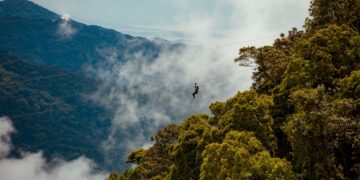
If Zimbabwe has a soul, it whispers from the Bvumba Mountains. Rising along the Mozambique border, these mountains wrap themselves in mists thick as memory. The name, Bvumba — meaning “mist” in Shona — isn’t metaphorical; it’s a constant veil that lends this green corner of the east an almost Celtic stillness.



Just outside Mutare, the Bunga Forest Botanical Reserve showcases ancient flora, while the air shimmers with butterflies and the calls of samango monkeys. For travellers willing to trade showiness for serenity, a stay at the Leopard Rock Hotel offers a touch of 1940s grandeur and a view that stretches across the border into Mozambique, where the line between countries feels as thin as the mist itself.

2. Domboshava, Mashonaland East
Just a half-hour north of Harare, Domboshava is a quiet rebellion against the capital’s concrete pulse. Here, a single, massive granite outcrop unfurls into sky — a natural amphitheatre that invites both ancient worship and modern reflection.
Cave shelters along the rock face bear the faded brushstrokes of San artists, their ochre figures dancing eternally in a silent theatre. The local Zezuru community continues to honour these rocks in ceremony and reverence, believing them to be imbued with ancestral spirits. Come at sunset, when the rock turns amber and the capital’s distant roar softens into hush.

3. Gonarezhou National Park, Masvingo Province
“Gonarezhou” translates as Place of Elephants, though the name only hints at its depth. This southern park, stitched into the Great Limpopo Transfrontier Park, is Zimbabwe’s wild heart — vast, remote, and pulsing with untamed energy.
Unlike the more travelled Hwange, Gonarezhou rewards patience with solitude. Here, the red sandstone Chilojo Cliffs rise from the Runde River like ancient cathedrals, and elephants roam unbothered through mopane scrub. Under joint management between Zimbabwe Parks and the Frankfurt Zoological Society, the park now models community conservation that invites travellers to tread lightly — and to return richer in spirit.

4. Lake Kariba, Mashonaland West
Engineered into existence in the 1950s, Lake Kariba has evolved from a hydroelectric solution to a spiritual and ecological sanctuary. At its western edge, the fishing town of Binga nestles against the waterline — a place of hot springs, cultural depth, and slow rhythms.
Sunburnt houseboats drift across the water like drowsy crocodiles, while tiger fish flash silver in the depths. At dusk, as the sun bleeds into the Zambezi horizon, the lake takes on an almost mythical aura. Locals say the spirit of the river god, Nyaminyami, still stirs these waters. You might not see him, but you’ll feel him — in the ripple, in the silence.


5. Great Zimbabwe (Beyond the Ruins), Masvingo Province
The dry stone walls of Great Zimbabwe need no introduction — but they do need time. Too many rush through the main enclosure, missing the full extent of what this ancient Shona civilisation left behind.
Venture into the surrounding Chikato Hills, where smaller, unmarked ruins crumble gently into the brush. These satellite sites speak in softer tones, offering moments of introspection rather than grandeur. As scholars like Tinashe Chibaya argue, the real legacy of Great Zimbabwe is not just its architecture but its cultural persistence — a civilisation not lost, but still quietly echoing in the rhythms of rural life.

6. Matobo Hills, Matabeleland South
There’s a strangeness to Matobo — a terrain of impossible boulders, sacred caves, and an uncanny hush. Located just south of Bulawayo, this UNESCO World Heritage site is a spiritual palimpsest, etched by San, Ndebele, and colonial histories alike.

The rock art of Nswatugi Cave still glows faintly in the dim light, while Malindidzimu Hill, the “Hill of the Spirits,” draws pilgrims, hikers, and historical reckoners. Cecil Rhodes chose to be buried here, an irony not lost on those who understand the land’s older gods. The rocks, silent and still, have heard every story. They are listening still.

7. Malilangwe Wildlife Reserve, Lowveld
Adjacent to Gonarezhou, the Malilangwe Trust has built a sanctuary that is both luxurious and local. At Singita Pamushana Lodge, African opulence meets ecological rigour. Days are spent tracking endangered black rhino, while evenings end with firelight and a glass of wine above the Malilangwe Dam.
Yet the true triumph is invisible: revenues here fund schools, health clinics, and conservation jobs across the region. This is safari without the performative gloss — tourism that nourishes both guest and host.

8. Tsholotsho, Matabeleland North
Bordering Hwange National Park, Tsholotsho is no game-viewing theatre. It is rural Zimbabwe, raw and rhythmic. Ndebele homesteads cluster across a dry savannah, where goats share shade with rusted bicycles and grandmothers grind maize by hand.
Here, a quiet tourism movement is stirring — walking safaris led by San trackers, immersive homestays, and storytelling under thatch roofs. It is a place that reminds you: travel isn’t always about seeing. Sometimes, it’s about being seen.

9. Chimanimani Mountains, Eastern Highlands
You don’t stumble upon Chimanimani — you commit to it. It’s the kind of place that demands your knees, your breath, your time. Those who give it all three are rewarded with one of Africa’s last true wildernesses.
Waterfalls thread through mossy valleys; peaks pierce the clouds. The Bridal Veil Falls drape themselves delicately across granite cliffs, while Skeleton Pass and Outward Bound trails test both thigh and soul. Chimanimani isn’t for everyone. But for those seeking silence, altitude, and a brush with the sublime — it is enough.

10. Chizarira Plateau, Matabeleland North
Remote even by Zimbabwean standards, Chizarira National Park is a last frontier of sorts. Perched on an escarpment overlooking Lake Kariba, its cliffs plunge into gorges tangled with fig trees and echoing with eagle calls.
But it is at night when Chizarira truly awakens. Free from artificial light, the park offers stargazing that rivals Chile’s Atacama. The Southern Cross, Orion, and the Milky Way blaze overhead — so vivid they seem carved into the sky. You’ll need patience to reach it, but once there, you may never look at the stars the same way again.

Zimbabwe is not a country easily reduced — not by itinerary, not by headline. To travel its lesser-known paths is to engage with landscapes that speak quietly but deeply. These are not bucket-list tick boxes. They are invitations to presence, perspective, and reverence.