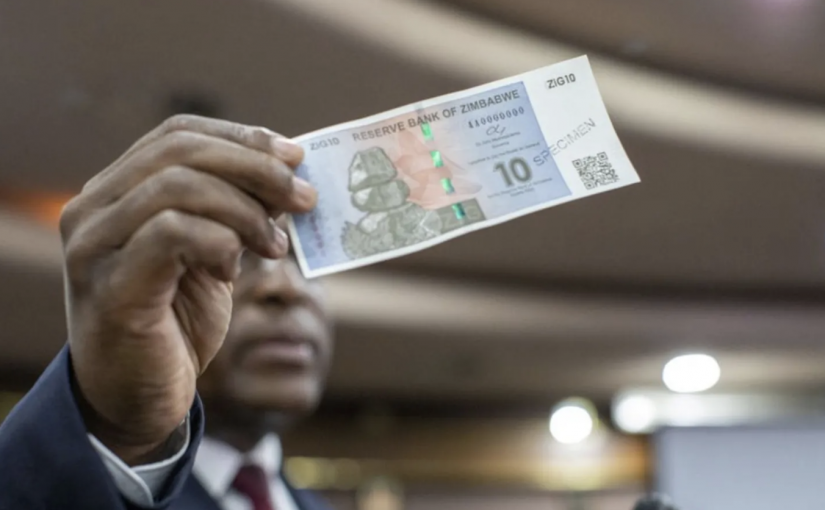
Five months after its much-touted launch, Zimbabwe’s new gold-backed currency, the ZiG (Zimbabwe Gold), is faltering under mounting economic pressures. The government’s ambitious goal of making the ZiG the sole legal tender by 2026 now faces significant challenges, as soaring grain imports erode the nation’s already fragile foreign reserves. The currency, introduced in April at a rate of 13.6 ZiG per U.S. dollar, has plummeted by nearly 80% in value on the black market, stoking fears of yet another failed currency experiment.
The ZiG represents Zimbabwe’s sixth attempt at establishing a stable currency in just 15 years, a period defined by hyperinflation, currency collapses, and reliance on foreign currencies. Despite early optimism, the local population has been slow to adopt the new currency, with many citing a lack of trust in its long-term viability. The rapid depreciation of the ZiG has only fuelled these concerns.
Independent economist Prosper Chitambara attributes the devaluation to widespread scepticism within the domestic market. “The weakening of the ZiG underscores the fundamental lack of confidence. People are hesitant to engage with it, which in turn drives down its value,” he noted in an interview.
Yet, the government insists it is too early to declare the ZiG a failure. Persistence Gwanyanya, a member of the Reserve Bank of Zimbabwe’s Monetary Policy Committee, acknowledged the sluggish uptake but argued that more time is needed before passing judgment. “It’s premature to consider the currency a failure. However, the state must take urgent steps to bolster demand, including injecting more foreign currency into the market and encouraging greater use of the ZiG through taxation,” Gwanyanya told Reuters.
Gwanyanya further suggested that the government lead by example, increasing the number of taxes payable in ZiG to stimulate broader use. “Government more than anyone should show preference for its own currency,” he added.
The market, however, remains unconvinced. Maynard Maketo, a street hawker in Harare, expressed his doubts. “The ZiG has been getting weaker, so it doesn’t make business sense to use it. I don’t have faith in it—we’ve seen this before with the Zimdollar,” he said, referencing Zimbabwe’s now-defunct currency, which was rendered worthless by hyperinflation.
At the heart of the problem lies the dual exchange rates that plague the currency. While the official rate remains relatively stable at 13.9 ZiG per U.S. dollar, the black market tells a different story, with rates fluctuating between 20 and 26 ZiG to the dollar, according to data from Pricecheck, a website that monitors currency exchanges.
The gap between the official and unofficial rates has led many traders to stick with more stable currencies. Carol Munjoma, who operates a grocery store in downtown Harare, explained her decision to avoid the ZiG entirely. “Where I buy these groceries, they don’t accept ZiG. To protect my business, I charge in U.S. dollars. The ZiG would need to be stable before we could even consider using it here,” she said.
The Reserve Bank of Zimbabwe (RBZ) remains optimistic. In July, RBZ Governor John Mushayavanhu reaffirmed the authorities’ commitment to building trust in the new currency. Gwanyanya echoed this view, adding that market forces require time to stabilise. “It is too early to declare this the death of the ZiG,” he said.
However, the question of whether the ZiG can withstand external economic pressures and domestic scepticism looms large. As Zimbabwe’s grain imports continue to drain foreign reserves, the currency’s fragility may soon turn into another chapter in the nation’s turbulent monetary history.