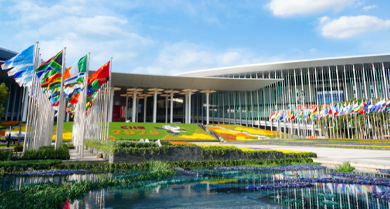
Zimbabwean business leaders have identified the upcoming China International Import Expo (CIIE) in Shanghai as a crucial platform for unlocking expansive business opportunities in the arts and crafts sector. The expo, scheduled for November 5-10, 2024, presents a significant occasion for Zimbabwe’s artisans to extend their reach into the burgeoning Chinese market, which has proven increasingly receptive to foreign goods and cultural artefacts.
One such entrepreneur, Clive Chirova, director of Samuneti Leathers, a Zimbabwean manufacturer renowned for high-quality leather goods, views the expo as a vital international platform for growth. In his reflections ahead of the event, Chirova noted the pivotal role the CIIE played in expanding the company’s portfolio beyond leather, to incorporate a diverse range of traditional Zimbabwean curio products.
“Participation in the expo has necessitated broadening our range to include artisanal goods such as woven baskets, wood carvings, and stone sculptures,” Chirova stated. “This expansion has not only increased our production capacity here in Zimbabwe, but it has also helped promote the unique craftsmanship our artisans offer to an international audience, particularly in China.”



Chirova, who attended the CIIE in 2023, underlined the direct economic impact of this expansion on rural communities, particularly those engaged in traditional crafts. “Our involvement in the Chinese market has a significant downstream effect. By sourcing products like woven baskets from rural women, we are directly contributing to their livelihoods. It’s a positive reinforcement of how opening new markets can drive local economic growth,” he explained.
The China International Import Expo, now in its seventh iteration, is one of the world’s premier import-themed trade exhibitions. It seeks to open the vast Chinese market to foreign businesses across various sectors, from technology and manufacturing to cultural and artisanal goods. Over 70 countries and international organisations have confirmed their participation this year, highlighting the expo’s global significance.
For Zimbabwe, the CIIE represents not only an opportunity for immediate trade but also a platform for elevating its rich cultural traditions onto the global stage. The country’s renowned stone sculpture, an artistic tradition with deep cultural roots, has attracted attention in international markets, and Chirova is hopeful that the Chinese market will continue to provide a robust avenue for promoting Zimbabwean arts.

“The Chinese market offers vast potential for growth, particularly for the arts and crafts sector. We have seen an increasing appreciation for Zimbabwean stone sculpture, which is now gaining international traction. The CIIE allows us to connect with a global audience while also reinforcing the value of our local artistic heritage,” he remarked.
In addition to tangible goods, the event highlights an often-overlooked dimension of international trade—the cross-pollination of cultural and artistic expression. As Zimbabwe seeks to build stronger trade links with China, events like the CIIE may well be instrumental in positioning the nation’s artisanal products not merely as commodities, but as cultural artefacts of global significance.
As Zimbabwe continues to participate in events like the CIIE, the hope is that these opportunities will not only boost trade but also lead to a deeper, sustained presence in global markets. For Chirova and others in Zimbabwe’s arts and crafts sector, the forthcoming expo in Shanghai promises to be another step in that direction—one that could secure broader economic benefits for the country and its artisans.