Tuesday, June 30, 2026
  • Login
The Southern African Times
  • Home
  • Southern Africa
  • Business
    • African Start ups
    • African Continental Free Trade Area
  • Technology
    • Lifestyle
      • Health
      • Culture
      • Food and Drink
      • Entertainment
  • Opinion
  • Sports
  • SAT Jobs
    • Events
  • About Us
    • Advertise with Us
    • Contact Us
No Result
View All Result
  • Home
  • Southern Africa
  • Business
    • African Start ups
    • African Continental Free Trade Area
  • Technology
    • Lifestyle
      • Health
      • Culture
      • Food and Drink
      • Entertainment
  • Opinion
  • Sports
  • SAT Jobs
    • Events
  • About Us
    • Advertise with Us
    • Contact Us
No Result
View All Result
The Southern African Times
No Result
View All Result
Home Finance

Zimbabwe debuts gold coins as legal tender to stem inflation

Zimbabwe has launched gold coins to be sold to the public in a bid to tame runaway inflation that has further eroded the country’s unstable currency.

by SAT Reporter
July 25, 2022
in Finance
0
Zimbabwe debuts gold coins as legal tender to stem inflation

The unprecedented move was announced on Monday by the country’s central bank, the Reserve Bank of Zimbabwe, to boost confidence in the local currency.

Trust in Zimbabwe’s currency is low after people saw their savings wiped out by hyperinflation in 2008 which reached five billion per cent, according to the IMF.

Many Zimbabweans today prefer to scramble on the illegal market for scarce US dollars to keep at home as savings or for daily transactions. Faith in Zimbabwe’s currency is already so low that many retailers don’t accept it.

The central bank disbursed 2,000 coins to commercial banks on Monday.

The first batch of the coins was minted outside the country but eventually they will be produced locally, according to the governor of the Reserve Bank of Zimbabwe, John Mangudya.

The coins can be used for purchases in shops, depending on whether the shop has enough change, he said.

“The government is trying to moderate the very high demand for the US dollar because this high demand is not being matched by supply,” said Zimbabwean economist Prosper Chitambara.

“The expectation is that … there will also be moderation in terms of the depreciation of the local currency, which should have some kind of stabilising effect in terms of pricing of goods,” he said.

Any individual or company can buy the coins from authorised outlets such as banks, according to an announcement by the country’s central bank.

People can buy the gold coins from authorised agents such as banks using the local currency or foreign currencies and purchasers can choose to keep the coins at a bank or take them home.

Foreigners can buy the coins only in foreign currency, said the central bank.

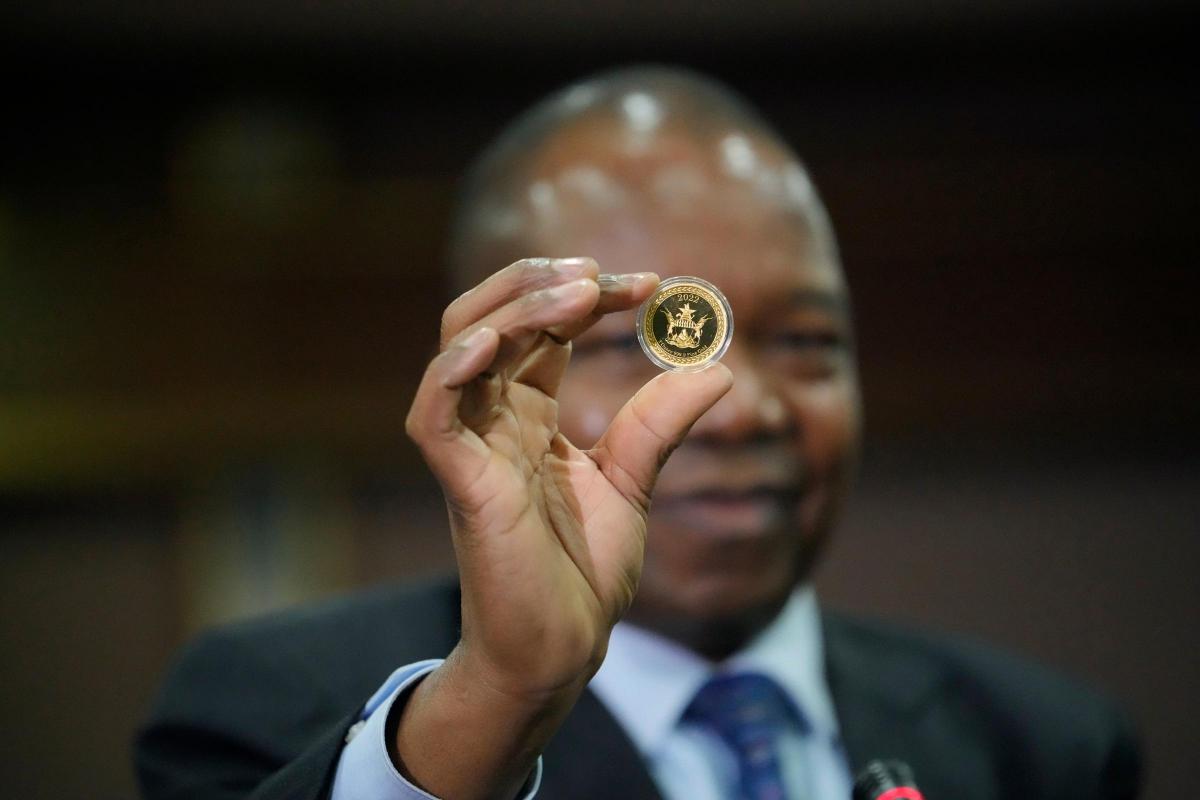
Called Mosi-oa-Tunya, which in the local Tonga language refers to Victoria Falls, the coins “will have liquid asset status, that is, it will be capable of being easily converted to cash, and will be tradable locally and internationally”, said the central bank.

“The coin may also be used for transactional purposes,” it said. People holding the coins can only trade them for cash after 180 days from the date of buying, it added.

The coins, each weighing one troy ounce with a purity of 22 carats, can also be used as security for loans and credit facilities, said the central bank.

The price of the coins will be determined by the international market rate for an ounce of gold, plus 5% for the cost of producing the coin. At the time of the launch on Monday, the cost of Mosi oa Tunya coin was 1,824 dollars (£1,514).
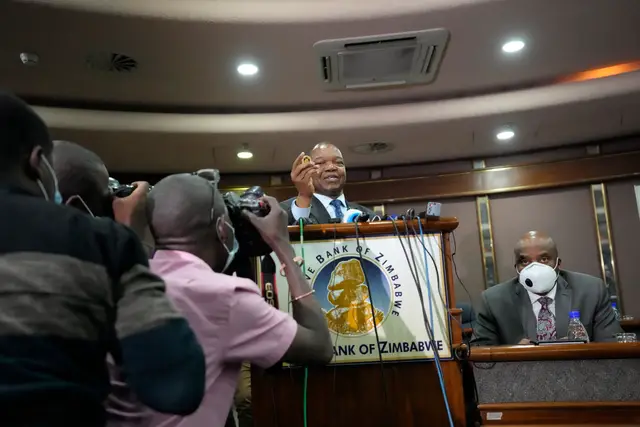
Reserve Bank of Zimbabwe Governor John Mangudya holds a sample of a gold coin at the launch in Harare (Tsvangirayi Mukwazhi/AP/PA)

Internationally, gold coins are used in countries such as China, South Africa and Australia to hedge against inflation and as an investment opportunity, although they are not as widely used as currency as envisaged by Zimbabwe’s central bank, said Mr Chitambara.

“For Zimbabwe we are in chronic hyperinflation so the expectation is that there will be a huge uptake of these gold coins,” he said. However, most Zimbabweans struggle with daily survival and won’t be able to buy them, he added.

“For the common man, there is not really much to benefit directly from this, especially if you don’t have any excess cash,” said Mr Chitambara.

“Many people have no money for bread, let alone for savings,” he said. “The expectation is that indirectly it will benefit the ordinary person through moderating the prices.”

Companies with excess cash can find the coins useful to store value and also as an alternative investment asset, although individuals and companies are likely to continue preferring the dollar because “it is convenient and highly liquid,” he said.

The fact that Zimbabwe’s central bank would have to buy the gold from miners of the metal such as informal artisanal miners could also present challenges and result in increased smuggling, analysts say.

“Gold deliveries in Zimbabwe have significantly recovered because of the appetising US dollar payments offered to artisanal miners,” noted securities firm Morgan & Co in a market intelligence report.

“However, should there be a disparity between the amount of US dollars used to purchase the gold from miners and the US dollars used to pay for the coins, this could squeeze the central bank and its intermediaries’ foreign currency reserves.

“If this ripples to artisanal gold miners, this could result in low deliveries to Fidelity Printers and increase gold smuggling activities,” noted the Morgan report.

Fidelity Printers, a subsidiary of the central bank, is the country’s only authorised gold buyer.

Zimbabwe has substantial gold deposits and exports of the precious metal are one of the southern African country’s major foreign currency earners.

Gold production improved to about 30 tons in 2021, compared with 19 tons in 2020, according to official figures. Small–scale producers such as poorly regulated artisanal miners contributed 19 tons of the gold delivered in 2021, according to official figures.

Gold smuggling has been rampant. The country is estimated to be losing about 100 million dollars worth of gold monthly to smuggling, home affairs minister Kazembe Kazembe has said.

Legally all gold mined in Zimbabwe is supposed to be sold to the central bank, but many producers prefer to smuggle the gold out of the country in order to get payment in US dollars.




Previous Post

A World in Crisis Needs Both Trade and Aid

Next Post

Russia’s top diplomat reassures Egyptians about grain, on first leg of African tour

SAT Reporter

Related Posts

IMF warns Iran war fallout strains African economies
Finance

IMF warns Iran war fallout strains African economies

by Times Reporter
June 23, 2026
Standard Bank Signals Support for Dangote Refinery Listing
Finance

Standard Bank Signals Support for Dangote Refinery Listing

by Times Reporter
June 10, 2026
South African Financial System Remains Resilient Despite Global Shocks
Finance

South African Financial System Remains Resilient Despite Global Shocks

by Times Reporter
June 10, 2026
Standard Chartered Appoints Manus Costello as Chief Financial Officer
Finance

Standard Chartered Appoints Manus Costello as Chief Financial Officer

by SAT Reporter
May 18, 2026
Fitch Upgrades Ghana’s Sovereign Rating Following Fiscal Reforms
Finance

Fitch Upgrades Ghana’s Sovereign Rating Following Fiscal Reforms

by SAT Reporter
May 11, 2026
Next Post
Russia’s top diplomat reassures Egyptians about grain, on first leg of African tour

Russia's top diplomat reassures Egyptians about grain, on first leg of African tour

Browse by Category

  • Africa AI
  • African Continental Free Trade Area
  • African Debt
  • African Start ups
  • Agriculture
  • AI Africa
  • Algeria
  • All News
  • Analysis
  • Angola
  • Arts / Culture
  • Asia
  • Botswana
  • BOTSWANA
  • BREAKING NEWS
  • BRICS
  • Burkina Faso
  • Burundi
  • Business
  • Business
  • Business Wire
  • Cameroon
  • Central Africa
  • Chad
  • China
  • Climate Change
  • Climate Changev
  • Community
  • Congo Republic
  • Conservation
  • Côte d’Ivoire
  • COVID 19
  • CRYPTOCURRENCY
  • Culture
  • Democratic Republic of Congo
  • Diplomacy
  • Eastern Africa
  • Economic Development
  • Economy
  • Education
  • Egypt
  • Elections 2024
  • Energy
  • Entertainment
  • Environment
  • Eritrea
  • Ethiopia
  • Europe
  • Fashion
  • Feature
  • Finance
  • Financial Inclusion
  • Food
  • Food and Drink
  • Foods
  • GABON
  • Ghana
  • Global
  • Global Africa
  • Guinea
  • Health
  • Humanitarian Aid
  • Immigration
  • in Southern Africa
  • International news
  • International Relations
  • Investment
  • Ivory Coast
  • Just In
  • Kenya
  • Lesotho
  • Libya
  • Life Style
  • Lifestyle
  • Literature
  • Malawi
  • Malawi
  • Mali
  • Markets
  • Mauritius
  • Middle East
  • Mining in Africa
  • Morocco
  • Mozambique
  • Namibia
  • Niger
  • niger
  • Nigeria
  • North Africa
  • North-Eastern Africa
  • Obituaries
  • Obituary
  • Opinion
  • PARTNER CONTENT
  • Politics
  • Property
  • Racism
  • Rwanda
  • Rwanda
  • SADC
  • SAT Interviews
  • SAT Investigation
  • SAT Jobs
  • Saudi Arabia
  • Senegal
  • Seychelles
  • Somaliland
  • South Africa
  • South Sudan
  • Sports
  • Startup Africa
  • STOCK EXCHANGE
  • Sudan
  • Sustainability
  • Sustainablity
  • Tanzania
  • Technology
  • Telecommunications
  • The Editorial Board
  • The Power Of She
  • Togo
  • Trade
  • Travel
  • Travel
  • Tunisia
  • Uganda
  • Uncategorized
  • Wealth
  • West Africa
  • World
  • World
  • ZAMBIA
  • Zambia
  • ZIMBABWE
  • Zimbabwe

Browse by Tags

#NewsUpdate #SouthAfrica #SouthernAfricanTimes #TheSouthernAfricanTimes AfCFTA africa African Continental Free Trade Area African development African Development Bank African economies African economy African Union Agriculture Angola Botswana China Climate change critical minerals Cyril Ramaphosa Economic Development economic growth energy transition governance industrialisation Inflation Infrastructure Infrastructure Development International relations Investment Kenya Mozambique Namibia news Nigeria Regional Integration renewable energy Rwanda SADC South Africa Southern Africa sustainable development Tanzania United States Zambia Zimbabwe
ADVERTISEMENT

WHO WE ARE

The Southern African Times is a regional bloc digital newspaper that covers Southern African and world news. The paper also gives a nuanced analysis on news and covers a wide range of reporting which include sports, entertainment, foreign affairs, arts and culture.

Welcome Back!

Login to your account below

Forgotten Password?

Retrieve your password

Please enter your username or email address to reset your password.

Log In
  • Home
  • Southern Africa
  • Business
    • African Start ups
    • African Continental Free Trade Area
  • Technology
    • Lifestyle
      • Health
      • Culture
      • Food and Drink
      • Entertainment
  • Opinion
  • Sports
  • SAT Jobs
    • Events
  • About Us
    • Advertise with Us
    • Contact Us
Not enough quota to unlock this post
Unlock left : 0
Are you sure want to cancel subscription?