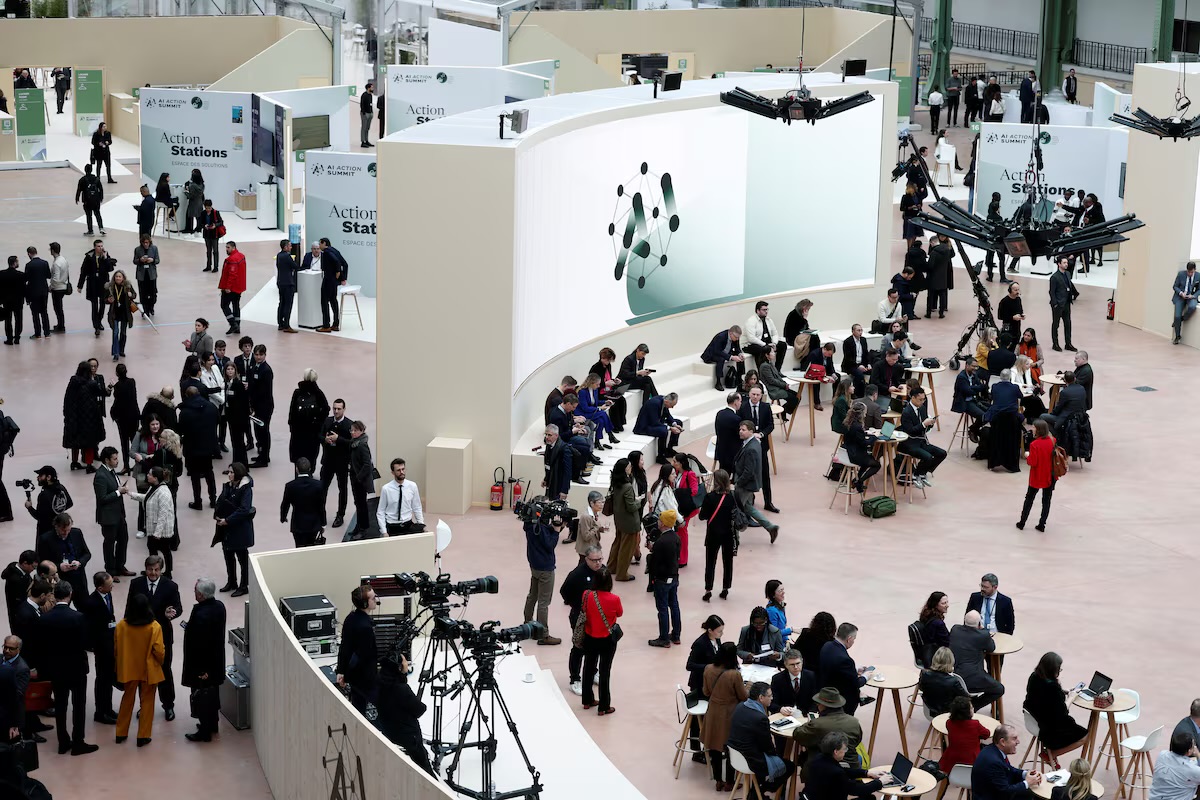
World leaders and top technology executives are converging in Paris this Monday for a high-stakes summit aimed at grappling with the rapidly evolving landscape of artificial intelligence (AI). With mounting resistance to regulation from businesses concerned about stifling innovation, the summit is set to explore how to navigate the fine line between controlling the risks AI poses and fostering technological advancement.
Since the viral rise of ChatGPT in 2022, global discourse around AI regulation has shifted. Previous summits in the UK and South Korea saw world powers unite in their cautionary stance on AI’s potential dangers. However, the urgency for regulation has waned, and the mood has shifted, especially with the backdrop of a competitive global race for AI dominance.
In the United States, President Donald Trump has moved decisively to dismantle AI guardrails put in place by his predecessor, choosing to prioritise national competitiveness over stringent regulation. His actions have intensified the pressure on Europe to take a more relaxed approach to AI regulation in order to prevent its tech sector from falling behind its US and Chinese counterparts.



“If we want growth, jobs, and progress, we must allow innovators to innovate, builders to build, and developers to develop.” argued Sam Altman, CEO of OpenAI, in a defiant opinion piece for Le Monde published ahead of the summit. Altman, representing a faction of Silicon Valley, champions the idea that regulation should not impede progress.

However, European leaders, including French President Emmanuel Macron, are cautious about the risks of unregulated AI while simultaneously pushing for flexibility within the EU’s newly passed AI Act. Macron expressed his concern that excessive regulation could undermine European innovation, but warned of the equally dangerous risk of having no rules at all.
“We should not be afraid of innovation,” Macron stated, urging for a balance that supports the growth of homegrown European tech firms without compromising safety.
The contrast in approaches is stark. While the EU has led the charge with the AI Act-arguably the world’s most comprehensive set of regulations for AI- many European tech giants and governments are pushing for a more lenient application. In the US, however, Trump’s deregulation is giving American tech firms a notable edge. This has sent a clear message: Europe’s tech sector must tread carefully to maintain its position in the race for AI supremacy.
Meanwhile, China is not sitting idly by. Last month, Chinese AI firm DeepSeek released a sophisticated human-like reasoning system, shaking the foundations of US and UK AI leadership. The move has sparked an accelerated race among geopolitical rivals, with each seeking to outpace the others in a contest that will define the future of technology.
Trump’s absence from the Paris summit, and the decision not to send representatives from the US AI Safety Institute, sends a troubling signal to those hoping for coordinated global action on AI safety. It is a missed opportunity for the US to engage with the rest of the world on the need for risk-based, global AI regulations.
Attendees at the summit include major political figures, such as US Vice President JD Vance, China’s Vice Premier Zhang Guoqing, Canadian Prime Minister Justin Trudeau, and Greek Prime Minister Kyriakos Mitsotakis, making it one of the most politically charged events of the year. As the global race for AI intensifies, the question remains: will the world find common ground, or will competing interests further fragment the regulation of this powerful technology?