The picturesque farming town of Citrusdal, located in South Africa’s Western Cape, is a key hub of the country’s citrus industry. With its vast orchards of oranges, lemons, and tangerines, it plays a crucial role in the nation’s agricultural exports. However, the future of this sector has been cast into uncertainty due to geopolitical tensions surrounding the African Growth and Opportunity Act (AGOA).
AGOA, a preferential trade agreement between the United States and Sub-Saharan African nations, provides duty-free access to the US market for eligible countries. South Africa has been a significant beneficiary of this agreement, with the citrus industry relying heavily on its provisions. However, with AGOA set to expire in September 2025, concerns are mounting about whether it will be renewed under a potential second Trump administration, given the former US president’s protectionist policies.
Gerrit van der Merwe, Chair of the Citrus Growers’ Association and Managing Director of ALG Estates, expressed concerns about the implications of a potential AGOA withdrawal. According to him, South Africa’s citrus exports to the US, while only accounting for 9% of total exports, support approximately 35,000 direct jobs within the industry and indirectly sustain an additional 25,000 jobs in the US. Given the country’s high unemployment rate—estimated at 35% to 45%—any disruption in trade would be detrimental to both South Africa and its trading partners.




Economic analysts have suggested that South Africa should consider voluntarily exiting AGOA to mitigate risks and explore alternative trade partnerships. This approach, they argue, could provide a strategic advantage by allowing South Africa to negotiate bilateral agreements with key markets before facing potential exclusion. However, such a move is fraught with uncertainty and could limit South Africa’s ability to compete with citrus exporters such as Peru and Spain.
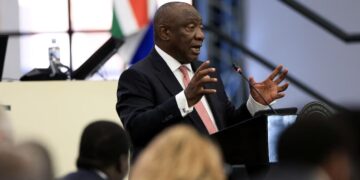
The debate over AGOA’s future is unfolding against a broader backdrop of economic and political challenges. Land ownership remains a contentious issue in South Africa, with white South Africans, who comprise approximately 7% of the population, owning a disproportionately large share of agricultural land. In an effort to redress historical inequalities, President Cyril Ramaphosa signed a land expropriation bill that allows for land redistribution in the public interest. This legislation has sparked criticism from various quarters, including former US President Donald Trump, who issued an executive order condemning the policy and offering asylum to white South African farmers.
Reports suggest that up to 67,000 South African farmers have expressed interest in seeking asylum in the US. However, van der Merwe dismissed these figures, stating that the vast majority of farmers have no intention of leaving South Africa. While acknowledging security concerns in certain areas, he emphasised that most farmers remain committed to their land and livelihoods.
The broader geopolitical implications of South Africa’s foreign policy have also influenced perceptions of its trade relationships. The country’s engagement with nations such as Iran, China, and Hamas has drawn scrutiny from US policymakers, with some arguing that these ties could jeopardise AGOA eligibility. The Trump administration’s past rhetoric suggests that political alignment may play a role in determining which countries benefit from trade agreements.
For citrus farmers in Citrusdal and beyond, the uncertainty surrounding AGOA’s renewal is a pressing concern. The industry has long been a pillar of South Africa’s agricultural economy, providing employment and economic stability to thousands. While alternative markets in Europe and Asia remain viable, losing preferential access to the US could disrupt supply chains and erode South Africa’s competitive edge.
As policymakers navigate these complex trade negotiations, the stakes for South Africa’s citrus sector could not be higher. The coming months will be critical in determining whether diplomatic efforts can secure AGOA’s renewal or whether South Africa must forge new trade alliances to safeguard its agricultural exports.