Recent data from South Africa paints an encouraging picture of improving internet accessibility, with a substantial decrease in the number of households lacking internet access. However, a deeper dive into the data reveals that the quality of internet service in the country still falls below global averages. The findings from the 2022 Census conducted by Stats SA and a Digital Quality of Life Index (DQL) analysis by Surfshark highlight the complexities of the country’s digital landscape.
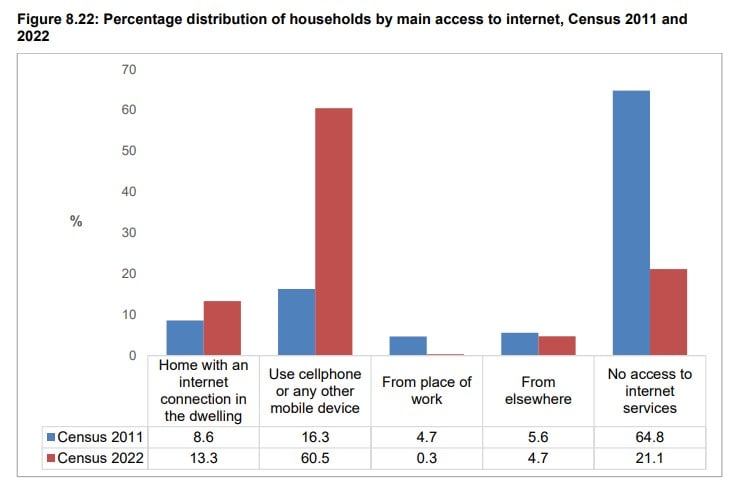
In 2011, a significant 64.8% of surveyed households in South Africa reported that they did not have internet access. Fast forward to 2022, and this number has dropped drastically to 21.1%. This substantial improvement in internet accessibility is undoubtedly a step in the right direction. Still, when we shift our focus to the quality of the internet service available, a more nuanced picture emerges.
Surfshark’s 2023 Digital Quality of Life Index delves into internet inequality by examining two crucial indicators: internet speed and the time it takes to work to afford it, relative to a country’s economic well-being.



When it comes to fixed broadband internet, the divide is stark. Lower-income countries work 4.1 times more for 3.3 times slower internet. On average, people in wealthier countries enjoy internet speeds of 140 Mbps, requiring less than three hours of work per month. In contrast, lower-income countries only experience 42 Mbps, but they must work for more than 12 hours to afford it. South Africa, despite being considered a higher-income country, falls significantly short of the average internet speed in wealthier nations, offering a mere 70 Mbps.

However, it’s important to note that a country’s economic status does not always equate to superior internet quality. Other factors, such as e-infrastructure within the region, play a pivotal role. As an example, the Philippines, classified as a lower-income country, boasts fixed internet speeds of 119 Mbps, three times faster than the average in the lower-income group. These disparities reveal the complex nature of internet accessibility and quality.
South Africa’s fixed internet speed, at 70 Mbps, falls below the global average of 108 Mbps. The story is similar for mobile internet, where the average speed in South Africa is 68 Mbps, also trailing behind the global average of 75 Mbps. These numbers indicate that there’s room for improvement in terms of the speed and quality of internet services provided in the country.
However, there are some positive aspects to consider. It takes significantly less time for South Africans to afford the cheapest mobile data package compared to the global average. The global average is 7,158 seconds, whereas in South Africa, it is 5,162 seconds. This affordability may be seen as a silver lining, making internet access more accessible to a broader segment of the population.
Furthermore, when it comes to the cheapest fixed internet package, South Africa again outperforms the global average, taking an average of 104 minutes compared to the global average of 359 minutes. These affordability metrics suggest that while internet quality might not yet be on par with global standards, it is becoming increasingly accessible to South African citizens, both in terms of mobile and fixed internet options.
South Africa’s progress in internet accessibility is undeniable, with a significant reduction in the percentage of households without internet access. However, the country still grapples with subpar internet quality, trailing behind global averages in both fixed and mobile internet speeds. Affordability, on the other hand, paints a more positive picture, indicating that South Africans have a relatively easier time accessing affordable internet packages. It’s clear that bridging the gap in internet quality is a vital next step for South Africa to ensure its citizens have access to high-quality, reliable internet services that can compete on a global scale.