

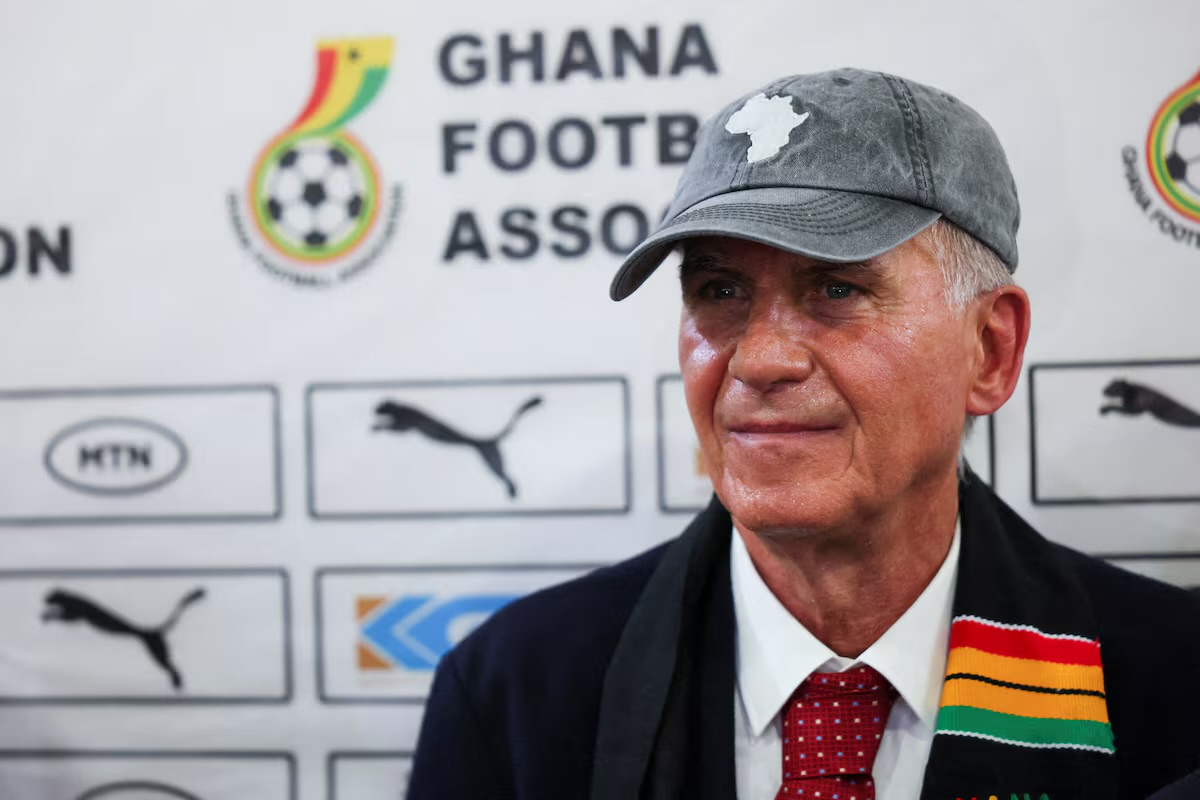
Veteran football coach Carlos Queiroz will write another chapter in his remarkable managerial career this week when he leads Ghana into the FIFA World Cup, matching one of the tournament’s most enduring coaching records.
The 73 year old Portuguese tactician takes charge of the Black Stars as they begin their Group L campaign against Panama in Toronto on Wednesday, marking his fifth consecutive World Cup appearance as a head coach.
The achievement places Queiroz alongside legendary Serbian coach Bora Milutinović, who managed teams at five successive World Cups between 1986 and 2002. Milutinović accomplished the feat with five different national teams, establishing a record that has stood for more than two decades.



Queiroz’s World Cup journey began with Portugal in 2010 before he guided Iran at three consecutive tournaments in 2014, 2018 and 2022. His appointment as Ghana coach earlier this year has now secured his place among the most experienced managers in World Cup history.
Only Brazilian coach Carlos Alberto Parreira has appeared at more World Cups, having managed teams at six editions of the tournament. However, Parreira’s appearances were not consecutive.
Queiroz was not expected to be part of this year’s World Cup in Canada, Mexico and the United States until Ghana turned to him in April following the dismissal of Otto Addo. The Ghana Football Association acted after a disappointing run of friendly match results led to growing concerns ahead of the tournament.
The appointment revived a coaching career that many believed had reached its conclusion. Before receiving the call from Ghana, Queiroz’s most recent role had been with Oman, the eighth national team he has managed during an extensive international coaching career.
His résumé extends far beyond international football. Queiroz enjoyed a brief spell as head coach of Real Madrid and twice served as assistant manager to legendary coach Sir Alex Ferguson at Manchester United, where he played an influential role during one of the club’s most successful periods.
Throughout his career, Queiroz has earned a reputation for his analytical and highly technical approach to the game. Admirers view him as one of football’s great strategic thinkers, while critics have occasionally questioned his personality and management style.
Former Manchester United captain Roy Keane once famously described him as having “the personality of a dead fly,” a comment that highlighted the contrasting opinions that have often followed the Portuguese coach throughout his career.
Despite such criticism, Queiroz remains widely respected in Portugal for the transformative impact he had on the country’s football development structures.
Many observers credit him with helping lay the foundations for Portugal’s golden generation of football talent. His work with youth football produced back to back FIFA Under 20 World Cup triumphs in 1989 and 1991 and helped nurture future stars including Luís Figo, Paulo Sousa and João Pinto.
Portuguese sports newspaper A Bola recently praised Queiroz for introducing a more scientific and educational approach to football development, helping establish Portugal as one of the world’s leading producers of elite football talent.
The publication argued that his greatest contribution was not simply winning matches but creating a lasting culture that connected academic knowledge with football coaching and player development.
Now, more than three decades after those youth team successes, Queiroz has another opportunity to enhance his legacy on football’s biggest stage.

Taking charge of Ghana offers him a chance not only to equal a historic World Cup record but also to guide one of Africa’s most talented teams deep into the tournament.
When he accepted the role, Queiroz made it clear that he believes his vast experience can still make a difference.
“I am prepared for this,” he said. “I bring 40 years of experience to every decision that will be made.”
As Ghana prepares to begin its World Cup campaign, Queiroz arrives with a wealth of knowledge accumulated across four decades in football and a determination to prove that experience remains one of the game’s greatest assets.
Whether he can lead the Black Stars to an extended run in the competition remains to be seen, but his place among the World Cup’s most enduring coaching figures is already secure.


