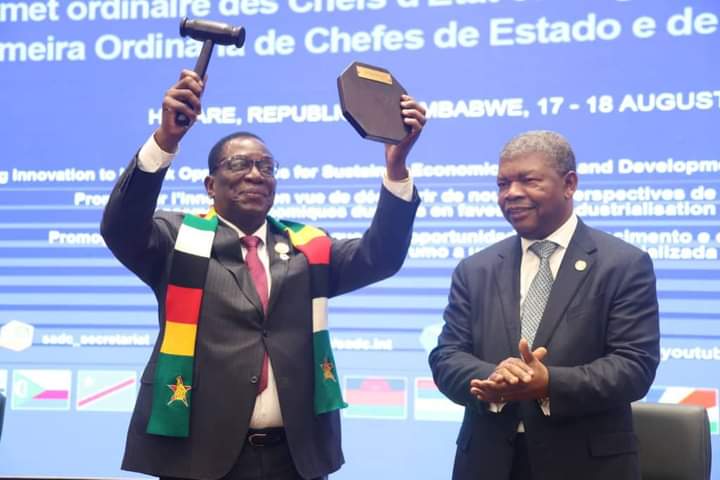
In a pivotal address at the 44th Ordinary Southern African Development Community (SADC) Summit in Harare, President Emmerson Dambudzo Mnangagwa of Zimbabwe assumed the role of SADC Chairperson, calling for a renewed focus on innovation, economic self-determination, and regional unity.
President Mnangagwa, taking over from Angolan President João Lourenço, praised his predecessor’s leadership, noting that the region’s integration agenda had remained resilient despite numerous challenges. Mnangagwa’s address was marked by a profound emphasis on leveraging innovation as a catalyst for sustainable economic growth and industrialisation across the region.
Innovation as the Cornerstone of Development



Mnangagwa articulated the summit’s theme, “Promoting Innovation to Unlock Opportunities for Sustainable Economic Growth and Development towards an Industrialised SADC,” highlighting the critical role of technology and innovation in transforming SADC’s economic landscape. He urged member states to harness the region’s human capital to modernise and industrialise, calling for concrete actions aligned with the SADC Industrialisation Strategy and Roadmap (2015-2063).
“The Fourth Industrial Revolution continues to impact and transform the way we operate. Our SADC bloc cannot afford to fall behind in this fast-changing frontier of science, technology, and innovation,” Mnangagwa stated. He emphasised that innovation-driven value addition and beneficiation of the region’s rich mineral resources were imperative for achieving higher living standards for SADC citizens.
Economic Self-Determination and Sovereignty
In a striking appeal for economic self-determination, Mnangagwa invoked the legacy of the region’s liberation struggles, urging SADC nations to realise maximum value from their natural resources. “The peoples of the region fought for our liberation, freedom, and independence. The time is now; we must realise maximum value from our God-given rich natural endowments,” he asserted.
He also called for the preservation and promotion of African culture, cautioning against sacrificing regional unity and sovereignty for political or economic expediency. Mnangagwa’s address underscored the importance of SADC nations retaining control over their developmental priorities and resisting external interference.
Climate Resilience and Energy Infrastructure
Addressing the pressing challenges posed by climate change, Mnangagwa highlighted the region’s vulnerability to climate-induced disasters, which have severe implications for food security. He urged increased investment in transformative agriculture and climate resilience to ensure that SADC can sustain itself in the face of these challenges.
Mnangagwa also placed significant emphasis on expanding the region’s energy infrastructure, particularly through renewable sources. He cited Zimbabwe’s own efforts in diversifying its energy mix, including the Geo-Pomona Waste Management Plant, which converts waste into energy, as a model for sustainable development.
Defending Regional Sovereignty and Global Advocacy

In his closing remarks, Mnangagwa reiterated Zimbabwe’s commitment to defending the sovereignty and independence of the SADC region. He called for the immediate and unconditional lifting of sanctions on Zimbabwe, condemned the use of sanctions as a foreign policy tool, and advocated for the end of conflicts in Palestine and Western Sahara, aligning SADC’s stance with broader continental and global issues.
“Zimbabwe is a friend to all and an enemy of none,” Mnangagwa declared, reaffirming his belief in dialogue and diplomacy as the most sustainable means of resolving conflicts.

As he assumes the SADC Chairmanship, Mnangagwa’s vision for the region is clear: a united, industrialised, and self-determined SADC, driven by innovation and the collective efforts of its citizens. His call to action reflects the enduring spirit of the region’s liberation struggles, with a renewed focus on securing a prosperous future for all SADC nations.