
Wednesday, June 24, 2026
  • Login
The Southern African Times
  • Home
  • Southern Africa
  • Business
    • African Start ups
    • African Continental Free Trade Area
  • Technology
    • Lifestyle
      • Health
      • Culture
      • Food and Drink
      • Entertainment
  • Opinion
  • Sports
  • SAT Jobs
    • Events
  • About Us
    • Advertise with Us
    • Contact Us
No Result
View All Result
  • Home
  • Southern Africa
  • Business
    • African Start ups
    • African Continental Free Trade Area
  • Technology
    • Lifestyle
      • Health
      • Culture
      • Food and Drink
      • Entertainment
  • Opinion
  • Sports
  • SAT Jobs
    • Events
  • About Us
    • Advertise with Us
    • Contact Us
No Result
View All Result
The Southern African Times
No Result
View All Result
Home Opinion

No Longer Nigerian? Kemi Badenoch and the Betrayal of Diasporic Duty

When visibility turns into vanishing.

by Times Reporter
August 2, 2025
in Opinion
0
No Longer Nigerian? Kemi Badenoch and the Betrayal of Diasporic Duty

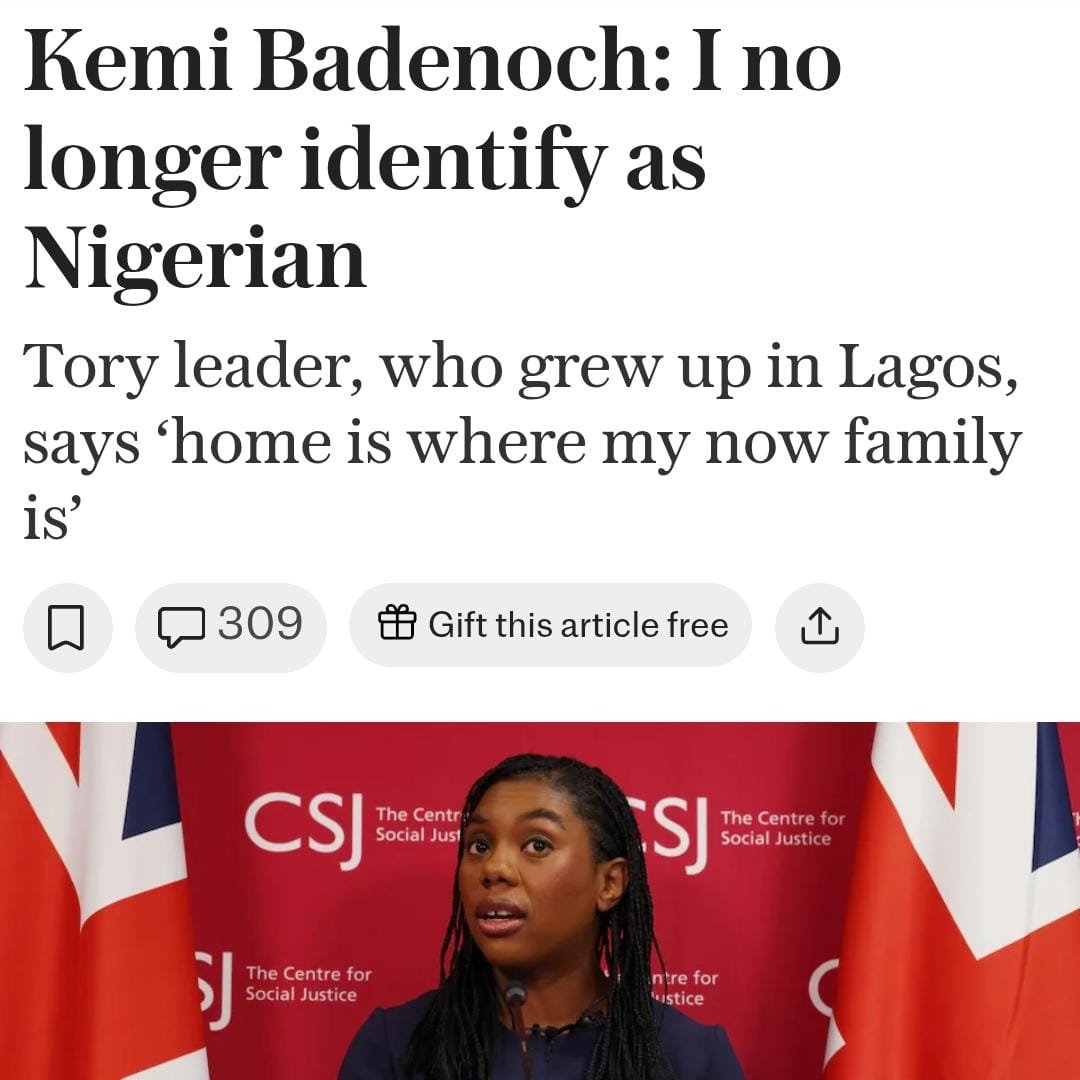
There is something faintly Shakespearean about Kemi Badenoch’s declaration that she “no longer identifies as Nigerian.” A tragedy unfolding not with thunder and war drums, but with polite applause from the seats of Westminster. One can almost hear Caliban hissing from the pages of The Tempest, “You taught me language; and my profit on’t is, I know how to curse.”

Badenoch’s statement is not just a personal act of disavowal. It is a symbolic gesture that strikes at the root of pan-African dignity in the diaspora. For those of us navigating life as African professionals in Western capitals, it is galling, if not mildly pathetic, to witness someone ascend through the ranks of British power only to trample the very soil that once nourished her.

ADVERTISEMENT

Let us not be naive. Throughout colonial and post-colonial history, there have always been individuals who, in proximity to power, mistake inclusion for assimilation. Cecil Rhodes understood this. So did Lord Lugard. And so, evidently, does Kemi Badenoch.

This is not a uniquely Nigerian matter. It resonates across the continent. In Zimbabwe, we have seen political figures who, once afforded British visas or investment portfolios, quickly unlearned their revolutionary tongues and adopted the Queen’s English with an accent refined in Kensington. Yet few have done so with the theatrical flair Badenoch now displays, using cultural severance as a form of political capital.

For the record, Badenoch is not the first Black British politician to rise within the Conservative Party. But she may be the first to weaponise her African origin so openly, treating it as a problem to be solved rather than a heritage to be honoured. Her trajectory relies on a familiar colonial narrative: Africa as dysfunction, Britain as salvation, and herself as a model migrant who overcame the misfortune of her roots. This story flatters empire but sells out her community in the process.

We in the diaspora are not merely living abroad. We are engaged in the laborious task of remaking perception. African doctors, academics, engineers, and creatives work daily to dismantle caricatures forged by centuries of imperial storytelling. We do not seek pity or tokenism. We seek equality and recognition as sovereign individuals. In that effort, representation carries weight.

So when a woman of Nigerian heritage, raised in Lagos, and shaped by African traditions, publicly states that she no longer identifies with Nigeria, her words reverberate far beyond personal preference. They echo in boardrooms, classrooms, and policy briefings where African identity is already misunderstood. Her statement becomes an alibi for those who still believe Africans must shed their identity to succeed in the West.

This is not unprecedented. In 1807, when Britain abolished the transatlantic slave trade, formerly enslaved Africans such as Ottobah Cugoano and Ignatius Sancho were paraded as proof of civilisation’s reach. Their literacy and poise were meant to suggest the success of British magnanimity. But beneath the polished exterior was the expectation that they perform gratitude and sever cultural ties. Today, Badenoch need not perform in chains. A party badge and media spotlight suffice.

There is nothing wrong with feeling at home in Britain. Many of us do. Britain is now part of our story. But identity is not a binary choice. One need not erase Africa to embrace Britishness. That expectation belongs to another century. In a plural society, complexity should be strength. The insistence on singularity is not only outdated but intellectually dishonest.

Badenoch’s assertion that “home is where my now family is” has the air of someone auditioning for national sainthood. It prioritises political theatre over genuine self-examination. Her statement dishonours the resilience of every African family whose members left home not out of disdain but from a desire to contribute meaningfully abroad.

Ironically, her words come at a moment when young Africans in the UK are reclaiming their cultural heritage. Amapiano fills London clubs. Afrobeat dominates global charts. African fashion and language are woven proudly into British life. The younger diaspora is not running from its roots but embracing them with confidence. While they decolonise the narrative, Badenoch pretends she was never part of it.

In Zimbabwe, we call this kusviba nhaka — to blacken one’s inheritance. To walk the halls of influence and forget the voices that lifted you toward them is not just ungrateful. It is cowardice masquerading as political strategy.

I do not mourn Badenoch’s position. Nor do I envy it. But I mark this moment with clarity. Because long after the applause dies down, long after the headlines are forgotten, history will ask where she stood when Africa called. And if the answer is silence or shame, history will answer in kind.

Written by Farai Ian Muvuti, the Chief Executive Officer of The Southern African Times, 2023 winner of the Young Entrepreneur of the Year award by the South African Chamber of Commerce UK, an advisor on the board of the Africa Chamber of Commerce, and a contributor to Arise News, Al Jazeera, and the BBC.


Tags: African DiasporaAfrican prideBlack British politicsBritain and Africa relationscolonial legacycultural assimilationDecolonisationFarai Ian MuvutiIdentity PoliticsKemi BadenochNigerian identityPan-AfricanismThe southern African TimesWestminsterZimbabwe diaspora
Previous Post

Tafara Makopa: The Zimbabwean Visionary Redefining UK Digital Culture

Next Post

Lesotho Trade Minister Criticises U.S. Tariffs as Disproportionate and Harmful to Developing Economies

Times Reporter

Related Posts

The Insurance Hack More Drivers Should Know
Opinion

The Insurance Hack More Drivers Should Know

by Times Reporter
June 22, 2026
Southern African Times Announces Brendan Amadi as Recipient of the 2026 Editorial Recognition of the Year Award
The Editorial Board

Southern African Times Announces Brendan Amadi as Recipient of the 2026 Editorial Recognition of the Year Award

by The Editorial Board
June 19, 2026
LONG READ | No Longer the World’s Dustbin: China’s Waste Ban and Africa’s Circular Economy Moment
Opinion

LONG READ | No Longer the World’s Dustbin: China’s Waste Ban and Africa’s Circular Economy Moment

by Times Reporter
June 12, 2026
OPINION | The Investors Southern Africa Refuses to See
Opinion

OPINION | The Investors Southern Africa Refuses to See

by Times Reporter
June 14, 2026
Faith, Miracles and the Crisis of Religious Authenticity
Opinion

Faith, Miracles and the Crisis of Religious Authenticity

by Brendan Amadi
June 10, 2026
Next Post
Lesotho Trade Minister Criticises U.S. Tariffs as Disproportionate and Harmful to Developing Economies

Lesotho Trade Minister Criticises U.S. Tariffs as Disproportionate and Harmful to Developing Economies

Browse by Category

  • Africa AI
  • African Continental Free Trade Area
  • African Debt
  • African Start ups
  • Agriculture
  • AI Africa
  • Algeria
  • All News
  • Analysis
  • Angola
  • Arts / Culture
  • Asia
  • Botswana
  • BOTSWANA
  • BREAKING NEWS
  • BRICS
  • Burkina Faso
  • Burundi
  • Business
  • Business
  • Business Wire
  • Cameroon
  • Central Africa
  • Chad
  • China
  • Climate Change
  • Climate Changev
  • Community
  • Congo Republic
  • Conservation
  • Côte d’Ivoire
  • COVID 19
  • CRYPTOCURRENCY
  • Culture
  • Democratic Republic of Congo
  • Diplomacy
  • Eastern Africa
  • Economic Development
  • Economy
  • Education
  • Egypt
  • Elections 2024
  • Energy
  • Entertainment
  • Environment
  • Eritrea
  • Ethiopia
  • Europe
  • Fashion
  • Feature
  • Finance
  • Financial Inclusion
  • Food
  • Food and Drink
  • Foods
  • GABON
  • Ghana
  • Global
  • Global Africa
  • Guinea
  • Health
  • Humanitarian Aid
  • Immigration
  • in Southern Africa
  • International news
  • International Relations
  • Investment
  • Ivory Coast
  • Just In
  • Kenya
  • Lesotho
  • Libya
  • Life Style
  • Lifestyle
  • Literature
  • Malawi
  • Malawi
  • Mali
  • Markets
  • Mauritius
  • Middle East
  • Mining in Africa
  • Morocco
  • Mozambique
  • Namibia
  • Niger
  • niger
  • Nigeria
  • North Africa
  • North-Eastern Africa
  • Obituaries
  • Obituary
  • Opinion
  • PARTNER CONTENT
  • Politics
  • Property
  • Racism
  • Rwanda
  • Rwanda
  • SADC
  • SAT Interviews
  • SAT Investigation
  • SAT Jobs
  • Saudi Arabia
  • Senegal
  • Seychelles
  • Somaliland
  • South Africa
  • South Sudan
  • Sports
  • Startup Africa
  • STOCK EXCHANGE
  • Sudan
  • Sustainability
  • Sustainablity
  • Tanzania
  • Technology
  • Telecommunications
  • The Editorial Board
  • The Power Of She
  • Togo
  • Trade
  • Travel
  • Travel
  • Tunisia
  • Uganda
  • Uncategorized
  • Wealth
  • West Africa
  • World
  • World
  • Zambia
  • ZAMBIA
  • ZIMBABWE
  • Zimbabwe

Browse by Tags

#NewsUpdate #SouthAfrica #SouthernAfricanTimes #TheSouthernAfricanTimes AfCFTA africa African Continental Free Trade Area African development African Development Bank African economies African economy African Union Agriculture Angola Botswana China Climate change Cyril Ramaphosa Economic Development economic growth energy transition Ghana governance industrialisation Inflation Infrastructure Infrastructure Development International relations Investment Kenya Mozambique Namibia news Nigeria Regional Integration renewable energy Rwanda SADC South Africa Southern Africa sustainable development Tanzania United States Zambia Zimbabwe
ADVERTISEMENT

WHO WE ARE

The Southern African Times is a regional bloc digital newspaper that covers Southern African and world news. The paper also gives a nuanced analysis on news and covers a wide range of reporting which include sports, entertainment, foreign affairs, arts and culture.

Welcome Back!

Login to your account below

Forgotten Password?

Retrieve your password

Please enter your username or email address to reset your password.

Log In
  • Home
  • Southern Africa
  • Business
    • African Start ups
    • African Continental Free Trade Area
  • Technology
    • Lifestyle
      • Health
      • Culture
      • Food and Drink
      • Entertainment
  • Opinion
  • Sports
  • SAT Jobs
    • Events
  • About Us
    • Advertise with Us
    • Contact Us
Not enough quota to unlock this post
Unlock left : 0
Are you sure want to cancel subscription?

