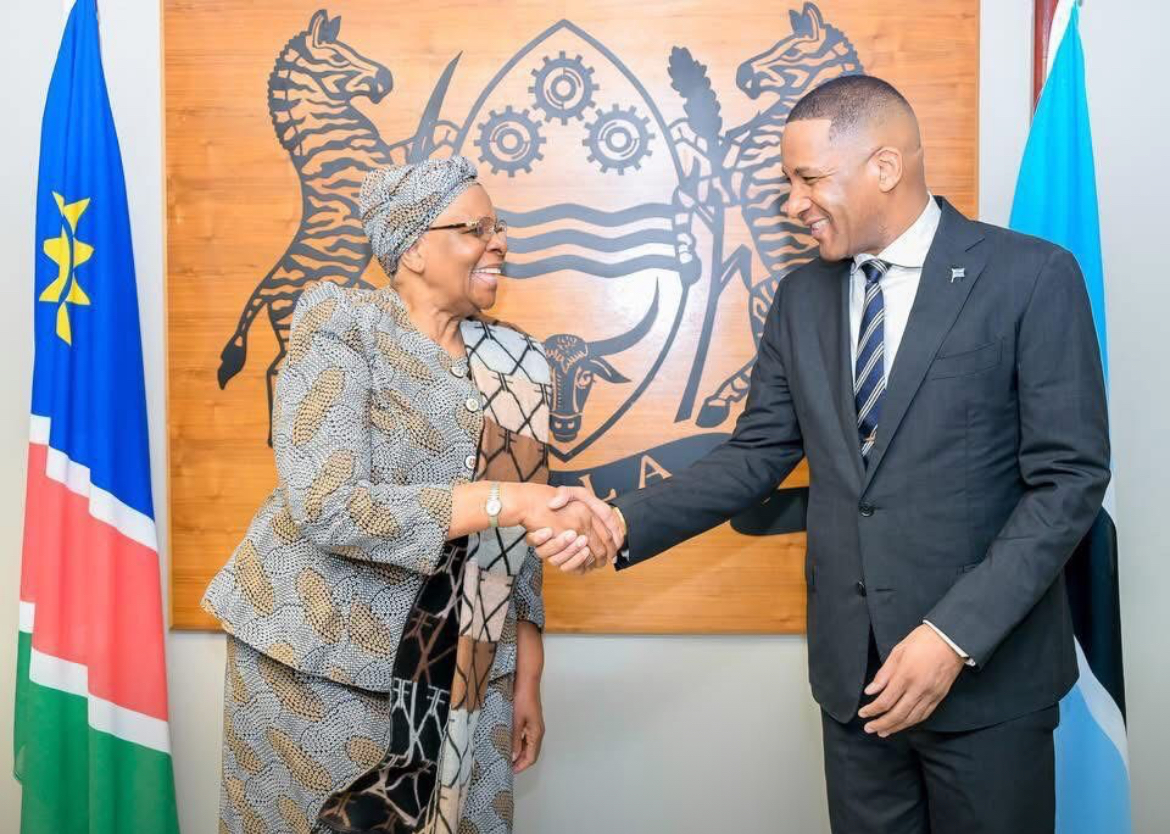
Namibia’s President, Dr Netumbo Nandi-Ndaitwah, has concluded back-to-back diplomatic engagements in Botswana and Zambia, in a continuation of her regional outreach since assuming office in March 2025. The working visits, held from 15 to 16 May, form part of a strategic recalibration of Windhoek’s foreign policy posture, aimed at enhancing bilateral relations and accelerating economic cooperation across Southern Africa.
In Gaborone, President Nandi-Ndaitwah met with her Botswanan counterpart, Advocate Duma Boko, marking their second high-level interaction in less than two months. The talks underscored the longstanding diplomatic ties between the two nations, which are maintained at the elevated level of a Bi-National Commission. The two leaders reaffirmed their commitment to strengthening economic integration, with a particular focus on infrastructure development, trade facilitation and job creation.
Namibia and Botswana, whose historical bonds stem from liberation-era solidarity and enduring socio-cultural linkages, are prioritising joint infrastructural undertakings. These include the upgrading of the Trans-Kalahari and Mamuno Border Posts and enhanced collaboration on the Trans-Kunene Corridor. The corridor, a critical component of regional logistics infrastructure, links Namibia’s Walvis Bay Port to key economic zones in Angola and beyond.



Further cooperation is anticipated in the energy sector, notably through the joint development of the Mohembo–Katima Mulilo and Gaborone–Kudzanai–Katima Mulilo transmission lines. These projects are expected to contribute to cross-border electrification initiatives and long-term energy security in the region. Namibia and Botswana are both participants in the Southern African Development Community Free Trade Area, with bilateral discussions extending to the tourism sector, where shared ecological assets offer mutual opportunities for sustainable development.
President Nandi-Ndaitwah proceeded to Lusaka on the evening of 15 May, where she held her inaugural meeting with Zambian President Hakainde Hichilema on 16 May. Their discussions covered a broad spectrum of shared interests, ranging from agriculture and mining to health, education, transport and investment. The two countries, whose liberation histories are intertwined, have maintained a consistently cordial relationship since Namibia’s independence in 1990.
During her visit, President Nandi-Ndaitwah participated in a symbolic street renaming ceremony in Lusaka, where Kasama Street was renamed in honour of Dr Sam Nujoma, Namibia’s Founding President, and Sadzu Street in tribute to the late Dr Hage Gottfried Geingob, Namibia’s third President. Both figures spent extended periods in Zambia during Namibia’s protracted struggle for liberation, and the renaming is seen as a reaffirmation of Zambia’s historic solidarity with Namibia.
The visit also brought into focus the strategic significance of Namibia’s Walvis Bay dry port for Zambia, which facilitates the movement of goods along the Walvis Bay–Ndola–Lubumbashi Development Corridor. To further streamline trade, the two nations signed a bilateral agreement for the establishment of a One-Stop Border Post at Katima Mulilo, expected to reduce transit times and logistical bottlenecks.
Namibia, Botswana and Zambia are all signatories to the African Continental Free Trade Area (AfCFTA), positioning themselves as key actors in the broader continental agenda of economic integration and intra-African trade. President Nandi-Ndaitwah’s engagements align with the principles of Agenda 2063, which advocates for inclusive growth, regional cooperation, and the advancement of Africa’s socio-economic transformation.

President Nandi-Ndaitwah returned to Windhoek on 16 May, concluding a week of intensive diplomatic engagements that began with her official visit to Angola. Her early international itinerary signals a decisive approach to regional cooperation and a reaffirmation of Namibia’s commitment to multilateralism and shared development within Southern Africa.