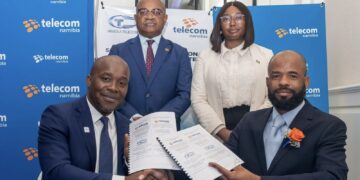
Liquid Telecommunication Holdings Ltd., an African telecommunications giant, is poised to raise $225 million in equity by the close of the year, with the United States International Development Finance Corporation (DFC) emerging as one of the key investors. This infusion of capital underscores the mounting geopolitical competition between the United States and China on the African continent, particularly in sectors with significant growth potential such as digital infrastructure.
In an email correspondence with SAT, Hardy Pemhiwa, Chief Executive Officer of Liquid Telecom, revealed that the DFC will be a principal participant in an initial $90 million tranche expected to be secured within the next few weeks. A subsequent round of funding is anticipated later in the year, as Liquid seeks to consolidate its financial position and address impending maturities on outstanding loans and bonds.
The strategic involvement of the DFC in Liquid Telecom’s funding drive is emblematic of broader US efforts to engage economically with Africa, a continent that boasts a burgeoning population and abundant mineral resources. Development agencies like the DFC have become instrumental in this endeavour, providing financial backing that aligns with the United States’ interests in countering Chinese influence in the region.
Liquid Telecom has been at the forefront of bridging the digital divide across Africa, a continent that, despite its rapid technological advancements, remains the least connected region globally. The fresh capital injection will not only support the company’s expansion but also aid in managing its financial obligations, including a $156 million equivalent term loan and $620 million in bonds due for repayment in 2026.
In collaboration with US technology behemoths Microsoft Corp. and Alphabet Inc.’s Google, Liquid Telecom is working on ambitious broadband projects aimed at transforming the digital landscape in East Africa. The partnership with Microsoft seeks to deliver affordable broadband access through last-mile connections to 20 million Africans across Kenya and Zambia. This initiative is part of a broader strategy to increase internet penetration in underserved regions, thereby fostering economic growth and development.
Concurrently, Liquid Telecom is joining forces with Google to extend its terrestrial fibre network through several key African nations, including South Africa, Kenya, Uganda, Rwanda, Zambia, Zimbabwe, and the Democratic Republic of Congo. This extensive route will not only enhance connectivity to numerous data centres but also provide a critical alternative for managing traffic disruptions in the event of a subsea cable outage between South Africa and Kenya.
To date, Liquid Telecom has laid over 110,000 kilometres (approximately 68,000 miles) of fibre across the African continent. As demand for higher-speed internet and increased data storage continues to rise, the company’s infrastructure initiatives are positioned to play a pivotal role in Africa’s digital evolution. The expansion of broadband and fibre networks is expected to drive further economic integration and development, positioning Liquid Telecom as a linchpin in the continent’s digital future.
This infusion of capital and the strategic partnerships with major US tech firms highlight Liquid Telecom’s crucial role in the ongoing digital transformation of Africa. As geopolitical tensions between the United States and China intensify, particularly in regions with significant growth potential, the actions of companies like Liquid Telecom will be closely watched as indicators of the evolving balance of power.