
Japanese private companies have traditionally taken a cautious approach to investment in Africa, balancing the continent’s strategic importance with a careful approach to risk. But the wary attitude of the Japanese private sector means that Japanese investors lag far behind their Western and Asian counterparts when it comes to the African market.
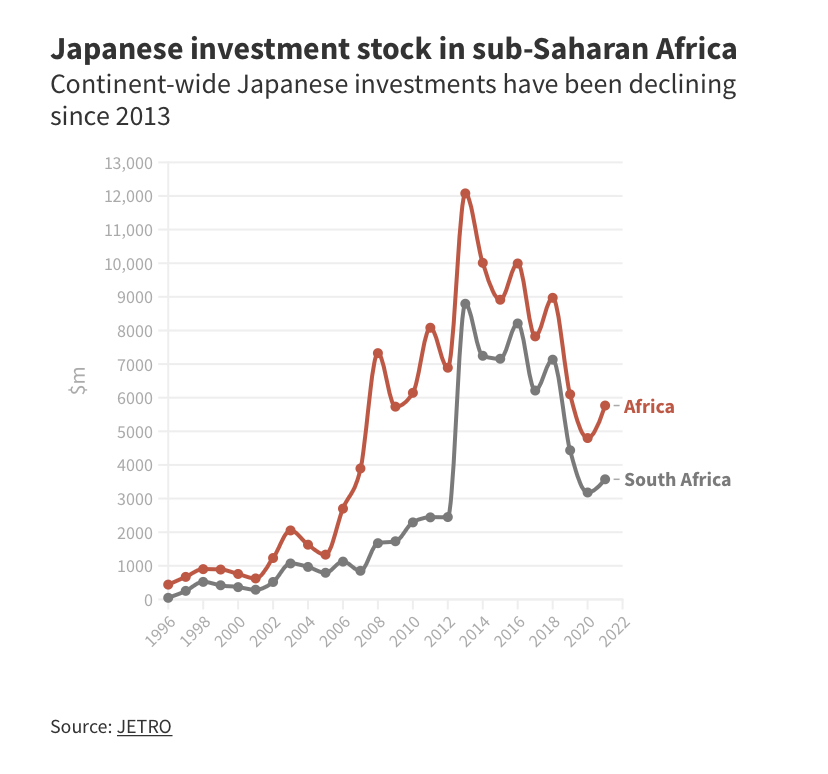
In recent years, Japanese investment stock in sub-Saharan Africa has been declining, falling from $12bn in 2013 to less than $6bn in 2021, with South Africa accounting for 70% of it. The Japanese government hopes to change that.



Japan moves towards private investment approach in Africa
Tokyo has a longstanding ambition to create a “Free and Open Indo-Pacific” – including embracing African coastal states such as Kenya, Mozambique, Somalia and Tanzania – in a bid to to counter China’s Belt and Road Initiative (BRI).
At the last TICAD, held in Yokohoma in 2019, Tokyo sought to move from a policy focused on official development assistance (ODA), to a private investment-based approach.
“The Japanese government will do everything possible to support Japanese companies expanding into Africa,” the late prime minister Shinzo Abe said at the conference.
Whereas Africa was once seen as merely a source of raw materials for Japanese industry, the government now sees Africa as an important market for the private sector to target.
Nowhere is this shift in focus more obvious than in Japan’s vital auto industry. Japan’s commercial relationship with South Africa, one of its main partners, was historically based on its needs for rare-earth minerals and metals – such as palladium and rhodium – which are key inputs in the auto manufacting process.
But Africa itself has now become a major importer and manufacturing destination for Japanese car companies, especially since the trading arm of Japan’s Toyota Group, Toyota Tsusho, bought the French distribution company CFAO in 2012. This made Toyota Tsusho the largest Japanese private investor on the continent, with a network encompassing every country in Africa and a total of 22,000 employees.
The latest results should give confidence to investors: in the fiscal year ended March 2022, the revenue (sales) of the Toyota Tshusho African business reached 1 trillion yen ($7.4bn) for the first time.
Where Toyoto goes, other Japanese automotive manufacturers follow. Companies such as component maker Yazaki and wiring systems firm Sumitomo recently announced plans to build auto wiring and parts facilities worth over $100m in Morocco.

Growing energy links
The Japanese government hopes to replicate this diverse approach in the energy sector. The government’s Basic Energy Plan includes a 2030 electricity energy mix target of 36-38% from renewables, 20-22% from nuclear, 22% from gas and 19% from coal. Africa is expected to be a major supplier.
As far as gas is concerned, Japanese utility companies are expected to offtake approximately 30% of LNG produced in Mozambique, home of the third-largest natural gas reserves in Africa. Japan, a firm ally of the West, could increasingly turn to Africa as it seeks to reduce the 10% of LNG it imports from Russia.
Four major Japanese private banks – MUFG Bank, Mizuho Bank, Sumitomo Mitsui Banking and Sumitomo Mitsui Trust Bank – and the Japan Bank for International Cooperation have invested approximately $14bn to develop the project, which should make Mozambique the largest recipient of Japan’s FDI on the continent.
In addition, two Japanese companies, Penta-Ocean Construction and Toa Corporation, are undertaking a $19bn expansion of the Port of Nacala, located on the northern shoreline of Mozambique, to secure the future trade of LNG. The project is being seen as a demonstration of Abe’s vision for a “Free and Open Indo-Pacific”.
But instead of just seeing Africa as the source of raw materials, the government believes that the experienced Japanese private sector can play a much more expansive role in energy infrastructure on the continent.
East Africa’s infrastructure and energy sectors have been particular areas of interest – in Kenya, the role of Japanese companies has been decisive in building the geothermal plant of Olkaria, which allowed the country to be among the world’s top 10 producers of geothermal energy.
Focus on startups

All of this represents a move away from traditional aid and development assistance to a much more productive private sector relationship. Japan’s development agency, JICA, has seen its role as an incubator of Japanese companies in Africa increase over the last few years, reflecting Japan’s call for more public-private partnerships.
JICA has connected African and Japanese entrepreneurs through networking events, such as the last TICAD, where for the first time private companies were recognised as official partners of the conference.
Japan also wants to expand its cooperation with third parties such as the EU, India, Australia, and the US, to take advantage of their extensive business networks on the continent.

Africa is one of the regions targeted by the Partnership on Sustainable Connectivity and Quality Infrastructure between the European Union and Japan, which aims to build infrastructure and enhance connectivity in the same regions targeted by China’s Belt and Road Initiative (BRI).
It’s not just major industries like energy and auto that stand to benefit. Using these emerging networks Japanese investors have entered the diverse venture capital business in Africa, increasingly financing innovative start-up companies which operate in various sectors from fintech to retail and entertainment.
Kepple African Ventures, established in 2019 by Japanese entrepreneur Takahiro Kanzaki, has invested in more than 100 companies across 11 markets in Africa, with first cheques going from $50K to $150K.Kanzaki is one of the rare Japanese entrepreneurs who has travelled in Africa to explore the potential for business investment.
In an interview with TechCabal in 2021, he said that Japanese investors were not lacking capital or willingness to invest in Africa, but rather “it’s about the shortage of capable and experienced talents who can manage the funds in Africa. It’s very difficult to find talent who understand the African market and who can commit their lives to Africa.”
Meanwhile, JICA has set up Next Innovation with Japan (NINJA), a startup support initiative designed to support African startups that are creating innovative business models and technologies to solve social issues.
This new focus on SMEs and startups is just one plank in a newly assertive approach that the government hopes will allow Japanese companies to move on from the excessive caution of the past.