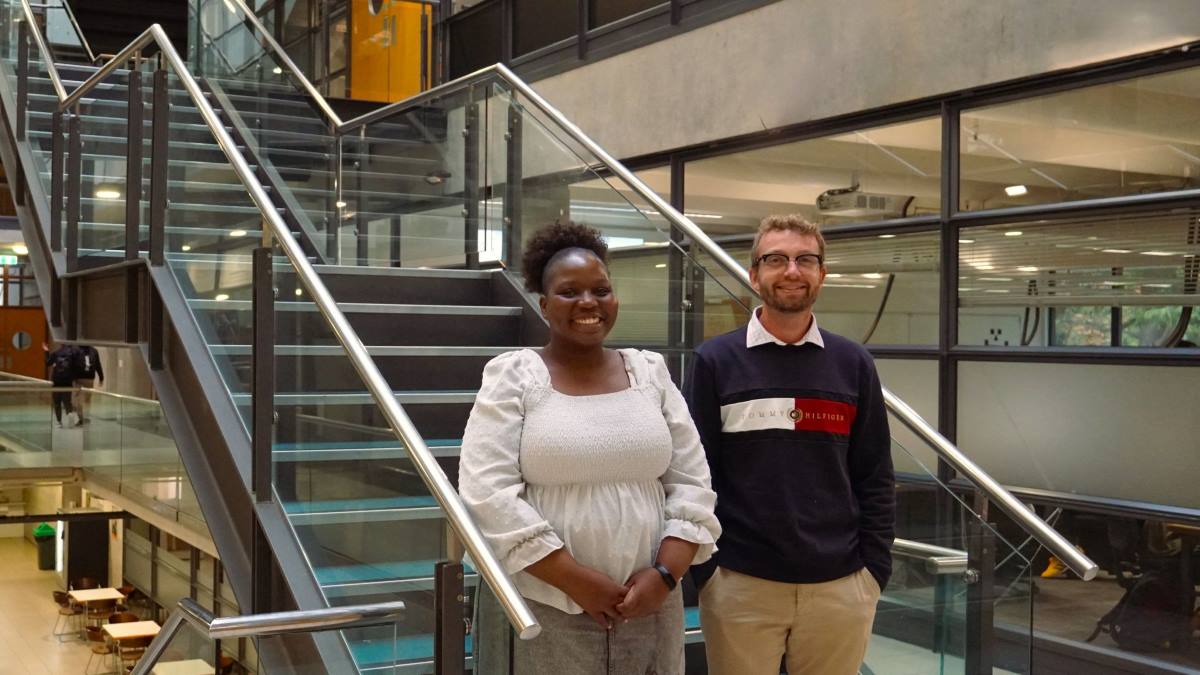
You would be hard-pressed to find two more contrasting landscapes than the warm subtropical valleys of Eswatini and the misty alpine terrains of New Zealand’s South Island. Yet it is in the academic corridors of Christchurch’s University of Canterbury (UC) that Sebenele (Sebe) Thwala, a native of Eswatini, is contributing to one of the most profound fields in modern physics: gravitational wave research.
Now in the second year of her PhD, Thwala is working alongside Dr Chris Stevens and Professor Jörg Frauendiener in the UC Applied Mathematics department, where her research is advancing our understanding of how gravitational waves—ripples in the fabric of spacetime—propagate across the cosmos. Gravitational waves, a concept first predicted by Albert Einstein in his general theory of relativity, remained a theoretical curiosity for a century until their direct detection by LIGO in 2015 confirmed their existence.
Since then, gravitational wave astronomy has become a transformative discipline, offering a new observational window into violent astrophysical events such as black hole mergers. Yet identifying the exact sources of gravitational wave signals remains an ongoing challenge. As Thwala explains, researchers often have to simulate events both forwards and backwards in time, because we detect only the final ripple here on Earth—never the cosmic collision that produced it.



“The problem is that many existing simulations simplify things too much. They truncate the far reaches of spacetime and make assumptions about what happens at large distances,” Thwala says. “But to measure energy and momentum accurately, one needs to simulate from infinity to infinity—to cover the full extent of spacetime.”

This comprehensive approach has been central to her recent paper, published in the journal Physical Review Letters. The work proposes a method to simulate gravitational wave propagation from the infinite past to the infinite future. This innovation allows for more accurate calculations of energy transfer when gravitational waves interact with massive objects such as black holes—distinguishing between energy absorbed by the black hole and energy radiated outward again.
The journal recognised Thwala’s contribution as a PRL Editors’ Suggestion, an accolade reserved for research deemed particularly insightful, well-articulated, and of exceptional impact across the physical sciences. Dr Stevens remarked that this recognition is “an extraordinary milestone for a second-year PhD student”, noting that the clarity and originality of Thwala’s work place it on an international stage of academic excellence.
Thwala’s academic path began in Eswatini and continued through South Africa, where she completed her Master’s degree. It was during this time that she connected with Dr Stevens, then also based in South Africa and seeking students with a keen interest in gravitational physics. Although the global pandemic initially delayed her plans, Thwala eventually made the move to New Zealand, seizing the opportunity to work on frontier research in numerical relativity.
Her journey reflects both geographical and disciplinary breadth, navigating transitions not only across continents but also through abstract realms of mathematical physics. Asked about her future, Thwala responds with cautious optimism: “I’m being led by where the opportunities are.”
For many aspiring scientists in Southern Africa, Thwala’s story is more than just a personal success. It signifies the growing participation of African researchers in global science, particularly in fields historically concentrated in the Global North. Through her work, she not only illuminates some of the darkest phenomena in the universe but also casts light on the expanding role of African talent in shaping 21st-century science.