Ethiopian Airlines, the renowned national flag carrier of Ethiopia, has recently made substantial additions to its fleet, securing orders for both Airbus and Boeing aircraft. In a press statement released on Wednesday, the airline confirmed its commitment to acquiring 11 Airbus A350-900s, with potential plans for an additional six from the European aircraft manufacturer.
The move signifies Ethiopian Airlines’ strategic focus on enhancing passenger experience, as highlighted by Mesfin Tasew, the airline’s Group CEO. Tasew expressed excitement about the Airbus A350-900s, emphasizing features such as the quietest cabin in its class and ambient lighting, which promise to elevate the onboard experience for travelers. Currently operating a fleet of 20 Airbus A350-900s, Ethiopian Airlines aims to further expand its capabilities by potentially adding more of these cutting-edge aircraft to its arsenal.
Founded in 1946, Ethiopian Airlines Group has grown into the largest African carrier, connecting over 130 international destinations spanning five continents. This recent aircraft acquisition aligns with the airline’s broader vision of increasing its fleet size from the current 140 to an ambitious 271 by the year 2035.




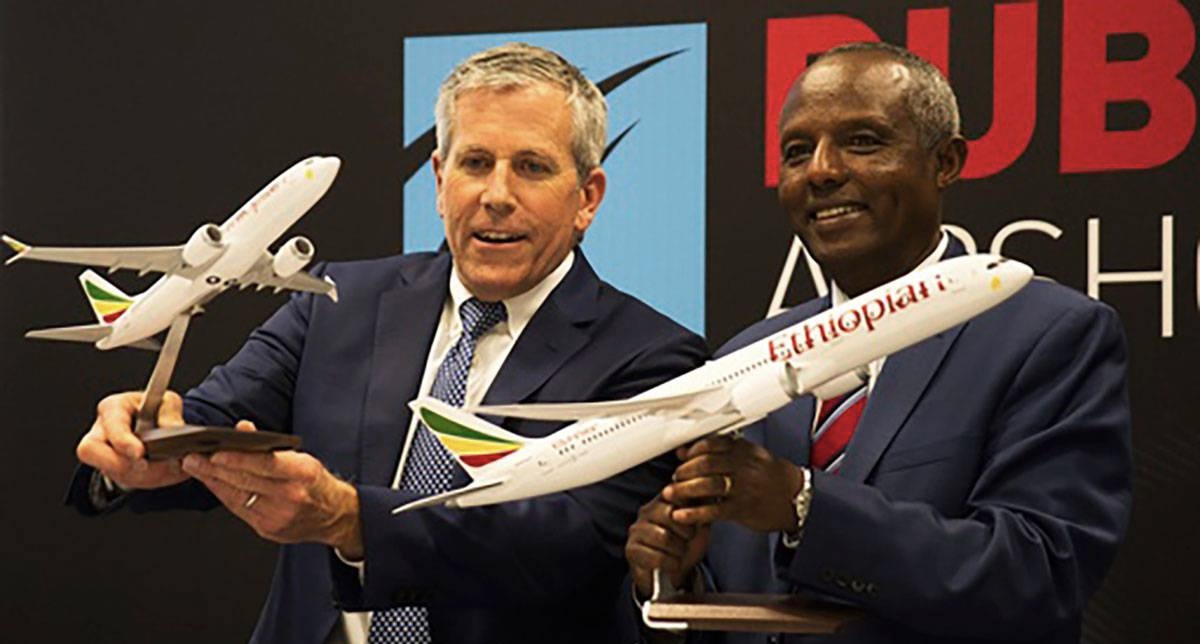
However, Ethiopian Airlines’ expansion strategy extends beyond Airbus, as evidenced by its Tuesday announcement of orders from Boeing. The airline has inked deals for 11 Boeing 787 Dreamliner and 20 Boeing 737 Max airplanes, accompanied by plans for a potential additional 36 Boeing aircraft in the future. This dual commitment to both major aircraft manufacturers underscores the carrier’s commitment to diversifying its fleet and ensuring operational flexibility.
The decision to simultaneously engage with Airbus and Boeing raises questions about the airline’s long-term procurement strategy. Industry experts note the potential benefits of a diversified fleet, including operational flexibility and negotiation leverage. However, challenges such as maintenance, training, and spare parts logistics could arise as Ethiopian Airlines manages a mixed fleet from two different manufacturers.
While the Airbus order aligns with the airline’s focus on the latest technology and passenger comfort, the Boeing selection emphasizes Ethiopian Airlines’ commitment to a diverse range of aircraft to cater to various route requirements. The Boeing 787 Dreamliner, known for its fuel efficiency and long-range capabilities, and the Boeing 737 Max, designed for shorter routes, reflect the airline’s strategic approach to meet evolving market demands.
As Ethiopian Airlines positions itself for substantial growth, questions also emerge about the environmental impact of such an expansion. The aviation industry faces increasing scrutiny for its contribution to carbon emissions, and the acquisition of a significant number of new aircraft raises concerns about the airline’s commitment to sustainability. Ethiopian Airlines may face pressure to integrate more fuel-efficient and environmentally friendly options into its fleet, aligning with global efforts to reduce the carbon footprint of the aviation sector.
Ethiopian Airlines’ recent aircraft orders mark a significant milestone in its ambitious growth plans. The dual commitment to Airbus and Boeing showcases the airline’s strategic approach to fleet diversification, passenger comfort, and operational efficiency. As the carrier aims to expand its fleet size substantially by 2035, it will need to navigate challenges related to managing a diverse range of aircraft and address growing environmental concerns. The aviation industry, as a whole, will be watching closely as Ethiopian Airlines charts its course in this dynamic and competitive landscape.