Thursday, May 14, 2026
  • Login
The Southern African Times
  • Home
  • Southern Africa
  • Business
    • African Start ups
    • African Continental Free Trade Area
  • Technology
    • Lifestyle
      • Health
      • Culture
      • Food and Drink
      • Entertainment
  • Opinion
  • Sports
  • SAT Jobs
    • Events
  • About Us
    • Advertise with Us
    • Contact Us
No Result
View All Result
  • Home
  • Southern Africa
  • Business
    • African Start ups
    • African Continental Free Trade Area
  • Technology
    • Lifestyle
      • Health
      • Culture
      • Food and Drink
      • Entertainment
  • Opinion
  • Sports
  • SAT Jobs
    • Events
  • About Us
    • Advertise with Us
    • Contact Us
No Result
View All Result
The Southern African Times
No Result
View All Result
Home Climate Change

COP26: What’s in the Glasgow Climate Pact?

by SAT Reporter
November 17, 2021
in Climate Change, Just In
0
COP26: What’s in the Glasgow Climate Pact?

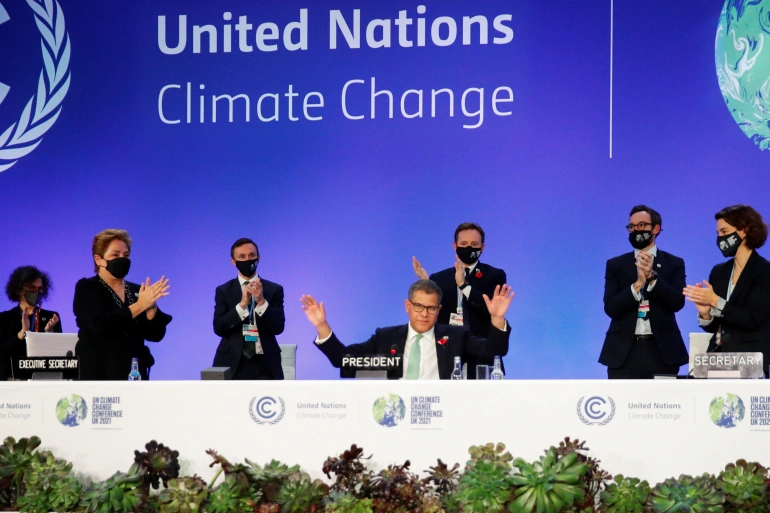
GLASGOW, (The Southern African Times) – Nearly 200 nations have agreed to adopt the Glasgow Climate Pact after more than two weeks of intense negotiations, with the United Kingdom – the host of the talks – saying the agreement will keep alive international hopes of averting the worst impacts of global warming.

Here are the biggest achievements of the deal:

Ratcheting up ambition

The agreement acknowledges that commitments made by countries so far to cut emissions of planet-heating greenhouse gases are nowhere near enough to prevent planetary warming from exceeding 1.5 degrees Celsius (2.7 degrees Fahrenheit) above pre-industrial temperatures.


ADVERTISEMENT

To attempt to solve this, it asks governments to strengthen those targets by the end of next year, rather than every five years, as previously required.

Failure to set and meet tougher emissions-cutting goals would have huge consequences. Scientists say that to go beyond a rise of 1.5C would unleash extreme sea level rises and catastrophes, including crippling droughts, monstrous storms and wildfires far worse than those the world is already suffering.

“I think today we can say with credibility that we’ve kept 1.5 (degrees Celsius) within reach,” said Alok Sharma, the president of the COP26 summit. “But its pulse is weak, and we will only survive if we keep our promises.”

Targeting fossil fuels

The pact for the first time includes language that asks countries to reduce their reliance on coal and roll back fossil fuel subsidies, moves that would target the energy sources that scientists say are the primary drivers of man-made climate change.

The wording was contentious, though.

Just before the Glasgow deal was adopted, India requested that the deal call on countries to “phase down”, instead of “phase out” unabated coal. That minor word change triggered a lot of angst in the plenary hall, but delegations agreed to the request to save the deal.

The deal’s wording on “inefficient subsidies” kept the “phase out” phrasing.

But questions remain about how to define “unabated” and “inefficient”.

Payments to poor and vulnerable nations

The deal made some headway on the demands of poor and vulnerable countries that wealthy countries responsible for most emissions pay up.

The deal, for example, “urges developed country Parties to at least double their collective provision of climate finance for adaptation to developing country Parties from 2019 levels by 2025”.

It also, for the first time, made mention of the so-called “loss and damage” in the cover section of the agreement. Loss and damage refers to the costs that some countries are already facing from climate change, and these countries have for years wanted payment to help deal with it.

Under the deal, though, developed countries have essentially just agreed to continue discussions on the topic.

Rules for global carbon markets

Negotiators also closed a deal setting rules for carbon markets, potentially unlocking trillions of dollars for protecting forests, building renewable energy facilities and other projects to combat climate change.

Companies, as well as countries with vast forest cover, had pushed for a robust deal on government-led carbon markets in Glasgow, in the hope of also legitimising the fast-growing global voluntary offset markets.

Under the accord, some measures would be implemented to ensure credits are not double-counted under national emissions targets, but bilateral trades between countries would not be taxed to help fund climate adaptation. The taxation of bilateral trades had been a core demand for less developed countries.

Side deals

There were a number of notable side deals too. The United States and the European Union spearheaded a global methane cutting initiative in which around 100 countries have promised to reduce methane emissions by 30 percent from 2020 levels by 2030.

The United States and China, the world’s two biggest carbon emitters, also announced a joint declaration to cooperate on climate change measures – a deal that reassured observers of Beijing’s intention to accelerate its efforts to combat global warming after a long quiet period.

Companies and investors also made a slew of voluntary pledges that would phase out gasoline-powered cars, decarbonize air travel, protect forests, and ensure more sustainable investing.

Previous Post

Virtual Africa Tech Festival Sets Record with 20,000 Registered Delegates

Next Post

Pfizer Signs Deal To Share Its Covid Antiviral Pill With Low Income Nations

SAT Reporter

Related Posts

Climate Change Drives Rising Health Risks in Southern Africa
Climate Change

Climate Change Drives Rising Health Risks in Southern Africa

by SAT Reporter
April 5, 2026
Green Climate Fund Approves 440 Million Dollars for African Climate Projects
Climate Change

Green Climate Fund Approves 440 Million Dollars for African Climate Projects

by SAT Reporter
March 31, 2026
South Africa’s Energy Transition Bottleneck Lies in Its Municipalities, IISD Report Finds
Climate Change

South Africa’s Energy Transition Bottleneck Lies in Its Municipalities, IISD Report Finds

by SAT Reporter
March 26, 2026
$1 Billion Boost for African Carbon Projects and Woodland Restoration
Climate Change

$1 Billion Boost for African Carbon Projects and Woodland Restoration

by SAT Reporter
January 30, 2026
UK-Backed Climate Accelerator Opens Doors for South African Green Innovators
African Start ups

UK-Backed Climate Accelerator Opens Doors for South African Green Innovators

by SAT Reporter
January 27, 2026
Next Post
Pfizer Signs Deal To Share Its Covid Antiviral Pill With Low Income Nations

Pfizer Signs Deal To Share Its Covid Antiviral Pill With Low Income Nations

Browse by Category

  • Africa AI
  • African Continental Free Trade Area
  • African Debt
  • African Start ups
  • Agriculture
  • AI Africa
  • Algeria
  • All News
  • Analysis
  • Angola
  • Arts / Culture
  • Asia
  • BOTSWANA
  • Botswana
  • BREAKING NEWS
  • BRICS
  • Burkina Faso
  • Burundi
  • Business
  • Business
  • Business Wire
  • Cameroon
  • Central Africa
  • Chad
  • China
  • Climate Change
  • Climate Changev
  • Community
  • Congo Republic
  • Conservation
  • Côte d’Ivoire
  • COVID 19
  • CRYPTOCURRENCY
  • Culture
  • Democratic Republic of Congo
  • Diplomacy
  • Eastern Africa
  • Economic Development
  • Economy
  • Education
  • Egypt
  • Elections 2024
  • Energy
  • Entertainment
  • Environment
  • Eritrea
  • Ethiopia
  • Europe
  • Fashion
  • Feature
  • Finance
  • Financial Inclusion
  • Food
  • Food and Drink
  • Foods
  • GABON
  • Ghana
  • Global
  • Global Africa
  • Guinea
  • Health
  • Immigration
  • in Southern Africa
  • International news
  • International Relations
  • Investment
  • Ivory Coast
  • Just In
  • Kenya
  • Lesotho
  • Libya
  • Life Style
  • Lifestyle
  • Literature
  • Malawi
  • Malawi
  • Mali
  • Markets
  • Mauritius
  • Middle East
  • Mining in Africa
  • Morocco
  • Mozambique
  • Namibia
  • Niger
  • niger
  • Nigeria
  • North Africa
  • North-Eastern Africa
  • Obituaries
  • Obituary
  • Opinion
  • PARTNER CONTENT
  • Politics
  • Property
  • Racism
  • Rwanda
  • Rwanda
  • SADC
  • SAT Interviews
  • SAT Investigation
  • SAT Jobs
  • Saudi Arabia
  • Senegal
  • Seychelles
  • Somaliland
  • South Africa
  • South Sudan
  • Sports
  • Startup Africa
  • STOCK EXCHANGE
  • Sudan
  • Sustainability
  • Sustainablity
  • Tanzania
  • Technology
  • Telecommunications
  • The Editorial Board
  • The Power Of She
  • Togo
  • Trade
  • Travel
  • Travel
  • Tunisia
  • Uganda
  • Uncategorized
  • Wealth
  • West Africa
  • World
  • World
  • Zambia
  • ZAMBIA
  • Zimbabwe
  • ZIMBABWE

Browse by Tags

#NewsUpdate #SouthAfrica #SouthernAfricanTimes #TheSouthernAfricanTimes AfCFTA africa African Continental Free Trade Area African development African Development Bank African economies African economy African Union Agriculture Angola Botswana Business China Climate change Cyril Ramaphosa Economic Development economic growth energy transition governance industrialisation Inflation Infrastructure Infrastructure Development International relations Investment Kenya Mozambique Namibia news Nigeria Regional Integration renewable energy Rwanda SADC South Africa Southern Africa sustainable development Tanzania United States Zambia Zimbabwe
ADVERTISEMENT

WHO WE ARE

The Southern African Times is a regional bloc digital newspaper that covers Southern African and world news. The paper also gives a nuanced analysis on news and covers a wide range of reporting which include sports, entertainment, foreign affairs, arts and culture.

Welcome Back!

Login to your account below

Forgotten Password?

Retrieve your password

Please enter your username or email address to reset your password.

Log In

  • Home
  • Southern Africa
  • Business
    • African Start ups
    • African Continental Free Trade Area
  • Technology
    • Lifestyle
      • Health
      • Culture
      • Food and Drink
      • Entertainment
  • Opinion
  • Sports
  • SAT Jobs
    • Events
  • About Us
    • Advertise with Us
    • Contact Us
Are you sure want to unlock this post?
Unlock left : 0
Are you sure want to cancel subscription?