Wednesday, May 13, 2026
  • Login
The Southern African Times
  • Home
  • Southern Africa
  • Business
    • African Start ups
    • African Continental Free Trade Area
  • Technology
    • Lifestyle
      • Health
      • Culture
      • Food and Drink
      • Entertainment
  • Opinion
  • Sports
  • SAT Jobs
    • Events
  • About Us
    • Advertise with Us
    • Contact Us
No Result
View All Result
  • Home
  • Southern Africa
  • Business
    • African Start ups
    • African Continental Free Trade Area
  • Technology
    • Lifestyle
      • Health
      • Culture
      • Food and Drink
      • Entertainment
  • Opinion
  • Sports
  • SAT Jobs
    • Events
  • About Us
    • Advertise with Us
    • Contact Us
No Result
View All Result
The Southern African Times
No Result
View All Result
Home Climate Change

CCARDESA/GCCA+ project surpasses expectations in Zimbabwe

by SAT Reporter
November 3, 2021
in Climate Change, in Southern Africa, Zimbabwe
0
CCARDESA/GCCA+ project surpasses expectations in Zimbabwe

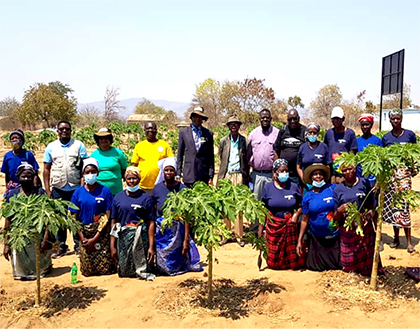
HARARE (The Southern African Times) – The Climate Smart Technology project in Rushinga district in north-eastern Zimbabwe has surpassed expectations with beneficiaries having harvested and sold their first crop.The project is being implemented by Grow a Tree Foundation, with support from the Centre for Coordination of Agricultural research and Development for Southern Africa (CCARDESA). 

It is an extension of the Global Climate Change Alliance Plus (GCCA+) programme which seeks to strengthen the capacity of SADC Member States to undertake regional and national adaptation and mitigation actions in response to the challenges caused by the effects of climate change.

The project was launched in December 2020 to mitigate the impact of COVID-19 on food and nutrition security using Climate Smart Technologies. Grow a Tree Foundation (GTF) is a partner of CCARDESA, with funding from the European Union (EU) through the Southern African Development Community (SADC), and technical support from Bembani Group.


ADVERTISEMENT

Mr Bartholomew Chataika, the project manager for CCARDESA, founded by SADC Member States to harmonise the implementation of agricultural research and development in the Region, recently visited the project on a monitoring and evaluation mission, and expressed satisfaction with the way the project is being run. 

“The project is a true model of what people can learn and integrate about climate change.  It is a clear demonstration that there was need and the people have the passion, especially after getting information that the European Union and Southern African Development Community (SADC) are coming through with assistance,” he said.

Mr Chataika said when he first visited the site of the project last year, the area was dry and degraded due to lack of water.  But the area is now flourishing with a thriving horticulture crop and fruit trees after seven boreholes were drilled to support the project. 

The water from the boreholes is being used effectively in mitigating the effects of climate change and the villagers growing vegetables and fruit trees  to address issues of hunger, income, and nutrition.

“After we went in to assist, so many organisations came on board to also assist, like the banks which came in by way of erecting a fence around the project and have also put the beneficiaries under life insurance. The model encourages other organisations to come through and assist since they found it credible and worthwhile as funds are paid directly to the service provider. One embassy is building a model village close to the project,” said Mr Chataika.

The 101 project beneficiaries have produced a lot of cabbages and tomatoes and planted a lot of trees which have started fruiting.  They sell the produce and share the proceeds, and reinvest some of the money into the project. They receive support from the Forestry Commission of Zimbabwe to plant indigenous trees and this is motivating them to find specific indigenous trees which they plant at a demonstration plot on the site as a way of preserving indigenous trees.

Plans are underway to expand the project to incorporate fish farming, poultry and goat rearing. 

Mr Chataika said project beneficiaries have understood the issue of climate change very well, and that they have been encouraged by the Government of Zimbabwe’s own climate smart agriculture project known as Pfumvudza project.  The Pfumvudza concept is based on conservation agriculture principles and helps climate-proof agricultural production, in particular the food production sub-sector.

The Rushinga project is carried out on 3.5 hectares of land, with 1,5 hectares under drip irrigation. Vegetables from the project are sold in nearby schools which have provided a ready market for the fresh produce.  Beneficiaries have been trained in agronomy and financial literacy so that they better manage the project. 

The SADC/CCARDESA COVID-19 Response project has benefitted the entire Gwangwawa village in Rushinga, which comprises over 100 households with an average of eight persons per household. Livelihood activities in the community are predominantly small-scale farming, but given the arid conditions of the area and emerging threats of climate change, the village became a prime candidate for piloting the SADC/CCARDESA COVID-19 Response project.

The project came about after the Chief Executive Officer for GTF, Mr Kudakwashe Manyanga, and his team assessed the needs of small-scale farmers in Rushinga District and realised that the community relied on drought resistant crops like small grains, tobacco, baobab fruit and maize for economic salvation. It was also observed that Gwangwawa village was experiencing environmental management issues due to a gold rush.

Alluvial gold mining, tobacco production, and deforestation for energy demands motivated GTF to plant fruit trees that will add to nutritional and economic value through the sale of produce/products and carbon sequestration. 

The mandate of GTF is premised on reforestation and therefore production of non-timber products will foster economic empowerment of communities while preserving the environment through green technology.  

The escalating threat on livelihoods, food and nutrition security due to the negative impact of COVID-19 prompted the EU to contribute US$180,000 through the GCCA+ project to mitigate the impact of COVID-19 on food and nutrition security using Climate Smart Technologies in Eswatini, Mozambique, Zambia and Zimbabwe. 

Previous Post

ZTE partners with Airtel to boost digital transformation of voice network in Africa

Next Post

Africa’s COVID-19 infections top 8.5 million

SAT Reporter

Related Posts

Botswana Braces for South Africa Fuel Shock
Botswana

Botswana Braces for South Africa Fuel Shock

by SAT Reporter
May 11, 2026
South Africa Constitutional Court Reopens Scrutiny of Ramaphosa Over Phala Phala Case
BREAKING NEWS

South Africa Constitutional Court Reopens Scrutiny of Ramaphosa Over Phala Phala Case

by SAT Reporter
May 8, 2026
Why Zimbabwe Is Returning 67 Foreign Owned Farms
in Southern Africa

Why Zimbabwe Is Returning 67 Foreign Owned Farms

by SAT Reporter
May 8, 2026
DR Congo Warns 2028 Elections Could Be Delayed if Eastern Conflict Persists
Democratic Republic of Congo

DR Congo Warns 2028 Elections Could Be Delayed if Eastern Conflict Persists

by SAT Reporter
May 8, 2026
Namibia Raises Fuel Prices as Global Oil Market Volatility Persists
Energy

Namibia Raises Fuel Prices as Global Oil Market Volatility Persists

by SAT Reporter
May 8, 2026
Next Post
Africa’s COVID-19 infections top 8.5 million

Africa's COVID-19 infections top 8.5 million

Browse by Category

  • Africa AI
  • African Continental Free Trade Area
  • African Debt
  • African Start ups
  • Agriculture
  • AI Africa
  • Algeria
  • All News
  • Analysis
  • Angola
  • Arts / Culture
  • Asia
  • Botswana
  • BOTSWANA
  • BREAKING NEWS
  • BRICS
  • Burkina Faso
  • Burundi
  • Business
  • Business
  • Business Wire
  • Cameroon
  • Central Africa
  • Chad
  • China
  • Climate Change
  • Climate Changev
  • Community
  • Congo Republic
  • Conservation
  • Côte d’Ivoire
  • COVID 19
  • CRYPTOCURRENCY
  • Culture
  • Democratic Republic of Congo
  • Diplomacy
  • Eastern Africa
  • Economic Development
  • Economy
  • Education
  • Egypt
  • Elections 2024
  • Energy
  • Entertainment
  • Environment
  • Eritrea
  • Ethiopia
  • Europe
  • Fashion
  • Feature
  • Finance
  • Financial Inclusion
  • Food
  • Food and Drink
  • Foods
  • GABON
  • Ghana
  • Global
  • Global Africa
  • Guinea
  • Health
  • Immigration
  • in Southern Africa
  • International news
  • International Relations
  • Investment
  • Ivory Coast
  • Just In
  • Kenya
  • Lesotho
  • Libya
  • Life Style
  • Lifestyle
  • Literature
  • Malawi
  • Malawi
  • Mali
  • Markets
  • Mauritius
  • Middle East
  • Mining in Africa
  • Morocco
  • Mozambique
  • Namibia
  • Niger
  • niger
  • Nigeria
  • North Africa
  • North-Eastern Africa
  • Obituaries
  • Obituary
  • Opinion
  • PARTNER CONTENT
  • Politics
  • Property
  • Racism
  • Rwanda
  • Rwanda
  • SADC
  • SAT Interviews
  • SAT Investigation
  • SAT Jobs
  • Saudi Arabia
  • Senegal
  • Seychelles
  • Somaliland
  • South Africa
  • South Sudan
  • Sports
  • Startup Africa
  • STOCK EXCHANGE
  • Sudan
  • Sustainability
  • Sustainablity
  • Tanzania
  • Technology
  • Telecommunications
  • The Editorial Board
  • The Power Of She
  • Togo
  • Trade
  • Travel
  • Travel
  • Tunisia
  • Uganda
  • Uncategorized
  • Wealth
  • West Africa
  • World
  • World
  • ZAMBIA
  • Zambia
  • Zimbabwe
  • ZIMBABWE

Browse by Tags

#NewsUpdate #SouthAfrica #SouthernAfricanTimes #TheSouthernAfricanTimes AfCFTA africa African Continental Free Trade Area African development African Development Bank African economies African economy African Union Agriculture Angola Botswana Business China Climate change Cyril Ramaphosa Economic Development economic growth energy transition fiscal policy industrialisation Inflation Infrastructure Infrastructure Development International relations Investment Kenya Mozambique Namibia news Nigeria Regional Integration renewable energy Rwanda SADC South Africa Southern Africa sustainable development Tanzania United States Zambia Zimbabwe
ADVERTISEMENT

WHO WE ARE

The Southern African Times is a regional bloc digital newspaper that covers Southern African and world news. The paper also gives a nuanced analysis on news and covers a wide range of reporting which include sports, entertainment, foreign affairs, arts and culture.

Welcome Back!

Login to your account below

Forgotten Password?

Retrieve your password

Please enter your username or email address to reset your password.

Log In

  • Home
  • Southern Africa
  • Business
    • African Start ups
    • African Continental Free Trade Area
  • Technology
    • Lifestyle
      • Health
      • Culture
      • Food and Drink
      • Entertainment
  • Opinion
  • Sports
  • SAT Jobs
    • Events
  • About Us
    • Advertise with Us
    • Contact Us
Are you sure want to unlock this post?
Unlock left : 0
Are you sure want to cancel subscription?