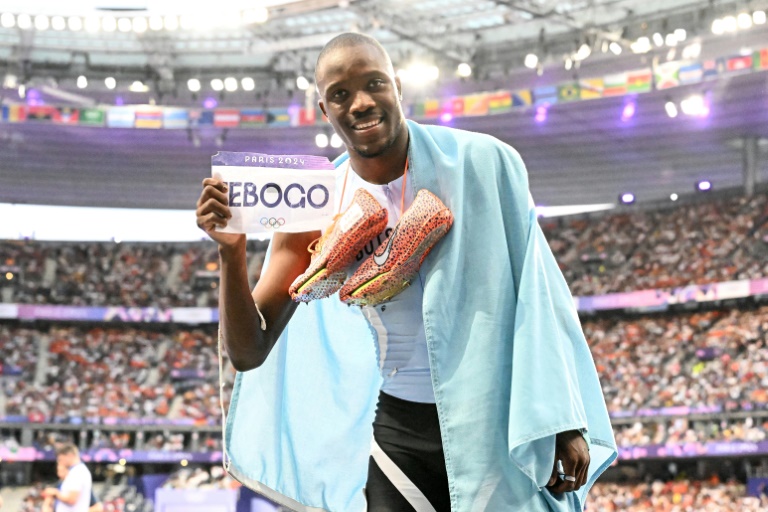
Letsile Tebogo has made history by becoming the first African to win the men’s 200 metres at the Olympic Games, delivering an extraordinary performance at the Stade de France in Paris on Thursday.
The 21-year-old sprinter from Botswana produced a breathtaking run, finishing with a time of 19.46 seconds to set a new African record. Tebogo’s victory is a landmark achievement in track and field, marking him as the first African to secure the gold medal in this event. Prior to this, the only African athlete to earn a medal in the 200m was Namibian Frankie Fredericks, who claimed two silver medals in the event at the 1996 Atlanta Olympics.
Tebogo’s triumph in Paris was especially remarkable as it came against strong competition. Pre-race favourite Noah Lyles, the reigning 100m champion, was left trailing in third place, underscoring the magnitude of Tebogo’s victory. This win not only highlights Tebogo’s individual talent but also signals a shift in the global perception of African sprinters, who have traditionally been more associated with long-distance running.




In his victory speech, Tebogo expressed his pride in representing not only Botswana but the entire African continent. “Africans were known for the long distance, marathon, and quarter mile,” Tebogo remarked earlier this year in an interview with NBC. “I just wanted to change that role and make sure that (people know) Africans can be sprinters too.” His words reflect a broader ambition to redefine the role of African athletes on the world stage, challenging stereotypes and proving that excellence in sprinting is equally within reach.
Tebogo’s journey to Olympic glory has been marked by perseverance and personal sacrifice. His rise to the top of the sprinting world comes after a series of significant milestones. Notably, he became the first male Botswanan athlete to win medals at the World Championships last year and set a new African record in the 200m, breaking a record that had stood for over 27 years. These achievements were part of a larger narrative of dedication and hard work that culminated in his historic Olympic win.
However, Tebogo’s victory is tinged with personal sorrow. His mother, Seratiwa Tebogo, who had been a constant source of support and encouragement, passed away in May. Her death was a profound loss for the sprinter, who described her as his “rock.” She had been an unwavering presence at his races, travelling to watch him compete and celebrating his successes. Her support extended beyond the track; she had made personal sacrifices to ensure that her son could pursue his athletic dreams. “Putting my interests on hold and emptying my savings just to be with him,” she had said in an interview, underscoring the depth of her commitment.
Tebogo honoured his mother by inscribing her date of birth on his racing spikes, a touching tribute to her enduring influence. Her passing left a significant void in his life, and Tebogo has openly acknowledged the emotional impact of her absence. “It doesn’t even feel like my birthday anymore. I don’t think I will enjoy it anymore,” he shared on social media, reflecting the depth of his grief.
Despite the personal challenges, Tebogo’s performance in Paris serves as a powerful testament to his resilience and determination. His mother’s legacy continues to inspire him, and her memory will forever be a part of his athletic journey. The gold medal not only represents a personal achievement for Tebogo but also a significant moment for African athletics, demonstrating that African athletes can excel in sprinting as well as in distance running.
Tebogo’s story is a poignant reminder of the power of dedication, familial support, and the drive to overcome adversity. His historic Olympic victory is a milestone not just for Botswana but for the entire African continent, marking a new era in sprinting and inspiring future generations of athletes. As he celebrates this achievement, Tebogo’s focus remains on honouring his mother’s memory and continuing to push the boundaries of what is possible in athletics.