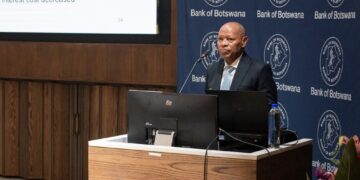
Botswana’s vice president and finance minister, Ndaba Nkosinathi Gaolathe, will lead a delegation to open trading at the London Stock Exchange on 18 September, as the government seeks to widen its investor base beyond the diamond revenues that have long dominated its economy.
The Market Open Ceremony, marking Botswana Day in London, is being hosted by the Government of Botswana and the Botswana Stock Exchange, in partnership with the London Stock Exchange and Standard Bank, under the theme “Botswana: Financing the Next Chapter of Growth.” Gaolathe, who has held the vice presidency and finance portfolio since November 2024 under President Duma Boko, is expected to use the platform to press the case for foreign and institutional capital in support of the country’s National Development Plan 12, a five-year, roughly 388 billion pula, or $27 billion, framework running to 2030.
The plan, approved by parliament as the vehicle for Botswana’s Economic Transformation Programme, targets nine priority sectors, including mining and energy, manufacturing, agriculture, tourism, information and communication technology, infrastructure, education, health and financial services, with the stated goal of moving Botswana from upper-middle-income to high-income status by 2036. Diamonds have historically accounted for more than 80 percent of the country’s export earnings, according to the Bank of Botswana, leaving successive governments exposed to swings in global demand for the gemstone. The Southern African Times has previously reported on the plan’s design and sectoral targets in its coverage of Botswana’s economic transformation agenda.



Following the market open, Gaolathe is scheduled to take part in a fireside discussion on Botswana’s investment case, expected to cover the country’s political stability, the depth of its financial services sector, its sustainability commitments and specific opportunities tied to national development priorities. Later sessions on the day’s agenda are set to focus on capital market connectivity, including the Botswana Stock Exchange’s plans to expand its international linkages and give listed companies greater access to global investors.

The visit places Botswana alongside a growing list of African governments turning to London for financing outside traditional donor and multilateral channels. Angola’s finance ministry led a comparable delegation to the London Stock Exchange earlier this month to open its own investment forum. Analysts tracking the trend say such market-open events function less as one-off publicity moments than as recurring touchpoints in a longer effort by African finance ministries to normalise direct engagement with international capital markets, on commercial terms rather than concessional ones.
Whether the ambitions set out in London translate into measurable capital flows into Botswana’s infrastructure, private sector and diversification agenda will depend on execution over the coming years, and on how NDP 12’s fiscal targets, including a projected budget deficit of 2.6 to 2.9 percent of GDP, hold up against tighter global financing conditions. For now, Botswana Day gives Gaborone a formal platform to argue that its transformation plan is grounded in more than a decade of fiscal management, and to test that argument against the scrutiny of institutional investors.