Albaddad Holding, a group based in the United Arab Emirates specialising in modular construction and large scale event infrastructure, has announced a 1.9 billion dollar development in Botswana that seeks to reposition Gaborone within regional trade, investment and business tourism networks.
The initiative, named New Botswana City, is being developed in partnership with the Botswana Development Corporation Botswana Development Corporation, the government owned investment arm mandated to support national industrialisation and economic diversification. According to the developers, the project spans approximately 1,240,000 square metres and will be delivered in three phases, combining residential, commercial, hospitality and events infrastructure within a single integrated urban framework.
Albaddad Holding Albaddad Holding stated that the development is intended to function as a long term economic platform rather than a conventional real estate project, with a focus on facilitating trade flows, exhibitions, conferences and tourism activity. The masterplan includes 51 residential towers arranged across 17 complexes, 18 commercial and office buildings distributed across six zones, five hotels designed for international visitors, and a central boulevard featuring retail, dining and entertainment spaces.



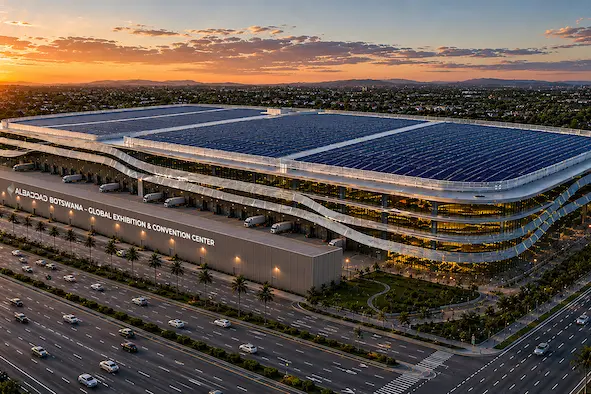
At the centre of the first phase is the Albaddad Botswana Global Exhibition and Convention Centre, a facility covering 124,000 square metres and valued at 292 million dollars. Developers describe it as one of the largest planned venues of its kind on the continent, designed to host trade fairs, conferences and sector specific exhibitions. The centre is expected to serve as an anchor for broader economic activity by attracting business tourism and supporting sectors such as hospitality, transport, retail and professional services.

Construction began following a ceremonial groundbreaking in Gaborone attended by President Duma Gideon Boko, alongside representatives from the United Arab Emirates diplomatic mission and senior officials from the Botswana Development Corporation. In remarks during the launch, President Boko emphasised that the long term measure of such developments would lie in their ability to generate sustainable national value, local participation and alignment with Botswana’s development priorities.
From the perspective of Albaddad leadership, the project is positioned as part of a broader strategy to extend the company’s footprint across African growth markets, where urbanisation and infrastructure demand continue to shape investment flows. The group’s chairmanship has described the initiative as an attempt to build environments that integrate living, working and commercial activity, while enabling international capital participation within structured development frameworks.
Analysts of regional development trends note that large scale projects of this nature often carry both opportunity and complexity. While they can contribute to job creation and infrastructure expansion, their long term impact depends on governance structures, supply chain localisation, skills transfer and the degree to which domestic enterprises are integrated into construction and operational phases.
In this case, developers estimate that the completed development could generate between 25,000 and 37,500 direct and indirect employment opportunities across construction, services and long term operations. However, such projections remain contingent on phased delivery timelines, financing conditions and sustained demand for large scale events and commercial occupancy.
The New Botswana City concept reflects a wider pattern of cross regional investment between the Gulf and African economies, particularly in infrastructure, logistics and urban development. It also raises broader questions about how African cities balance foreign led capital inflows with domestic planning priorities, spatial equity and long term urban resilience.
As the project progresses, attention is likely to focus on implementation milestones, regulatory coordination and the extent to which local businesses and labour markets are embedded within its value chain. For Botswana, the initiative represents both an economic opportunity and a test of how large scale international partnerships can be aligned with national development objectives in a manner that is inclusive and sustainable.