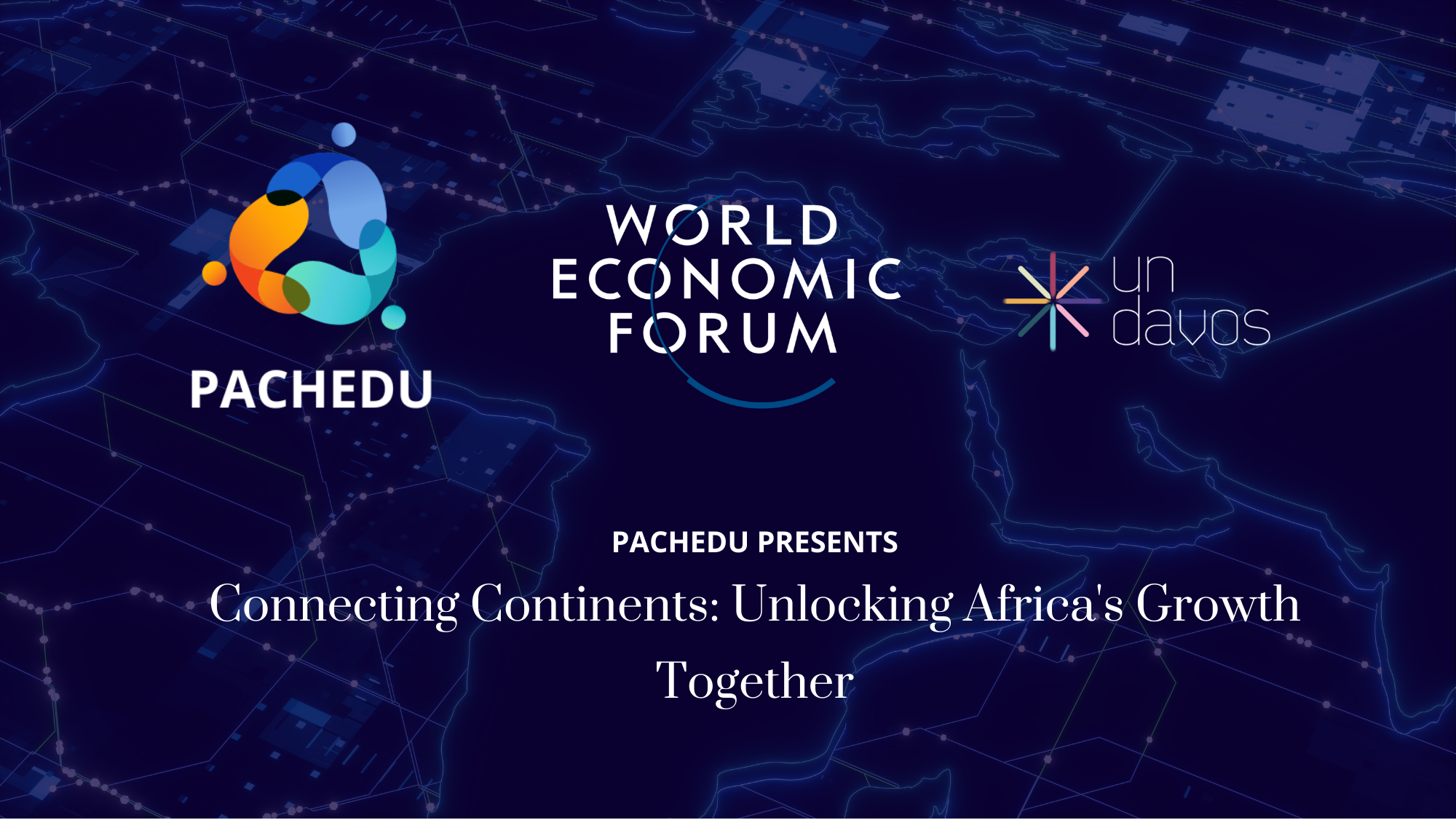
When business leaders, investors, policymakers and entrepreneurs gather in Davos on 21 January 2026, one African led platform hopes to shift how the continent is understood and engaged. Pachedu, a global connection and collaboration initiative rooted in Africa but reaching far beyond it, will host its first event on the margins of the World Economic Forum. The aim is direct and ambitious: to bring Africans on the continent, Africans in the diaspora and global allies into one ecosystem focused on building sustainable, impact driven growth across Africa.
There is a quiet realisation that many people who leave home eventually come to understand. Identity is not fixed. It shifts with the places we live, the languages we speak and the experiences we collect. Every new environment leaves its mark. For Africans who travel abroad, that awareness can sharpen rather than fade. Distance clarifies belonging. Trevor Noah has often spoken about how language, culture and environment shape identity, and that truth becomes unmistakable once home is no longer close at hand. You learn which parts of you are deeply rooted and which were formed by circumstance. It is freeing and unsettling in equal measure.
That sense of movement and multiplicity defines much of the African experience today. Millions of Africans live and work abroad, gaining skills, capital and perspective. At the same time, profound change is unfolding across the continent itself. Africa is not standing still, even if global narratives often suggest otherwise. International media still leans heavily on stories of crisis, conflict and dependency, leaving little room for the complexity and momentum that exist on the ground.



From the vantage point of the diaspora, and increasingly from within Africa itself, a different picture is visible. Africans are building companies, institutions and networks that reflect confidence rather than extraction. They are creating solutions for local markets with global relevance. They are asserting ownership of their futures rather than waiting for permission or rescue.


That shift becomes clearer when attention is directed deliberately. Biasing a social media feed towards African success stories reveals a continent in motion. Cassava Technologies, founded by Zimbabwean entrepreneur Strive Masiyiwa, has partnered with Nvidia to develop Africa’s first artificial intelligence factory, placing the continent firmly within the global AI economy. Flutterwave, the Nigerian fintech firm, has transformed digital payments across Africa, processing billions of dollars in transactions and proving that global scale is possible from Lagos. South Africa’s Tyme Group has grown into a major digital bank serving millions of customers, attracting international capital while building inclusive financial infrastructure. Andela has connected tens of thousands of African software developers to leading global companies, turning African human capital into a globally competitive force.
These are not isolated stories. Africa is currently home to more than 120,000 millionaires, a figure projected to rise sharply by 2035. The digital economy alone is expected to add roughly 180 billion dollars to GDP and create millions of jobs within the next few years. What is emerging is not simply growth, but the foundations of long term transformation.
Zimbabwe offers a case study in both ambition and complexity. In 2018, President Emmerson Mnangagwa arrived in Davos with a clear message: Zimbabwe was open for business. Foreign direct investment rose to 744 million dollars that year, a notable increase even if it fell short of government projections. Progress since then has been uneven. Yet in 2025, Nigerian industrialist Aliko Dangote committed one billion dollars to Zimbabwean infrastructure. The symbolism mattered. Africans are increasingly investing in Africa, not out of sentiment, but strategy.
This context matters for Pachedu. The platform was born from a simple observation. Africa’s greatest strength may be its people, but they are often fragmented. Founders, investors, policymakers, creatives and experts are scattered across continents, frequently working in isolation despite sharing the same objective of advancing Africa’s development through business, innovation and investment.
Pachedu, which means together with shared purpose in Shona, seeks to change that dynamic. It is not designed exclusively for the diaspora, nor solely for those on the continent. Its ambition is broader. It aims to convene a global ecosystem that includes Africans at home, Africans abroad and allies who are genuinely committed to Africa’s long term prosperity. Businesses, institutional investors, development finance actors, policymakers and individuals all have a role to play.

The platform functions as connective infrastructure. It identifies shared intent and translates it into collaboration. Where networks have traditionally been siloed by geography, sector or background, Pachedu works to bring them into alignment. The goal is not visibility for its own sake, but impact that compounds over time.
That emphasis reflects the backgrounds of its founders, who come from sustainability, ESG and long term investment disciplines. Growth, in this vision, is not extractive or short term. It is regenerative. It is measured not only in financial return, but in resilience, institutional capacity and intergenerational benefit. Pachedu positions itself at the intersection of capital, ideas and purpose, where impact is designed rather than incidental.
The decision to launch at the World Economic Forum is deliberate. Davos remains one of the few spaces where heads of state, multinational executives, investors and civil society leaders converge in one place. For Africa, visibility in such spaces has often been symbolic rather than substantive. Pachedu’s intervention is intended to move beyond rhetoric and into relationship building that leads to concrete outcomes.
This moment arrives amid a wider global recalibration. As traditional aid flows face uncertainty and geopolitical alliances shift, African leaders and institutions are increasingly looking inward for solutions. When the United States reduced certain aid commitments, Afreximbank’s chief executive George Elombi noted that Africa was being pushed to rely more on itself. That need not be a weakness. The African Continental Free Trade Area, covering 55 countries and a combined GDP of 3.4 trillion dollars, provides a structural foundation for intra African trade and cooperation on an unprecedented scale.
Against that backdrop, platforms that prioritise connection and trust become essential. Markets do not integrate on paper alone. They require relationships, shared standards and aligned incentives. Pachedu positions itself as a facilitator of that human infrastructure.
The call to action at the heart of the initiative is straightforward. Africa does not lack talent, capital or ideas. What it has lacked is coherence. The opportunity now is to move from fragmented effort to coordinated action. That requires Africans and non Africans alike to engage differently. Allies are not peripheral to this vision. When aligned around impact and accountability, they become partners rather than patrons.
By 2050, one in every four people on the planet will be African. This is not merely a demographic statistic. It represents a profound shift in labour markets, consumption patterns, innovation and cultural influence. Ignoring Africa is not only unjustified, it is strategically irrational.
Pachedu’s upcoming gathering in Davos is not presented as a solution in itself. It is an invitation. An invitation to investors to look beyond short term risk and towards long term value. An invitation to entrepreneurs to collaborate across borders. An invitation to policymakers to engage with private sector actors committed to sustainable outcomes. And an invitation to allies to participate in Africa’s future with humility, clarity and purpose.

The future being imagined is not one where Africa waits to be discovered or developed by others. It is one where Africans, together with committed global partners, build systems that endure. The work is already underway. What remains is to connect it.