

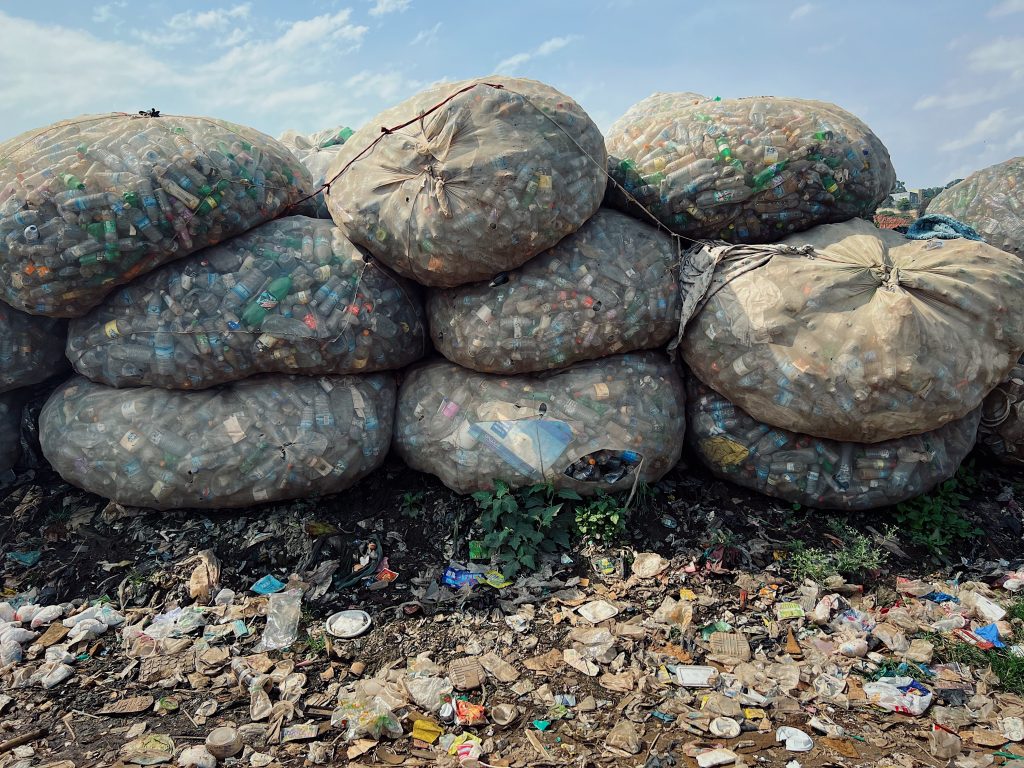
Plastic pollution is a growing global menace. Between 2010 and 2020, the global production of plastics increased from 270 million tonnes to 367 million tonnes. Every year, more than 12 million tonnes of plastics end up in the world’s oceans, with severe consequences for marine life. When macro plastics degrade into micro-plastics, they easily contaminate the food chain and pose significant threats to human health via inhalation and ingestion.
By 2030, plastic waste is expected to double to 165 million tonnes in African countries. Most of this will be in Egypt, Nigeria, South Africa, Algeria, Morocco and Tunisia.
A significant proportion of the plastic that ends up on African shores is produced in developed, industrialised countries. By 2010, it was estimated that close to 4.4 million tonnes of mismanaged plastic waste was in oceans and seas off the coast of Africa every year. A 2022 estimate has put this number at 17 million tonnes.



Growing numbers of NGOs and innovators across the continent are responding to the challenge. They are developing digital solutions to reduce plastic waste generation, and promoting reuse and recyling of plastic products. Increasingly, African tech hubs are incorporating environmental sustainability in their business models.
In our recent paper, we highlight ongoing efforts and innovations in what is called the plastic value chain. This comprises four phases, from the design of plastic products to manufacture, use, and end of life.
We found a number of initiatives that are transforming the plastic value chain into a smart, innovative and sustainable network. Most aim to improve plastic identification, collection, transport, sorting, processing and reuse. Some focus on the earlier phases: design and production of plastic products.
A whole value chain approach to the circular plastic economy is very important. While the majority of plastic waste management activities tend to focus on the use and end-of-life phases, more attention needs to be given to design and manufacture. This is where the problem of plastic waste begins.
Worldwide, attention is turning to designing simpler and standardised products that are easier to recycle and reuse.
Innovators cracking the code

A Nigerian software company, Wecyclers, operates a rewards-for-recycling platform. It offers incentives to individuals and households in low-income communities to make money and capture value from recyclable plastic waste.
Via the platform, waste collectors are connected to a fleet of locally assembled waste cargo vehicles. They use these to collect waste from subscribing households. These households are also rewarded according to the quantity of waste collected from them.
The collected waste is deposited in designated locations in the Lagos metropolis, to be collected in bulk by recyclers. This provides materials to manufacturers who turn it into new items like tissue paper, stuffing for bedding, plastic furniture, aluminium sheets and nylon bags.
The impact is significant on many levels. Firstly, by linking waste generating households with waste collectors in their neighbourhoods, the Wecycler model simplifies the logistics of collection and sorting at source, at practically no cost to households. Secondly, it enables households not only to mitigate the public health risks associated with plastic waste accumulation and mismanagement, but also to generate income. Finally, it elongates the end-of-life phase in the plastic value chain through recycling and potential reuse.
In Uganda, Yo Waste, a technology start-up, has developed a mobile, cloud-based solution that connects waste generators to the nearest waste haulers in their community. Yo Waste improves the efficiency of scheduling and waste collection. It also helps waste collection companies measure the productivity of their trucks, and gives recyclers easier access to the plastic waste.
In Zambia, Recyclebot is connecting waste sellers to waste buyers via a crowdsourcing platform that aggregates waste by type and location. In effect, the plastic waste producers dispose of their waste for free, and waste buyers overcome the cost of separation, transfer and storage.
While these are promising innovations, the main challenge is scaling. This is slow on the continent. Start-ups in the recycling industry face additional challenges like inadequate funding and an under-developed plastic market that offers limited opportunities for growth and income generation.
A significant proportion of the funds accessed by start-ups is provided as grants from international and local organisations. Pure business investments are rare, and policy interventions are way behind the curve.
What can be done

To accelerate the transition to a circular plastic economy, stakeholders from across a spectrum of organisations must work together. They include NGOs, cooperatives, think tanks and community groups. The current approach to tackle plastic waste on the continent remains scattered and inadequately co-ordinated. While efforts are being made to develop new ecosystems in many countries, key stakeholders are often missing.
In particular, African governments have a key role to play. They need to commit more to strategic investment in infrastructure, incentives and support for start-ups. African countries also need policy interventions to grow the market for circular plastic products at national and continent-wide levels.
In another study, we argued that innovators must tailor their strategies to create innovations that are functional and easy to use. This will make it easier for ordinary consumers and the general public to accept them. In turn it will help change habits of consumption and expand the market for circular plastic products.
Digital innovators, as early adopters, are critical for driving changes in the way the plastics economy works across the continent. Their innovations are also leading to knowledge exchange and cross-sectoral collaborations.
However, they also face significant institutional challenges and infrastructural limitations that are slowing down the pace of progress. By working together and pooling resources, stakeholders can achieve an impact that is much greater than the sum of their individual initiatives and contributions towards a circular plastic economy in Africa.
Seun Kolade, Associate professor, De Montfort University and Muyiwa Oyinlola, Associate Professor


