

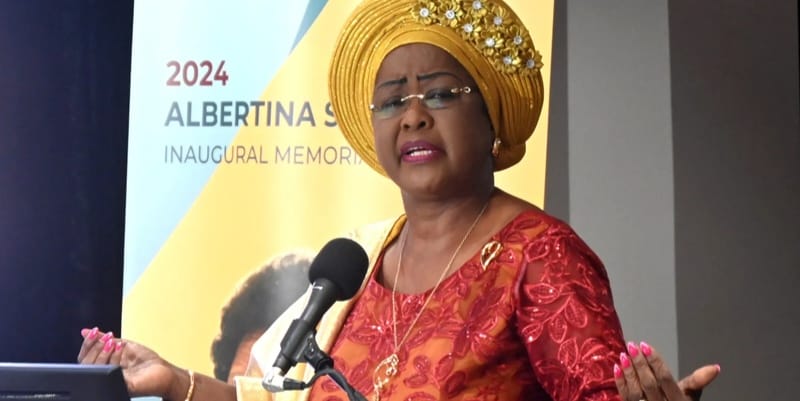
On October 31, 2024, the University of Cape Town’s Graduate School of Business hosted the inaugural Albertina Sisulu Memorial Lecture in collaboration with the Sisulu Foundation for Social Justice.
The event honored the legacy of Albertina Sisulu, a prominent anti-apartheid activist and nurse, whose life was defined by an unwavering commitment to social justice and human rights. The keynote address was delivered by Her Excellency Ambassador Arikana Chihombori-Quao, a Zimbabwean-born medical doctor, activist, and former African Union Ambassador to the United States. Her speech, titled The Sisulu Legacy and the Future of Socio-Economic Justice in Africa, served as both a tribute and a call to action, emphasizing the need to continue Sisulu’s work in tackling socio-economic inequalities across the continent.
In an electrifying and unapologetic delivery, Dr. Arikana Chihombori-Quao stood before her audience not only as a speaker but as a voice embodying the spiritual intensity and wisdom of an African oracle. A fierce advocate for Pan-African unity, Dr. Chihombori-Quao has gained renown for her critiques of neo-colonial structures that still attempt to constrain Africa’s independence. On this night, she rose as a revolutionary, a healer, and a relentless advocate for the African continent’s self-determination, calling upon Africa to confront its inherited trauma, systemic oppression, and internalized colonial mentality. Her words demanded that Africa reclaim what is rightfully its own and pushed the audience into a shared urgency for change.



Colonial Trauma as a Persistent Wound
Dr. Chihombori-Quao began her address by describing what she called a “sickness” within the African spirit—a deep psychological wound inflicted by colonial brutality and perpetuated by systems that keep the continent dependent. She illustrated the trauma using powerful imagery: during the colonial era, Africans were tied between two horses and torn apart as a demonstration of what could happen to those who resisted. “They wanted to break more than our bodies,” she said. “They sought to tear apart our spirit.” For Dr. Chihombori-Quao, this was not a story confined to history but a wound that still bleeds today. Colonialism, she argued, did not merely seize African land and resources; it fractured African identity, shattered community bonds, and embedded a fear that has echoed through generations.
She did not mince her words as she reiterated that this trauma continues to shape Africa’s psyche, holding Africans back from claiming their rightful autonomy. She argued that this fear, this “sickness,” persists as a weapon used to ensure complacency and passivity, keeping African nations subjugated and internally divided.
Internalized Whiteness and Cultural Alienation
One of the symptoms of this sickness, Dr. Chihombori-Quao said, was internalized whiteness. Her words echoed Frantz Fanon’s quote from Black Skin, White Masks: “The black man wants to be white. The white man slaves to reach a human level… For the black man, there is only one destiny. And it is white.” This movement toward “whiteness,” she argued, is a choice that some Africans have made to align with Western ideology and to distance themselves from anything that reflects their African roots—including teaching their children indigenous languages and prioritizing “the Queen’s English.” For her, this was not merely a misstep but a betrayal. “Why do we choose this?” she asked, challenging the internalized colonial mentality that drives individuals and nations alike to seek Western validation instead of embracing their heritage.
“It’s not enough to resist colonial rule if we invite it into our minds.”
This voluntary assimilation, she argued, serves as a dangerous form of complicity. “It’s not enough to resist colonial rule if we invite it into our minds,” she contended. Her words urged Africans to reject this pursuit of Western validation and to stand proudly within their own culture. Dr. Chihombori-Quao held up Burkina Faso, Niger, and Mali as examples—nations actively resisting foreign control. “Do what Burkina Faso and Niger are doing,” she urged, her words a call to Africans everywhere to awaken to their agency, their autonomy, and their rightful self-determination.
Honoring African Voices
Dr. Chihombori-Quao made it clear that she was not alone in her mission to reawaken African pride and agency; she stood alongside a legacy of African leaders who have long championed these ideals. She recognized Dr. Allan Boesak, a revered theologian and anti-apartheid activist, for his lifelong commitment to justice, calling him a warrior for human dignity. She honored Minister Lindiwe Sisulu, daughter of Walter and Albertina Sisulu, noting her family’s profound contribution to the liberation struggle and her own role in continuing that legacy. Dr. Chihombori-Quao’s words resonated with respect for Minister Sisulu’s dedication to governance and public service, acknowledging her as a symbol of South Africa’s ongoing journey toward equality.
She also extended profound gratitude to former President Jacob Zuma, who was present on the podium at the lecture, for his role in the African struggle for freedom. Despite the controversies and media attacks that have surrounded him, she highlighted his contributions to the continent’s liberation and his significance as a leader in Africa’s fight for self-determination. These figures, she noted, are often marginalized and misrepresented by Western media, which strives to erase the voices that challenge its control. She pointedly noted the absence of mainstream media at this gathering as evidence of a liberal hegemony that attempts to silence leaders like President Zuma and Minister Sisulu, creating a narrative that aligns with Western interests.
Global NGOs and Neo-Colonialism
Dr. Chihombori-Quao’s delivery did not stop with political figures and historical trauma; she addressed the role of non-governmental organizations as neocolonial agents in the modern era. “The NGOs come with their dollars, with their ‘help,’ but it is never help,” she declared. Her words exposed the insidious nature of foreign aid, which reinscribes dependency rather than empowering true African autonomy. “It’s a new form of colonialism,” she stated. “They act as though we are incapable, when it is they who are there to keep us from rising.” Her analysis was a scathing indictment of these organizations that operate under a guise of goodwill but, in reality, hold Africa’s future hostage, limiting true progress and independence.
“It’s a new form of colonialism.”
For Dr. Chihombori-Quao, NGOs serve to maintain Africa’s subservience by masking exploitation with benevolent language, presenting Western intervention as necessary while undermining African self-sufficiency.
Fear and Division as Tools of Control
Dr. Chihombori-Quao returned to the theme of fear, dissecting it as an inherited colonial weapon that stifles African assertiveness. She insisted that this fear is not inherent but an emotional scar left by colonial oppression. “Fear was their tool to enslave us, and it remains their weapon to control us,” she explained, urging Africans to recognize this psychological manipulation. She argued that this fear binds Africans to systems that do not serve them, creating a hollow peace that leaves Africa vulnerable to exploitation.

Her solution was as daring as her critique: she called for a revolutionary reclamation of African autonomy, a bold self-determination that rejects Western influence altogether. Drawing from the examples of Burkina Faso and Niger, she called upon Africans to throw off the remnants of colonial rule and to resist the forces that still seek to dictate Africa’s economy and politics, asking why this has not been done already.
Unity and Self-Determination
At the heart of Dr. Chihombori-Quao’s address was her vision of a united Africa, a continent where borders are bridges and natural resources enrich local communities instead of foreign corporations. She spoke of an Africa where cultural heritage, languages, and identities are not diluted to align with Western ideals but preserved as sources of strength. For her, unity was not simply a solution but a radical reimagining of Africa’s destiny.

She argued that African nations must decolonize their minds as well as their economies, freeing themselves from the internalized oppression that keeps them bound to Western powers. Her vision extended to the African diaspora, whom she urged to reclaim the narrative of African resilience. “The diaspora must take back our narrative,” she declared, calling upon Africans worldwide to reinvest their talents, skills, and wealth into Africa’s future.
Women as Leaders of the Revolution
Dr. Chihombori-Quao’s parting words were a bold proposition: perhaps it is time for African men to step aside and allow women to lead the revolution. “African women are more forthright,” she stated. “More determined. Men, you have an inbuilt diplomacy that holds up the process. Women, when we are enraged, will not stop at anything.” She proposed that African women possess an unyielding resolve essential for reclaiming Africa’s dignity and autonomy, suggesting that women’s leadership could cut through the compromises that often hold back revolutionary action.
In her closing remarks, she even suggested that, like the women of Liberia once did, African women deny men access to their bodies until they are willing to take back what is rightfully Africa’s. Her words echoed the spirit of women’s resistance across history, calling for a radical shift in leadership that draws upon the resilience and fortitude of African women.
Towards Collective Renewal
Throughout her address, Dr. Chihombori-Quao grounded her call to action in a legacy of African resistance, honoring the Sisulu family, especially Albertina Sisulu, as symbols of the courage and leadership that Africa needs now. She paid tribute to Dr. Allan Boesak and former President Jacob Zuma for their lifelong dedication to justice, despite the media
Gillian Schutte is a film-maker, and a well-known social justice and race-justice activist and public intellectual. The views expressed do not necessarily reflect the views od The Southern African Times.


