

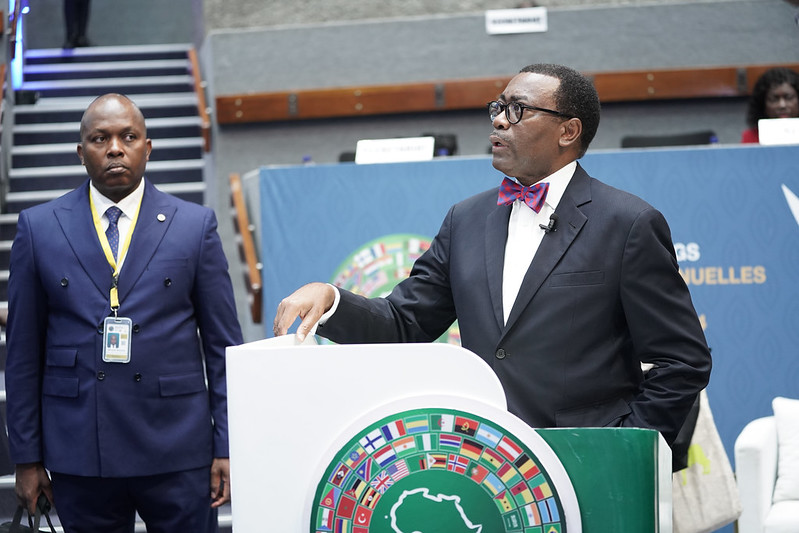



“We need to be nimble, faster, and responsive… Only then can the African Development Bank Group really help transform Africa through the private sector,” Adesina declared to the Bank Group’s Boards of Governors. He emphasized a critical shift from a predominantly public sector-driven financial institution to one that is significantly driven by the private sector. This transformation, according to Adesina, will involve adapting instruments and processes to better suit private sector engagement.
Adesina pointed out that the world is currently grappling with multiple challenges, including geopolitical tensions, persistent global inflation, rising food and energy prices, and climate change. Given these hurdles, he noted, “the resources of governments alone would never be enough to meet Africa’s development needs. The private sector must therefore play a critical role, whether it is dealing with climate change, expanding access to global capital markets, supporting business financing, or delivering more cost-efficient infrastructure through public-private partnerships.”
To accelerate private sector investment into Africa, Adesina highlighted five key areas requiring the Bank Group’s focus:
- Preparation of Bankable Projects: Aggregating and scaling up the currently disparate project preparation facilities across the continent to attract investments.
- Standalone Guarantee Platform for Africa: Consolidating all partial risk and partial credit guarantees to provide risk mitigation at scale for investors through a standalone Guarantee Platform for Africa (GPA).
- Independent African Credit Rating Agency: Establishing a credit rating agency to offer fair risk assessments and counteract the current biases in credit ratings of African sovereigns and non-sovereigns.
- Strengthening the Africa Investment Forum: Enhancing its role as a marketplace for investors and ensuring its financial sustainability, whether within the Bank or externally.
- Scaling Up Private Sector Financing: Tripling non-sovereign financing operations to $7.5 billion annually over the next decade, requiring a reconsideration of the Bank’s business model to allow for greater risk-taking while decoupling these risks from the Bank’s balance sheet.
Adesina highlighted that Africa currently holds over $2.5 trillion in assets under management by pension funds, sovereign wealth funds, insurance companies, and collective savings. He proposed creatively leveraging these funds for development to achieve transformational outcomes.
He also noted the Bank’s support for scalable private equity vehicles, exemplified by the establishment of Africa50, which aims to mobilize private sector financing for infrastructure development with market rates of return. Africa50 has already invested in portfolio infrastructure companies valued at over $3 billion and mobilized $500 million in private capital through its Infrastructure Acceleration Fund.
Adesina concluded by urging for introspection and the establishment of an independent Private Sector Advisory Group, akin to the one recently created by the World Bank Group. “We must take a hard look at ourselves if we want to do more with the private sector. If you ask the private sector, they will say we are too slow. That is true, because we still operate largely as a public-sector institution, with public-sector systems and processes,” he remarked.
The programme set forth by Adesina represents a bold vision for harnessing private sector capabilities to address Africa’s pressing development challenges and capitalize on its abundant opportunities.


