Monday, June 8, 2026
  • Login
The Southern African Times
  • Home
  • Southern Africa
  • Business
    • African Start ups
    • African Continental Free Trade Area
  • Technology
    • Lifestyle
      • Health
      • Culture
      • Food and Drink
      • Entertainment
  • Opinion
  • Sports
  • SAT Jobs
    • Events
  • About Us
    • Advertise with Us
    • Contact Us
No Result
View All Result
  • Home
  • Southern Africa
  • Business
    • African Start ups
    • African Continental Free Trade Area
  • Technology
    • Lifestyle
      • Health
      • Culture
      • Food and Drink
      • Entertainment
  • Opinion
  • Sports
  • SAT Jobs
    • Events
  • About Us
    • Advertise with Us
    • Contact Us
No Result
View All Result
The Southern African Times
No Result
View All Result
Home Business Business

The countdown to implementing the African Continental Free Trade Area in East Africa

by SAT Reporter
October 21, 2020
in Business, Just In
0
The countdown to implementing the African Continental Free Trade Area in East Africa

LONDON, (The Southern African Times) – The implementation stage of the African Continental Free Trade Area (AfCFTA) is due to begin in under three months. While the COVID-19 crisis has undoubtedly complicated the picture, the East Africa region is actually well-placed to implement the AfCFTA. Despite the skepticism expressed in some quarters about the ability of countries to get the landmark trade agreement up and running, there are strong reasons for optimism.

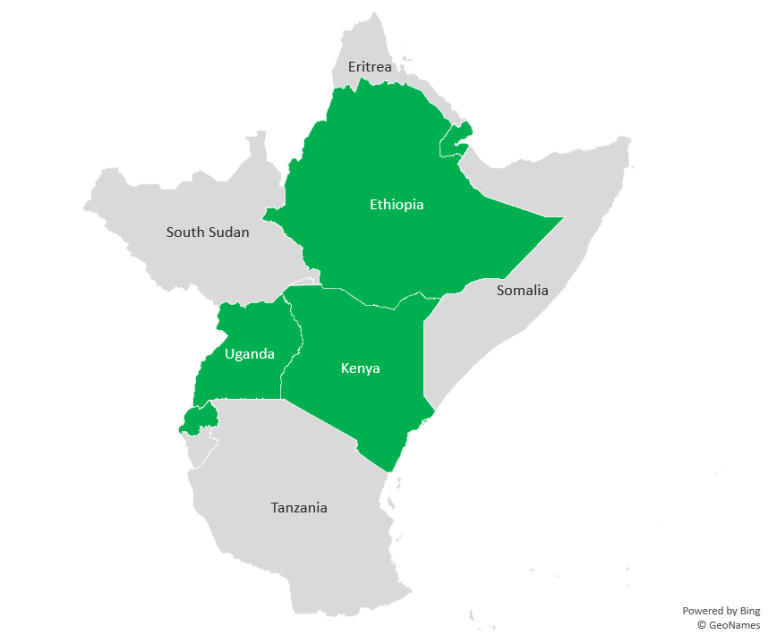
Thus far, it is true that only five countries in Eastern Africa have deposited their ratification of the AfCFTA. However, it is not the number of countries that counts but the fact that a regional block of contiguous countries—representing around three-quarters of regional GDP—is coalescing. From January 1, 2021, Djibouti, Ethiopia, Kenya, Rwanda, and Uganda will all begin a reduction in their tariffs—starting with a linear reduction on 90 percent of tariff lines—leading to the elimination of tariffs on intra-regional imports over a period of five years (10 years in the case of countries classified by the United Nations as “least developed countries”); by the standards of regional trade agreements, this pace of liberalization will be quite rapid.

Figure 1. East African countries that have deposited the ratification of the AfCFTA with the African Union, September 2020


ADVERTISEMENT
Source: TRALAC, 2020

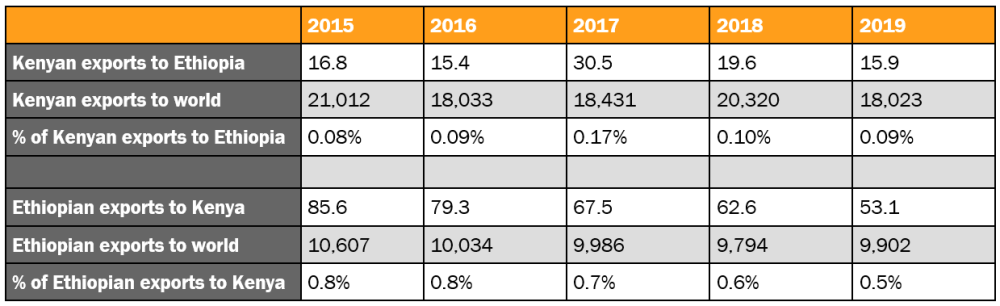
One of the big boons for the region from the AfCFTA will be unblocking the trade barriers between Kenya and Ethiopia—the two largest economies in eastern Africa. Despite previous efforts to deepen economic relations, the volumes of bilateral trade between the two remain exceedingly low. In fact, total bilateral trade did not even reach $70 million in 2019, accounting for just 0.5 percent of Ethiopia’s total exports and 0.09 percent of Kenya’s, and consisting principally of food and live animals and some manufactured goods (Table 1).

Table 1. Bilateral Ethiopian/Kenyan trade, 2015-2019 (millions USD and %)

Source: IMF Direction of Trade Statistics

The reasons for this neglect so far of these neighboring markets are fairly clear and go beyond the usual considerations of prevailing low per capita incomes. On the one hand, Ethiopia retains a fairly protectionist tariff policy, with high tariff peaks in particular sectors. But East African Community (EAC) members like Kenya (and not Ethiopia) also currently impose a high common external tariff on imports of Ethiopian goods in spite of the fact that both countries are members of regional grouping the Common Market for Eastern and Southern Africa (COMESA). The reason is that Ethiopia has not yet acceded to the COMESA Free Trade Area, and, hence, relatively high tariffs are still imposed on bilateral trade. A similar problem impacts Burundian, Rwandan, and Ugandan trade with neighboring Democratic Republic of the Congo (DRC)—all are members of COMESA, yet the DRC has yet to accede to the FTA.

In principle, the implementation of the AfCFTA will pave the way for a rapid dismantling of such impediments to cross-border trade. Alongside the removal of tariff barriers, the AfCFTA will also focus attention on outstanding nontariff barriers (NTBs), an important step toward increased trade in the region as studies consistently show that NTBs constrain intra-regional trade as much as or even more than tariff barriers. East Africa has already made some progress in this area by, for example, installing 25 one-stop border posts, significantly reducing the time taken for goods to pass through customs. Accompanying regional programs to the AfCFTA, like the African Union’s Action Plan for Boosting Intra-Africa Trade (BIAT), should help accelerate the progress.

To be sure, East Africa will continue to face a number of challenges, including one shared by all countries on the continent: the need to rapidly finalize the tariff offers and outstanding negotiations on the rules of origin as well as the schedules on services trade offers. This shared challenge will be particularly tough as the negotiations in areas like services and those in phase IIsuch as competition and intellectual property policies will inevitably be quite complex and highly technical.

A second challenge is peculiar to the East African Community. Of the six members, only three have so far ratified the AfCFTA. Because the regional block of the EAC is a customs union and, consequently, has a common external tariff (CET), without further ratification of the AfCFTA by the other three member states, problems for the integrity of the CET will arise. Rules of origin in principle may limit this problem, but their liberal application will lead to greater bureaucratic overheads and increase the risk of trade diversion (whereby trade is diverted from a more efficient exporter toward a less efficient one because of the differential tariffs being applied). This could thereby reduce the benefits derived from the AfCFTA. Thus, the greater the degree of harmonization of trade policy regimes within East Africa, the better, as this will facilitate deeper regional economic integration and pave the way for the eventual formation of an African-wide customs union, as contemplated under the AfCFTA agreement.

A third related question is how to manage future trade negotiations with third parties. Mindful of the consequences of a possible phasing out of the African Growth and Opportunity Act (AGOA) in 2025, Kenya has already entered into negotiations with the aim of establishing a free trade agreement with the United States. Eager to establish new trade deals after its departure from the European Union, the United Kingdom is also approaching a number of countries in the region. The Kenya-U.S. free trade agreement has been particularly controversial, but perhaps unduly so: In principle, there is nothing impeding countries in East Africa from negotiating with third parties. 

Previous Post

Lagos imposes indefinite curfew to curb Nigeria protests, police deploy anti-riot squad

Next Post

Low-interest rate loans from China are attractive to African countries, says Senegalese president

SAT Reporter

Related Posts

Pick n Pay Raises R4.7bn from Boxer Stake Sale to Fund Turnaround
Business

Pick n Pay Raises R4.7bn from Boxer Stake Sale to Fund Turnaround

by SAT Reporter
May 19, 2026
Uganda Grants Starlink Licence in Boost to Internet Competition
Business

Uganda Grants Starlink Licence in Boost to Internet Competition

by SAT Reporter
May 16, 2026
Ericsson Appoints Siseko Ngxola to Lead South African Operations
Telecommunications

Ericsson Appoints Siseko Ngxola to Lead South African Operations

by SAT Reporter
March 25, 2026
Global Investors and Policymakers Convene in London for Africa Investment Summit 2026
Business

Global Investors and Policymakers Convene in London for Africa Investment Summit 2026

by SAT Reporter
March 16, 2026
Tongaat Hulett Faces Crucial Liquidation Battle
Business

Tongaat Hulett Faces Crucial Liquidation Battle

by SAT Reporter
March 2, 2026
Next Post
Low-interest rate loans from China are attractive to African countries, says Senegalese president

Low-interest rate loans from China are attractive to African countries, says Senegalese president

Browse by Category

  • Africa AI
  • African Continental Free Trade Area
  • African Debt
  • African Start ups
  • Agriculture
  • AI Africa
  • Algeria
  • All News
  • Analysis
  • Angola
  • Arts / Culture
  • Asia
  • Botswana
  • BOTSWANA
  • BREAKING NEWS
  • BRICS
  • Burkina Faso
  • Burundi
  • Business
  • Business
  • Business Wire
  • Cameroon
  • Central Africa
  • Chad
  • China
  • Climate Change
  • Climate Changev
  • Community
  • Congo Republic
  • Conservation
  • Côte d’Ivoire
  • COVID 19
  • CRYPTOCURRENCY
  • Culture
  • Democratic Republic of Congo
  • Diplomacy
  • Eastern Africa
  • Economic Development
  • Economy
  • Education
  • Egypt
  • Elections 2024
  • Energy
  • Entertainment
  • Environment
  • Eritrea
  • Ethiopia
  • Europe
  • Fashion
  • Feature
  • Finance
  • Financial Inclusion
  • Food
  • Food and Drink
  • Foods
  • GABON
  • Ghana
  • Global
  • Global Africa
  • Guinea
  • Health
  • Humanitarian Aid
  • Immigration
  • in Southern Africa
  • International news
  • International Relations
  • Investment
  • Ivory Coast
  • Just In
  • Kenya
  • Lesotho
  • Libya
  • Life Style
  • Lifestyle
  • Literature
  • Malawi
  • Malawi
  • Mali
  • Markets
  • Mauritius
  • Middle East
  • Mining in Africa
  • Morocco
  • Mozambique
  • Namibia
  • Niger
  • niger
  • Nigeria
  • North Africa
  • North-Eastern Africa
  • Obituaries
  • Obituary
  • Opinion
  • PARTNER CONTENT
  • Politics
  • Property
  • Racism
  • Rwanda
  • Rwanda
  • SADC
  • SAT Interviews
  • SAT Investigation
  • SAT Jobs
  • Saudi Arabia
  • Senegal
  • Seychelles
  • Somaliland
  • South Africa
  • South Sudan
  • Sports
  • Startup Africa
  • STOCK EXCHANGE
  • Sudan
  • Sustainability
  • Sustainablity
  • Tanzania
  • Technology
  • Telecommunications
  • The Editorial Board
  • The Power Of She
  • Togo
  • Trade
  • Travel
  • Travel
  • Tunisia
  • Uganda
  • Uncategorized
  • Wealth
  • West Africa
  • World
  • World
  • Zambia
  • ZAMBIA
  • ZIMBABWE
  • Zimbabwe

Browse by Tags

#NewsUpdate #SouthAfrica #SouthernAfricanTimes #TheSouthernAfricanTimes AfCFTA africa African Continental Free Trade Area African development African Development Bank African economies African economy African Union Agriculture Angola Botswana China Climate change Cyril Ramaphosa Economic Development economic growth energy transition Ghana governance industrialisation Inflation Infrastructure Infrastructure Development International relations Investment Kenya Mozambique Namibia news Nigeria Regional Integration renewable energy Rwanda SADC South Africa Southern Africa sustainable development Tanzania United States Zambia Zimbabwe
ADVERTISEMENT

WHO WE ARE

The Southern African Times is a regional bloc digital newspaper that covers Southern African and world news. The paper also gives a nuanced analysis on news and covers a wide range of reporting which include sports, entertainment, foreign affairs, arts and culture.

Welcome Back!

Login to your account below

Forgotten Password?

Retrieve your password

Please enter your username or email address to reset your password.

Log In
  • Home
  • Southern Africa
  • Business
    • African Start ups
    • African Continental Free Trade Area
  • Technology
    • Lifestyle
      • Health
      • Culture
      • Food and Drink
      • Entertainment
  • Opinion
  • Sports
  • SAT Jobs
    • Events
  • About Us
    • Advertise with Us
    • Contact Us
Not enough quota to unlock this post
Unlock left : 0
Are you sure want to cancel subscription?