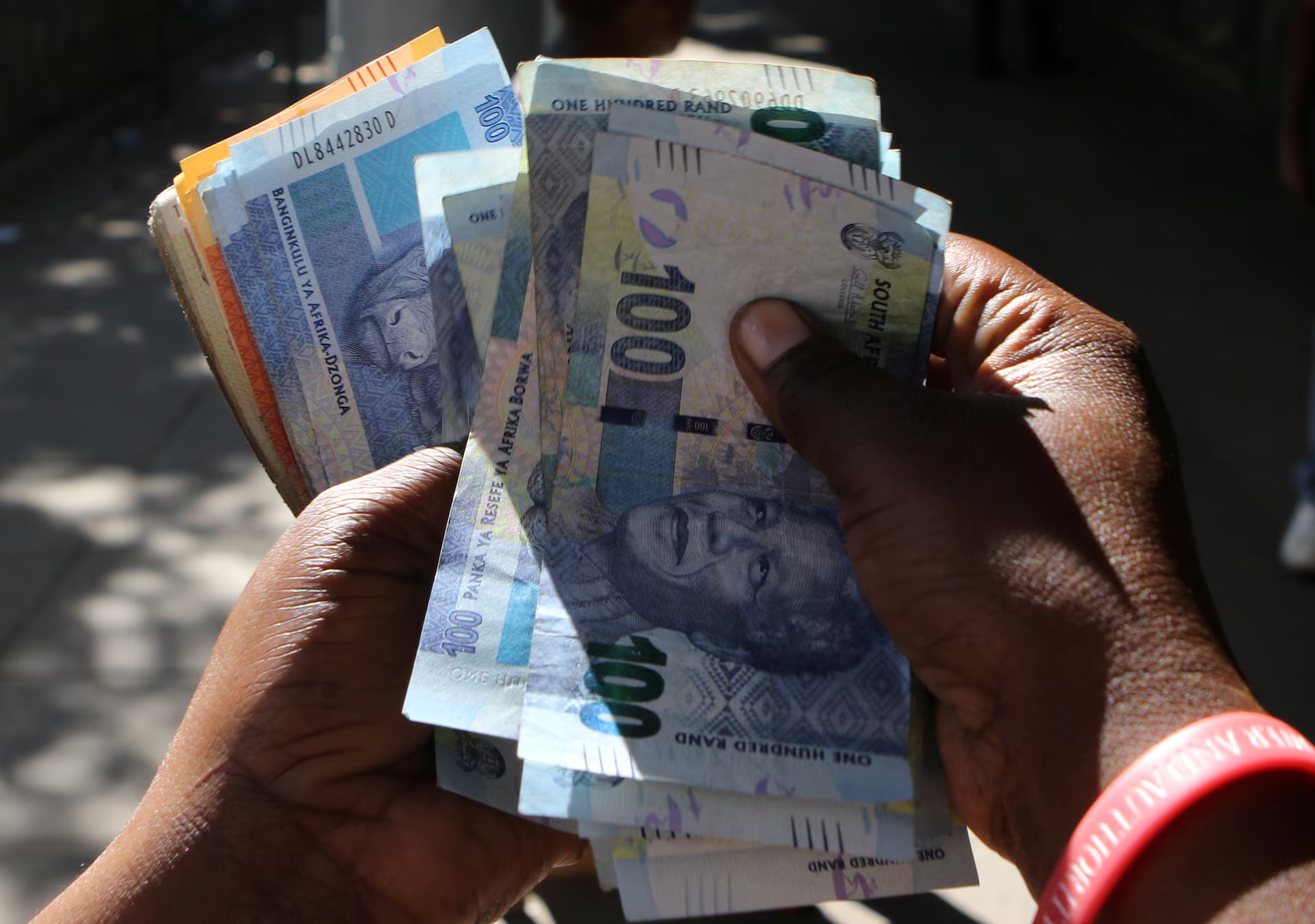
The South African rand weakened against the United States dollar in early trading on Tuesday as investors responded to heightened global risk aversion linked to the fragile ceasefire in the Middle East, while domestic attention turned towards planned anti immigration demonstrations across South Africa.
The rand traded at 16.4550 against the US dollar during morning trade, representing a decline of approximately 0.3 per cent from the previous session. The currency’s movement broadly reflected trends seen across several emerging markets, where investors continued to exercise caution amid ongoing geopolitical uncertainty and concerns over the durability of the regional truce.
Financial markets have remained sensitive to developments in the Middle East in recent weeks, with shifts in investor confidence influencing demand for emerging market currencies, including the rand. Analysts note that while South Africa’s currency often responds to domestic economic conditions, it is also highly exposed to international risk sentiment because of the country’s deep integration into global financial markets.




Alongside external factors, investor attention has also centred on planned demonstrations organised by the civic group March and March, which has called for undocumented foreign nationals to leave South Africa. Organisers have stated publicly that the demonstrations are intended to remain peaceful.
The planned protests have generated concern among communities across the country, particularly among migrants from neighbouring African states. Reports indicate that some foreign nationals have sought temporary shelter in community facilities or have chosen to return to their countries of origin amid fears of possible violence, although authorities have continued to monitor the situation closely.
South Africa has periodically experienced tensions surrounding migration, employment and access to public services. These debates reflect a complex set of economic and social challenges affecting both South African citizens and migrant communities. Researchers and policymakers have consistently noted that migration within the Southern African region is shaped by historical ties, economic interdependence and labour mobility, making the issue one that extends beyond national borders.
For many African countries, migration remains an integral part of regional economic integration, with workers, entrepreneurs and families contributing to cross border trade, investment and cultural exchange. Organisations such as the African Union and the Southern African Development Community have long advocated for approaches that balance national security concerns with the protection of human rights and regional cooperation.
Market participants will also be monitoring a series of South African economic releases scheduled for Tuesday, including money supply figures, private sector credit data, the South African Reserve Bank’s inflation expectations survey, together with trade balance and budget balance statistics.
Ordinarily, these indicators would provide investors with important signals regarding domestic economic conditions and the outlook for monetary policy. However, some analysts expect developments surrounding the planned demonstrations to attract greater immediate market attention, particularly if they influence investor perceptions of political stability or consumer confidence.
South Africa continues to face the dual challenge of sustaining economic growth while addressing persistently high unemployment, fiscal pressures and social inequality. These structural issues have contributed to robust public debate regarding migration policy, labour markets and public service delivery.
Economists generally caution that currency movements are influenced by a broad range of domestic and international factors, including commodity prices, interest rate expectations, investor confidence and geopolitical developments. As such, short term fluctuations in the rand should be viewed within the wider context of global financial markets rather than being attributed to any single event.
Investors are expected to continue monitoring both international geopolitical developments and South Africa’s domestic economic indicators in the coming days as they assess the outlook for Africa’s most industrialised economy.