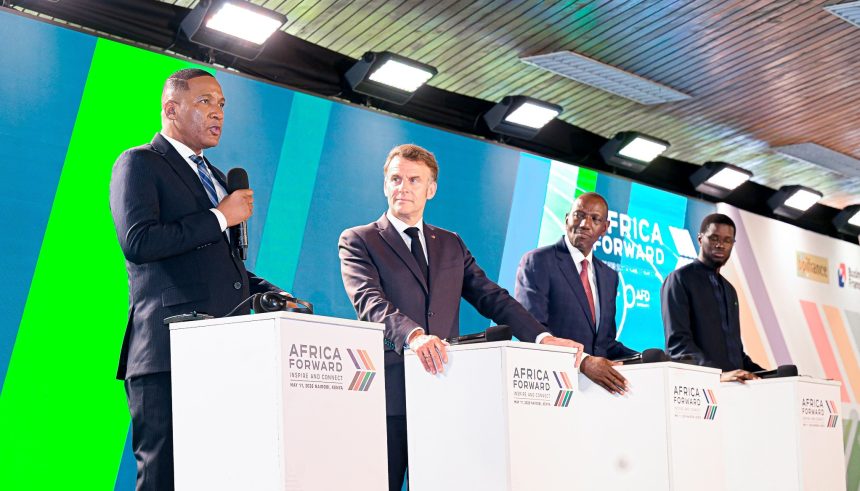
Botswana President Duma Boko has called for African nations to pursue international economic partnerships that prioritise value addition, regional industrialisation, and long term continental interests, as France seeks to expand commercial ties across Africa amid shifting geopolitical and economic dynamics.
Speaking in the context of the recent Africa Forward Summit held in Nairobi, Kenya, President Boko emphasised that African governments should negotiate with global partners from a position centred on African priorities rather than external strategic interests. The summit marked France’s first major Africa focused economic gathering in an English speaking East African country, signalling a broader recalibration of Paris’ engagement across the continent.
France has historically maintained strong political and economic ties with francophone states in West and Central Africa. However, evolving political developments in parts of the Sahel, including Burkina Faso, Mali, and Niger, have contributed to changing diplomatic relations and growing calls within those countries for greater economic sovereignty and diversified international partnerships.



At the Nairobi summit, French President Emmanuel Macron announced an investment package valued at approximately US$27 billion aimed at supporting sectors including artificial intelligence, agriculture, renewable energy, and industrial development across Africa. According to summit declarations, the initiative combines funding from French public and private institutions alongside African financial contributions.
President Macron stated that France no longer views Africa through the lens of historical dependency or privileged commercial access. Analysts have interpreted the summit as part of a broader French effort to reposition its role on the continent amid increasing economic competition from China, Türkiye, Gulf states, India, and Russia.
In an interview with the BBC, President Boko welcomed expanded engagement with international partners while stressing that African countries must define the terms of cooperation themselves.
“When we get to the negotiating table, we must pursue vigorously these initiatives,” Boko said, referring to African development priorities including industrialisation, infrastructure integration, digital transformation, and intra African trade.
The Nairobi summit declaration outlined ten strategic priorities including sustainable agriculture, resilient healthcare systems, green industrialisation, blue economy development, and digital innovation. The declaration also called for reforms to international financial institutions to improve African countries’ access to development financing.
Botswana’s position reflects a wider continental debate concerning how African states can secure greater economic value from natural resources and reduce dependence on raw commodity exports. President Boko argued that infrastructure inherited from the colonial era was largely designed to extract raw materials rather than integrate African economies.
“Even the way the infrastructure is laid out, it was never intended to connect African countries. It was designed to evacuate raw materials from Africa,” he said.
Botswana has increasingly positioned itself as an advocate for regional economic integration through the African Continental Free Trade Area, which seeks to create a unified market across the continent. President Boko reiterated support for expanding intra African trade corridors and strengthening investment flows between African states.
“We need to develop corridors of trade. We need to encourage flows of trade and investment amongst ourselves as African countries,” he said.
The president also referenced Botswana’s ongoing cooperation with French nuclear fuel company Orano, which holds uranium exploration interests in the country. He stated that Botswana’s mining licensing framework remains open to international companies provided they comply with national laws and regulatory standards.
Botswana’s approach differs from recent developments in Niger, where the military led government announced plans in 2025 to nationalise the Somair uranium mine operated by Orano. Authorities in Niger argued that the country had not received equitable economic benefits from decades of uranium extraction, while Orano described the move as part of a broader deterioration in relations between the company and the state.

President Boko said Botswana’s mining partnerships are intended to ensure greater domestic participation in extraction, beneficiation, and commodity trading rather than limiting the country’s role to raw material production.
“This is about the country from which the uranium is produced playing a leading role in the extraction process, in beneficiation, and in the trade of the commodity,” he said.
Observers note that African governments are increasingly seeking to renegotiate the structure of foreign investment partnerships in sectors such as mining, energy, infrastructure, and technology. The shift reflects broader continental efforts to align economic agreements with industrial development goals, employment creation, and regional value chains.
The summit declaration also highlighted concerns regarding the global financial system and access to concessional financing for African development projects. Participating states called for reforms to the International Monetary Fund and other multilateral institutions to better reflect contemporary global economic realities and improve representation for underrepresented economies.

Botswana’s intervention at the summit reflects an emerging policy direction among several African governments seeking partnerships that balance foreign investment with national development priorities, local industrial participation, and regional economic integration.
As international competition for African markets and strategic minerals intensifies, debates around sovereignty, beneficiation, and equitable economic cooperation are expected to remain central to the continent’s evolving engagement with global powers.