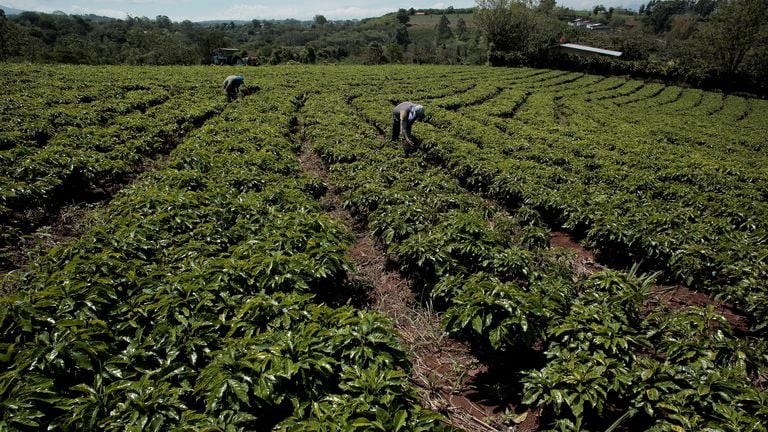
Acoalition of major coffee companies and commodity traders has announced a satellite driven monitoring initiative aimed at improving the accuracy of deforestation tracking across global coffee producing regions, with an initial focus on East Africa. The programme, known as the Coffee Canopy Partnership, brings together firms including JDE Peet’s, Tchibo, Louis Dreyfus Company, Neumann Kaffee Gruppe and Sucafina, alongside aerospace company Airbus, which will supply satellite imagery integrated with artificial intelligence systems.
The initiative reflects growing regulatory and environmental pressures within global commodity supply chains. In particular, the European Union Deforestation Regulation is expected to restrict market access for commodities linked to deforestation after December 2020, with implementation timelines beginning in late 2026 for large corporations. Coffee is among the commodities covered, placing increased scrutiny on producing regions, many of which are located in Africa, Latin America and Asia.
Participating companies state that the system will combine high resolution satellite data with machine learning models to map coffee farms and identify forest loss in surrounding landscapes. Airbus has previously developed Earth observation capabilities that enable land use monitoring at scale, and the partnership intends to apply these tools to address long standing data gaps in agricultural mapping.




The first phase will prioritise Ethiopia, Kenya, Uganda, Tanzania, Rwanda and Burundi, regions that collectively represent a significant share of Africa’s coffee production and where smallholder farmers dominate the sector. Across these landscapes, coffee cultivation often coexists with tree cover through agroforestry and shade grown systems. Industry representatives argue that conventional mapping techniques have frequently misclassified such systems as natural forest, creating potential compliance risks under new regulatory frameworks.
In a statement, JDE Peet’s indicated that inaccurate classification could result in the exclusion of smallholder producers from key export markets despite adherence to sustainable practices. The company emphasised that the initiative seeks to improve the precision of land use data while supporting forest restoration and conservation efforts in collaboration with local communities and governments.
The programme is expected to expand globally by 2027, with the intention of covering all major coffee growing regions. Organisers have also indicated that the platform will be accessible to a range of stakeholders, including farmers, policymakers and supply chain actors, allowing for consultation and verification of mapped data.
The announcement highlights broader tensions between environmental governance and livelihoods in agricultural economies. In many African contexts, coffee production is deeply embedded in rural socio economic systems, providing income for millions of households. At the same time, concerns about deforestation and biodiversity loss continue to shape international trade policy.
Analysts note that technological interventions such as satellite monitoring may offer improved transparency, but their effectiveness will depend on how data is interpreted and applied. Questions remain regarding data governance, local participation and the capacity of smallholder farmers to engage with complex compliance requirements.

From a pan African perspective, the initiative underscores the need for approaches that recognise the diversity of land use systems across the continent. Agroforestry practices, which integrate crops and tree cover, have long been part of African agricultural knowledge systems and may not align neatly with externally defined categories of forest and farmland. Ensuring that such systems are accurately represented will be critical to balancing environmental objectives with equitable economic participation.
While the Coffee Canopy Partnership presents a technological response to regulatory demands, its long term impact will likely depend on collaboration with local institutions and the extent to which it supports, rather than constrains, the agency of African producers within global markets.