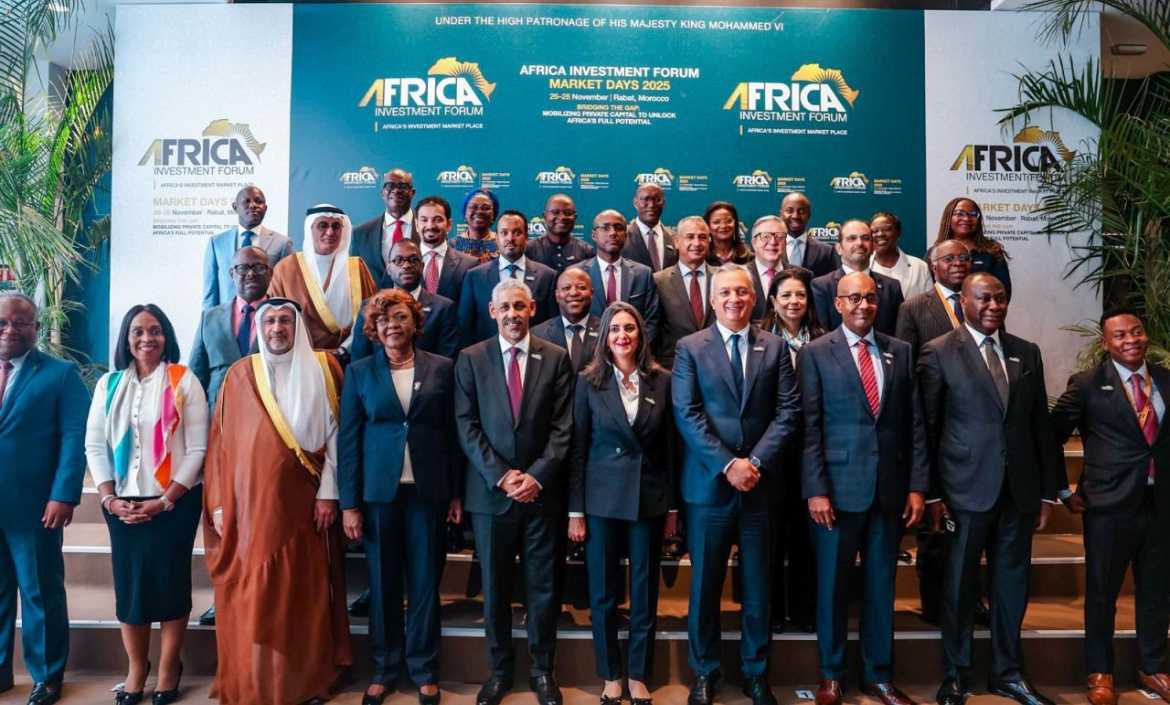
The African Development Bank (AfDB) has announced that its flagship investment platform, the Africa Investment Forum (AIF), held in Rabat in November 2025, recorded $15.3 billion in investor commitments across 39 bankable projects. The event, which convened over 2,000 delegates from nearly 80 countries, underscored the growing maturity of Africa’s investment landscape, with organisers highlighting a notable rise in the proportion of investment-ready ventures.
While the figure represents a decline from the $29.5 billion pledged at the 2024 edition, AfDB officials emphasised that the quality and readiness of projects had significantly improved. According to the Bank, 95 percent of the projects presented during this year’s boardroom sessions were investment-ready, compared with 81 percent the previous year. The boardrooms, which serve as closed-door sessions for vetted projects to be pitched directly to investors, featured 41 transactions in total.
Participants at the forum included private capital providers, multilateral development finance institutions, entrepreneurs, commercial banks, and government representatives. Over the three-day event, discussions explored a wide range of themes, including project structuring, capital mobilisation, and women’s access to finance.



Sidi Ould Tah, who presided over his first Africa Investment Forum as President of the AfDB, described the 2025 Market Days as a turning point for the continent’s investment ecosystem. “The conclusion of this year’s Market Days marks a new beginning, full of optimism, for the future of our continent,” he told delegates at the closing ceremony.

A significant share of this year’s transactions focused on the energy and transport sectors, aligning with the continent’s urgent climate finance priorities. Many of these projects were purposefully structured to address Africa’s energy transition, with several initiatives integrating renewable energy components and climate resilience mechanisms.
Created in 2018 through a partnership between the AfDB, Africa Finance Corporation, Afreximbank, Africa50, the Development Bank of Southern Africa (DBSA), the Trade and Development Bank (TDB), and the Arab Bank for Economic Development in Africa (BADEA), the AIF serves as a platform that bridges investors with project developers. It provides a comprehensive framework for advancing projects from concept to financial closure.
To reinforce accountability and enhance project execution, the AfDB used the forum to launch a new annual dashboard designed to track progress and monitor implementation. The tool aims to ensure that commitments made during AIF translate into measurable development outcomes. Tah stated that the dashboard would strengthen transparency and investor confidence by ensuring that pledges result in tangible results on the ground.
Among the prominent deals announced in Rabat was a joint financing package between the European Investment Bank (EIB Global) and the AfDB amounting to $275 million to modernise Mauritania’s principal railway corridor. The corridor connects the iron ore hub of Zouerate to the Atlantic port of Nouadhibou. The financing comprises $150 million from the AfDB and $125 million from EIB Global, guaranteed by the European Union. Both facilities are private sector, non-sovereign loans extended to the Société Nationale Industrielle et Minière (SNIM), Mauritania’s largest formal employer.
“This financing marks an important milestone for Mauritania and for the African Development Bank,” Tah remarked during the signing ceremony. “By supporting SNIM through a corporate loan, we are scaling up private sector investment in strategic value chains. Modernising this railway will unlock new opportunities for industry, enhance Mauritania’s role in regional trade, and accelerate the country’s path toward sustainable growth.”
Ethiopia’s Bishoftu Airport Expansion, a major greenfield aviation project spearheaded by Ethiopian Airlines, also attracted attention at the forum. Designed as a continental aviation hub to complement and eventually ease capacity pressures at Addis Ababa Bole International Airport, the new facility is located approximately 40 kilometres southwest of the capital. The first phase, expected to handle 60 million passengers annually, carries an estimated cost of $8.6 billion, with a second phase expansion to 100 million passengers projected at $12.5 billion.
The AfDB has been appointed as the initial mandated lead arranger for the airport project, with financing commitments also emerging from the United States International Development Finance Corporation and an unnamed Chinese bank pledging $500 million. Ethiopian Airlines Chief Executive Officer Mesfin Tasew Bekele said that the project embodies the national carrier’s vision to reinforce Ethiopia’s role as a regional aviation hub.
The Rabat gathering reinforced the AIF’s role as Africa’s leading platform for mobilising capital and facilitating partnerships that advance the continent’s industrialisation, infrastructure, and climate finance objectives. Although the total volume of pledges declined from the previous year, the focus on bankability and project execution represents a maturing shift in Africa’s investment narrative. The emphasis has moved away from headline commitments toward the actualisation of financially viable, socially responsible, and environmentally sustainable investments.
The 2025 AIF thus signals a broader recalibration within Africa’s development finance architecture, one that prioritises long-term transformation over short-term announcements and places African agency at the centre of global investment dialogues.