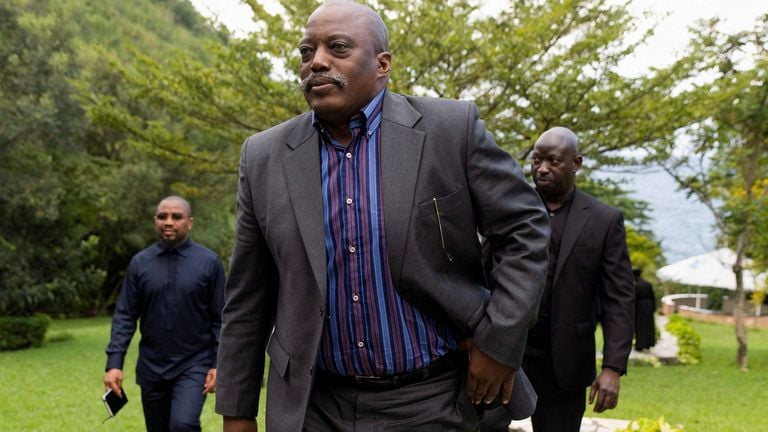
The Democratic Republic of Congo’s (DRC) former president Joseph Kabila has been sentenced to death in absentia by a military court in Kinshasa, following convictions on charges of war crimes, treason, and crimes against humanity. The ruling, handed down by Lieutenant-General Joseph Mutombo Katalayi, follows accusations that Kabila supported the advance of the Rwanda-linked M23 rebellion in the eastern provinces of North Kivu and South Kivu.
Kabila, who governed the DRC from 2001 until 2019, did not attend the proceedings, nor was he represented by legal counsel. His current whereabouts remain uncertain, although reports indicate that since 2023 he has spent much of his time in South Africa, with a recent appearance in the rebel-held city of Goma in May 2025. He has consistently rejected allegations of complicity, asserting that the Congolese judiciary has been politicised.
In addition to the death penalty, the court ordered Kabila to pay approximately USD 50 billion in damages to the state and to victims. While capital punishment remains on the Congolese statute books, executions have not been carried out for two decades, leaving the ruling’s enforceability open to legal and political contestation.




The trial and verdict arrive at a moment of acute instability in the mineral-rich nation. The resurgence of M23, a rebel group that has historically been linked to Rwanda, has redrawn the security map in the east of the country. Since late 2021, its offensives have resulted in mass displacement, with hundreds of thousands forced from their homes. The United Nations and humanitarian agencies have documented extensive human rights violations, including extrajudicial killings and sexual violence, in areas of rebel control.
Relations between Kabila and his successor, President Félix Tshisekedi, deteriorated soon after the contested 2019 transfer of power, despite an initial power-sharing agreement. Tshisekedi publicly accused Kabila at the 2025 Munich Security Conference of sponsoring the M23 insurgency. These allegations have reverberated in regional diplomacy, particularly given Rwanda’s longstanding denial of direct involvement with the rebels. Kigali insists its security forces act solely in self-defence against Congolese forces and allied militias, including elements linked to the 1994 Rwandan genocide.

The Congolese government has recently moved to suspend Kabila’s political party and seize the assets of its leaders, deepening political divisions within the country. Analysts suggest that the verdict could fuel further polarisation in Congolese politics, where contestations over legitimacy, resource governance, and sovereignty have historically shaped both domestic and regional dynamics.
The ruling also underscores broader questions about transitional justice in African contexts. While the trial was hailed by some as a step towards accountability, critics argue that justice processes in the DRC remain entangled with political rivalries. Regional observers note that the outcome could have implications beyond Congo’s borders, shaping both the trajectory of the Great Lakes region’s security landscape and debates about sovereignty, external intervention, and accountability in African conflicts.