

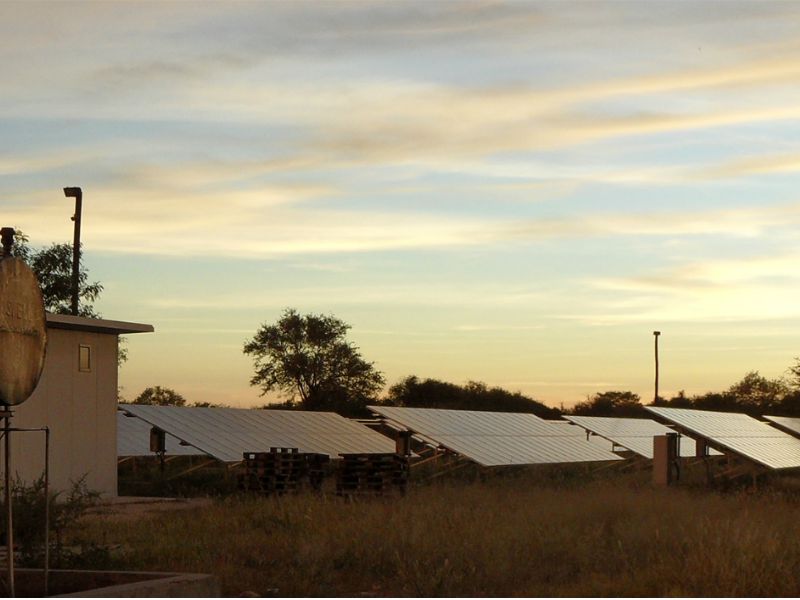
Namibia has announced a new national initiative designed to expand access to electricity in rural communities beyond the reach of the country’s central grid. The programme, unveiled on Friday, will focus on decentralised off-grid solutions, building on earlier successes of the government’s Solar Revolving Fund, a long-established credit facility offering loans for solar energy systems to both rural and urban households.
The announcement was made by Deputy Prime Minister and Minister of Industries, Mines, and Energy, Natangue Ithete, during the commissioning of joint electrification projects in Otjiwarongo, located in north-central Namibia. He underscored the logistical and financial challenges of extending the national grid into sparsely populated rural areas, noting that for some communities, grid connection is neither economically viable nor technically feasible.
“In our determination to bring electricity to every Namibian, we must also recognise the practical reality that certain communities are too remote to be connected to the grid,” Ithete stated. He emphasised that the solar systems being deployed under the initiative are high-quality technologies aimed at providing modern, sustainable energy to underserved households.



The programme is framed as part of Namibia’s broader commitment to universal energy access, aligning with the Mission 300 energy compact, a pan-African undertaking to provide electricity to 300 million households across the continent by 2030. For Namibia, this translates to an additional 200,000 household connections by 2030, and 400,000 by 2040.
While the Namibian government will provide resources and strategic direction, the initiative is explicitly designed as a collaborative effort. Ithete stressed that meaningful progress depends upon partnerships between the state, the private sector, and citizens themselves. “By 2040, no single Namibian must live without electricity, because electricity is a need, not a luxury,” he affirmed.
Rural electrification remains one of the most pressing development challenges across Africa, where more than 600 million people currently lack access to electricity, according to the International Energy Agency (IEA). Off-grid and decentralised renewable solutions, particularly solar, have been recognised as critical pathways for achieving universal access, especially in geographically dispersed regions where grid extension costs remain prohibitive.

Namibia’s policy stance reflects a broader continental shift towards locally adapted solutions that avoid linear narratives of development borrowed from other regions. Instead, the country’s approach acknowledges diverse energy realities across African geographies and economies, while embedding community ownership and sustainability at its core.
For further details on Namibia’s Solar Revolving Fund, visit the official Ministry of Mines and Energy platform. Insights on Mission 300 and broader African electrification targets can be accessed through the African Union’s Sustainable Energy for All framework.


