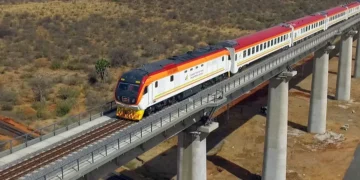
The Government of Tanzania has officially launched electric freight services on its Standard Gauge Railway (SGR), marking a significant milestone in the country’s ongoing transport infrastructure modernisation. The service, operated by the Tanzania Railways Corporation (TRC), commenced on 29 June 2025 with the inaugural train departing from Pugu Station in Dar es Salaam at 04:35 local time, and scheduled to arrive at Ihumwa Station in the capital, Dodoma, by 14:00 the same day.
The newly operational route is part of the broader national SGR development plan, which seeks to replace the century-old metre gauge railway with a modern, high-capacity network. The SGR is envisaged as a transformative pillar for regional connectivity and trade efficiency across East and Southern Africa, supporting both domestic and cross-border freight mobility.
According to a statement released by the TRC, the inaugural freight convoy consisted of ten wagons, collectively carrying over 700 tonnes of assorted goods. This follows the completion of earlier trial operations, which involved 264 newly acquired cargo wagons manufactured in China. Of these, 200 are designated for containerised cargo, while 64 are purposed for bulk freight.



The SGR electric trains are powered by overhead electric lines, a sustainable shift that aligns with Tanzania’s commitments to reduce carbon emissions in the transport sector. Electric locomotion not only offers environmental benefits but also allows for faster, more reliable, and cost-efficient movement of goods. The integration of the electric freight component is seen as a critical step towards full operationalisation of the Dar es Salaam–Dodoma SGR corridor, which also accommodates passenger traffic.
TRC has invited commercial traders, logistics operators, and institutions to capitalise on this modern freight transport platform, noting its enhanced safety features, scheduling accuracy, and improved cargo security. The corporation reaffirmed its commitment to expanding cargo handling capacity and strengthening regional logistics competitiveness.

The strategic Dar es Salaam–Dodoma route is of particular importance, as Dar es Salaam serves as the country’s principal maritime gateway. By directly connecting the port to the political and administrative capital through an electrified rail link, the project reduces road congestion, shortens turnaround times for goods in transit, and enhances the flow of commodities within Tanzania’s economic corridors.
Tanzania’s broader SGR initiative includes additional phases extending toward the borders with Rwanda, Burundi, and the Democratic Republic of Congo, further bolstering regional trade under the African Continental Free Trade Area (AfCFTA) framework. The Government remains engaged with international development partners, including China’s CRCC (China Railway Construction Corporation), who are key players in the design and implementation of this extensive transport upgrade.