

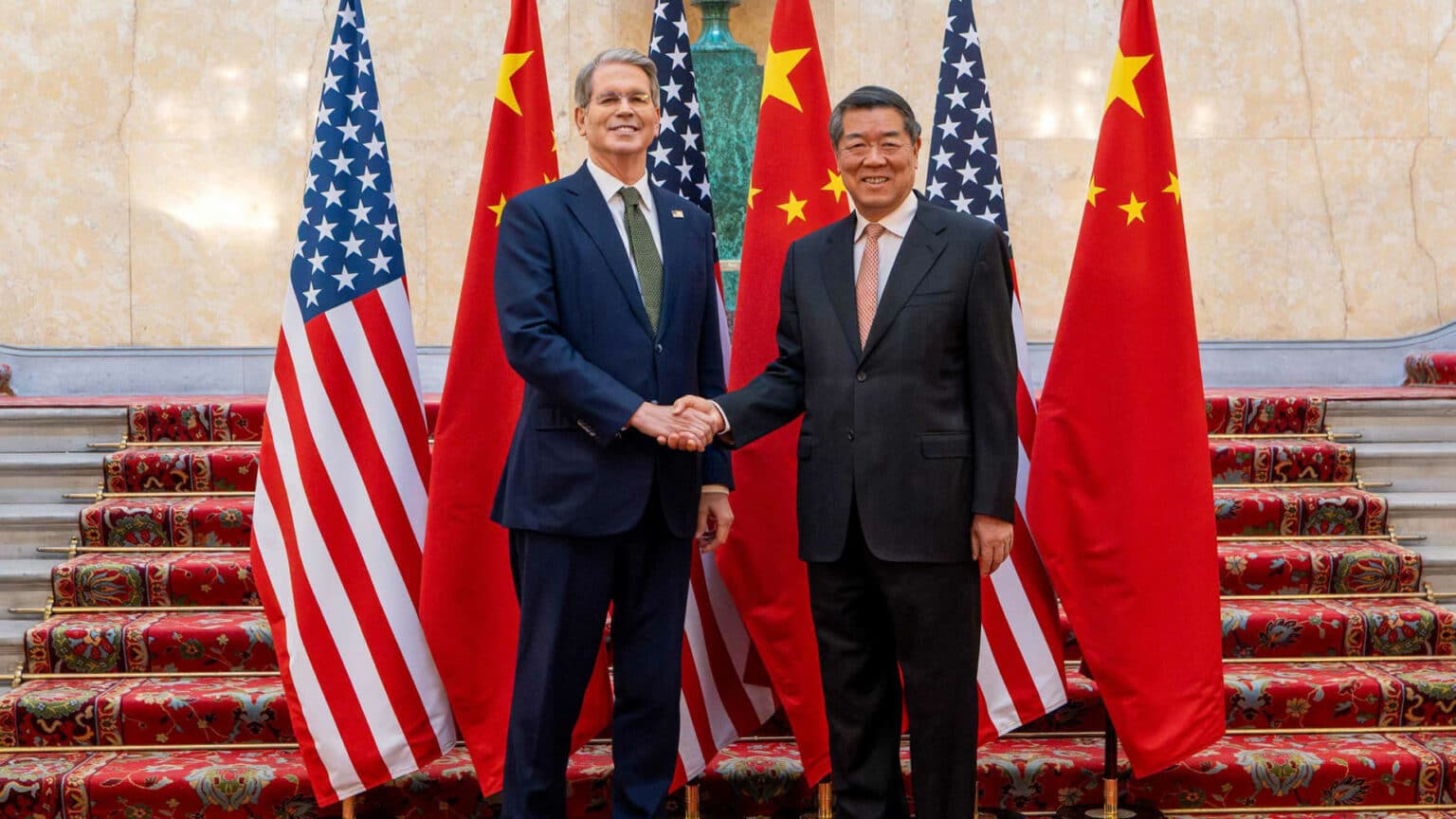
Trade representatives from China and the United States reconvened in London on Monday for a new round of negotiations, aimed at addressing persistent trade imbalances and geopolitical frictions between the world’s two largest economies. The discussions, initiated following a recent phone conversation between U.S. President Donald Trump and Chinese President Xi Jinping, mark a continued attempt to de-escalate a multi-front economic confrontation that has gripped global markets since early 2025.
U.S. officials present in London included Treasury Secretary Scott Bessent, Commerce Secretary Howard Lutnick, and Trade Representative Jamieson Greer. Representing China were Vice Premier He Lifeng—Beijing’s chief trade negotiator—Commerce Minister Wang Wentao, and Vice Minister of Commerce Li Chenggang. The talks follow a temporary accord established in Geneva last month, which saw both countries reduce punitive tariffs for a 90-day negotiation window. The U.S. cut its tariffs on Chinese goods from 145% to 30%, while China reciprocated by lowering its duties on American imports from 125% to 10%.
President Trump, commenting from Washington, stated he was receiving “only good reports” regarding the progress in London, referencing feedback from his negotiating team. According to The Wall Street Journal, Trump has authorised U.S. officials to consider easing export controls on chip design software, aerospace components, and ethane—subject to reciprocal Chinese commitments, particularly on strategic exports such as rare earth minerals.



Amid this backdrop, Kevin Hassett, Director of the National Economic Council, told CNBC that the United States is seeking a firm commitment from China to resume and expand shipments of critical minerals. “The purpose of the meeting today is to make sure that they’re serious… and to literally get handshakes,” he said, indicating that immediate reciprocal concessions were expected if the meeting proved productive. These would include the easing of U.S. export restrictions in tandem with resumed Chinese mineral exports.

Chinese state media confirmed the presence of high-level officials in London, with Vice Premier He Lifeng’s visit scheduled from 8–13 June. The continuation of the negotiations on Tuesday underscores the fragile but ongoing nature of dialogue, despite several reported infractions of the Geneva agreement. The United States has accused Beijing of delaying critical mineral exports, while China has pushed back against new U.S. restrictions on Chinese students and export controls on semiconductor technologies.
Analysts, however, remain sceptical of a comprehensive resolution. Dr Rebecca Harding, Chief Executive of the Centre for Economic Security, described the negotiations as emblematic of a broader geopolitical contest. Speaking on CNBC’s Squawk Box Europe, Harding noted, “This is an existential battle. It’s about data flows, artificial intelligence, defence, and how these two nations adapt to a digitally integrated global economy.” She added that the rivalry extends beyond tariffs and touches on the very fabric of state power and economic governance in the 21st century.
Zhiwei Zhang, President and Chief Economist at Pinpoint Asset Management, similarly cautioned against premature optimism. While recognising the symbolic value of the London talks, Zhang argued that substantive breakthroughs are unlikely in the short term. “There could be some resolution on specific issues, like rare earths… but I doubt we will have a complete solution coming from this dialogue,” he told CNBC’s China Connection.
The resumption of talks, though modest in its immediate yield, suggests a shared recognition by both capitals of the broader economic risks posed by prolonged trade discord. With high-tech industries, natural resources, and strategic supply chains hanging in the balance, the outcomes of these negotiations are likely to influence not only bilateral relations but also global economic stability.

Whether this round of diplomacy will pave the way for longer-term cooperation or merely delay deeper conflict remains uncertain. However, the willingness of both parties to engage in dialogue, after months of escalation, offers a glimmer of cautious optimism in an otherwise fraught geopolitical climate.


