Asian stocks followed Wall Street higher on Wednesday as markets awaited clarity on President Donald Trump’s trade policy ahead of a new round of tariffs set for April 2. Investors found some relief after Trump signaled that not all levies would be imposed immediately and that some countries might receive exemptions, though he offered no further details.
At the same time, Trump escalated his trade war by imposing a 25% secondary tariff on any country purchasing oil or gas from Venezuela. The move initially pushed oil prices higher, but the impact was tempered by U.S.-brokered Black Sea maritime security deals aimed at stabilizing global trade amid the ongoing war in Ukraine.
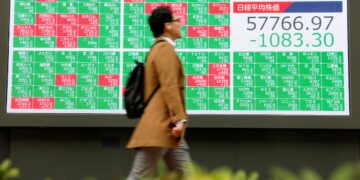
Japan’s Nikkei gained 0.65%, while South Korea’s KOSPI climbed 1.08%. Australian stocks advanced 0.71%, and Hong Kong’s Hang Seng added 0.25%, though mainland Chinese blue-chip stocks slipped by 0.32%. In the U.S., S&P 500 futures pointed down 0.12% after the index posted a modest 0.16% gain overnight, while Pan-European STOXX 50 futures eased 0.06%.



The U.S. dollar index edged up 0.1%, recovering slightly from Tuesday’s 0.12% decline—its first losing session in a week. Concerns that Trump’s trade policies could push the U.S. into a recession had recently weighed on the greenback, which hit a five-month low of 103.19 last week. The dollar strengthened 0.39% against the yen, reaching 150.49, after Bank of Japan Governor Kazuo Ueda stated that inflation remained below target but that the central bank would consider rate hikes if persistent food price increases led to broader inflationary pressures. The yield on 10-year Japanese government bonds hit its highest level since 2008.

The euro slipped 0.08% to $1.0783, and the British pound fell 0.2% to $1.2918. Gold edged up 0.2% to $3,026 per ounce, staying just below its all-time high of $3,057.21 reached last Thursday.
Market anxiety remains high as investors await further details on U.S. trade policy. While Trump’s suggestion of a more targeted approach to tariffs has provided some reassurance, uncertainty continues to weigh on global financial markets.