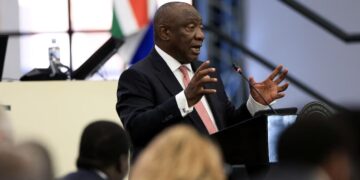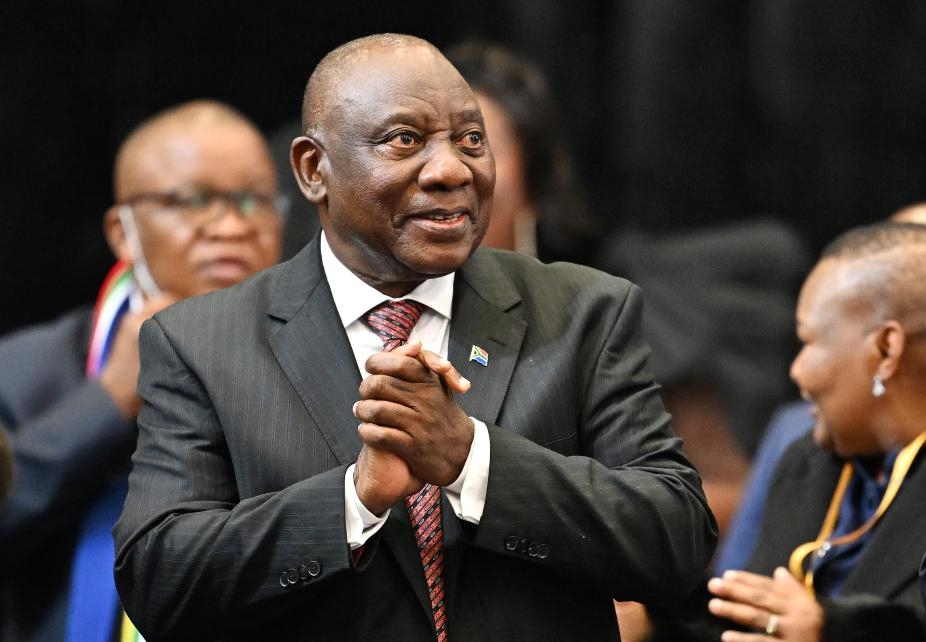
Cyril Ramaphosa, the incumbent leader of South Africa’s ruling African National Congress (ANC), has been reelected as the nation’s president. The announcement was made during the first sitting of the National Assembly in Cape Town on Friday, marking the beginning of his second term in office.
Chief Justice Raymond Zondo, who presided over the session, declared Ramaphosa the victor with 283 votes. His competitor, Julius Malema of the Economic Freedom Fighters, received 44 votes.
In his address as president-elect, Ramaphosa emphasised the importance of unity and cooperation among all political parties. “I accept my reelection as a significant responsibility,” he stated. “The results of the general elections have made it clear that the people of South Africa expect their leaders to collaborate to meet their needs.”



Ramaphosa highlighted the electorate’s demand for a government that operates within the constitutional framework to achieve a democratic society grounded in non-racialism, non-sexism, peace, justice, and stability. He pledged to address the nation’s pressing issues of poverty, unemployment, and inequality, and to strive for prosperity for all citizens.
At 71, Ramaphosa underscored the necessity of a government of national unity, clarifying that it is not merely a coalition of a few parties. “We are directed by the votes of our people to work together to address the challenges they face. This is my commitment as the president of the Republic of South Africa,” he asserted.
The South African Constitution mandates that the president-elect must assume office within five days of election by the National Assembly. According to a statement from the National Assembly, Ramaphosa will be sworn in on June 19 in Pretoria, the administrative capital.
In the same assembly session, Thoko Didiza, previously the agriculture minister, was elected as the speaker of the National Assembly. Annelie Lotriet of the Democratic Alliance (DA) was chosen as deputy speaker.

Local media reports revealed that the ANC and the DA, the principal opposition party, had brokered a deal earlier on Friday to form a government of national unity. This agreement also includes the Patriotic Alliance and the Inkatha Freedom Party. As part of this coalition agreement, Ramaphosa secured reelection with the support of the DA.

The general elections held on May 29 resulted in the ANC securing 159 out of 400 seats in the National Assembly. This outcome marked the first time the ANC fell below the 50 percent threshold needed to maintain its outright majority in the lower house of parliament, a majority it had held for three decades.
Ramaphosa’s reelection is seen as a pivotal moment in South African politics, with expectations high for a unified approach to governance and the resolution of long-standing socio-economic challenges.