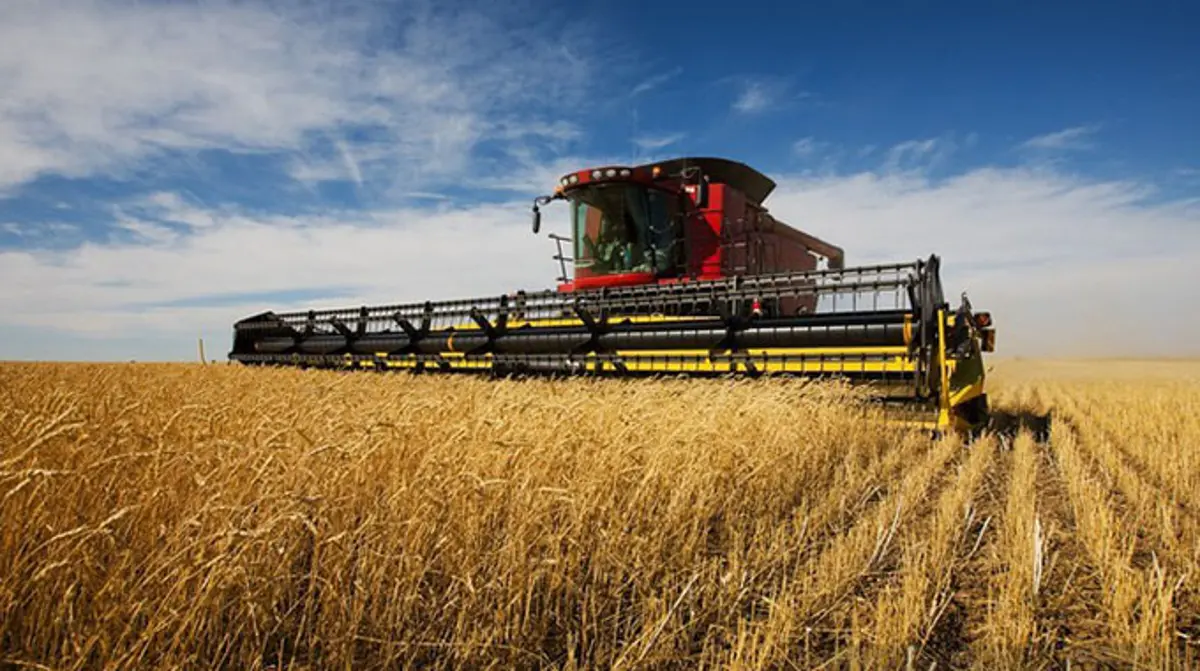
Amid the mid-morning sweltering heat, George Ngwarwi hurriedly pushed his family to finish off harvesting their remaining portion of wheat at his six-hectare farm before the early rains fell.
Ngwarwi, a small-scale farmer from Nyagori Farm in the Chegutu District near Harare, Zimbabwe’s capital, is one of many farmers who ventured into wheat farming for the very first time during this year’s winter wheat farming season.
In Zimbabwe, wheat is mostly grown under irrigation during the winter season which runs from May to July before the crop is harvested from October up to December.



Although the bulk of Zimbabwe’s wheat traditionally has been produced by large-scale commercial farmers, this year the government encouraged more small-scale farmers with irrigation capacity to venture into winter wheat farming.
According to the agriculture ministry, small-scale farmers are expected to deliver 25 percent of the 380,000 tonnes of wheat projected to be delivered this year.
“It is my first-time growing wheat,” Ngwarwi told SAT. “We have been growing other horticulture products and maize, but because of the shortage (of wheat) and the conflict in Ukraine, the government decided that as Zimbabweans we should grow our own wheat.”
Wheat is the second most important cereal after the staple crop maize in the southern African country. Following years of wheat insecurity, Zimbabwe is seeking to eliminate dependence on the importation of the key crop.
“We are really working hard so that we won’t have to import (wheat) anymore. It should be a thing of the past that we used to import wheat, but now I think we should start exporting wheat,” said Ngwarwi.
Small-scale wheat farmers were supported under the Presidential Input Scheme whereby they were provided with technical skills, fertilizer, seed, and chemicals, among other inputs.
As many African countries face wheat shortages owing to the disruption of supply chains, this year Zimbabwe is projected to produce 380,000 tonnes of wheat against a national consumption estimate of 360,000 tonnes.
Last season, the southern African nation produced wheat only enough to cover around nine months’ supply of domestic demand.
Instability in Eastern Europe which has destabilized the global wheat supply chains, as well as the quest to reduce the import bill by eliminating exports of products that can be competitively produced locally has pushed the need for self-sufficiency.
“We told ourselves to say we need to look inward in terms of import substitution especially in light of our realities, in terms of COVID-19, climate change – which is heating everybody hard – as well as the conflict in Eastern Europe which is disrupting the global supply chains for fertilizer, for food, etc.,” said John Basera, Permanent Secretary in the Ministry of Lands, Agriculture, Fisheries, Water and Rural Resettlement.
Basera said the government this year targeted to cultivate 75,000 hectares of wheat, a target which was surpassed by 4,000 hectares.
Grain Marketing Board (GMB) CEO Rocky Mutenha said most of the wheat that had been delivered by farmers so far was in very good grade.
“We have never harvested a big crop like that. In the past, we were hovering around 140,000 to 150,000 (tonnes) where we were saying we have done very well, but this year it has doubled actually. It has gone beyond what we expected,” Mutenha told SAT.
“What we are aiming at is to become a regional hub for trade, where we produce more than what we require and be able to export to neighboring countries where wheat production is probably non-existent, or is very little,” said Mutenha.
To increase wheat production, the government encouraged hundreds of small-scale and rural farmers to start growing wheat. The private sector and financial institutions were encouraged to support wheat farmers.

Furthermore, the government also encouraged users of agricultural commodities to fund the production of at least 40 percent of their respective annual agricultural raw materials requirements.
“So we looked inward and we told ourselves that we need to produce our own wheat, we call that food security with sovereignty, and we call that food security with self-sufficiency,” said Basera.

Considering that wheat production is a highly technical crop, the government provided farmers with tillage equipment and harvesting equipment through the Agricultural Finance Corporation Leasing Company which provided farmers with services for an affordable fee.
“Resultantly, our average yield increased from 4.5 tonnes per hectare on average last year to about 4.8 to 5 tonnes per hectare this year. It is because we had those strategic and timeous interventions in terms of providing the much-needed mechanization levels and modernization levels of planting activities, of harvesting activities, spraying activities, especially targeting the stallholder farmers,” said Basera.
“Smallholder farmers contributed over 22,000 hectares of wheat and ultimately over 100,000 metric tons of wheat of the projected 380,000 metric tons of wheat. So pretty much, smallholder farmers contributed over 25 percent to our success (in) this winter wheat season,” said Basera.
From less than 20,000 tonnes of wheat harvested in the 2009 agricultural season, this year’s bumper harvest is expected to cut the import bill of grain significantly. “We put a big saving in terms of foreign currency, because ideally if we didn’t look inward, we were going to spend 360,000 metric tonnes worth of forex to import the same wheat into the country, but now we supported local production, we supported local value chains, the fertilizer industry, the downstream side and so forth,” Basera added.
Wheat production declined significantly over the past two decades as disturbances from the land reform program heavily affected Zimbabwe’s capacity to meet its grain requirements.
Under the land reform program, which started in the early 2000s, the government compulsorily acquired farmland from white farmers to resettle landless blacks as a way to redress colonial land ownership imbalances.
However, Ngwarwi is one of the thousands of black farmers who benefited from the land reform program. “In the past, we thought that wheat was for commercial farmers, especially white farmers, but now we have discovered with the support of the government even small-scale farmers can grow wheat,” he said.
With a new crop of farmers now spearheading the government’s quest to attain food sufficiency, Basera said the land reform program had been a huge success.
“We believe that the land reform program is indeed a big success, but what we are now doing is obviously to consolidate on the gains of the land reform by crowding in more participation of smallholder farmers, some of whom were the beneficiaries of the land reform process,” he said.
“We created over 400,000 new farmers, some of whom were not necessarily farmers, or had some experiences or knowledge on farming. So we had to upscale our game in terms of training our farmers, in terms of educating our farmers,” Basera added.
Apart from wheat production, the government is also aiming to cut the importation of the staple maize crop by increasing support to small-scale farmers through the Presidential Input Scheme.