Tuesday, June 9, 2026
  • Login
The Southern African Times
  • Home
  • Southern Africa
  • Business
    • African Start ups
    • African Continental Free Trade Area
  • Technology
    • Lifestyle
      • Health
      • Culture
      • Food and Drink
      • Entertainment
  • Opinion
  • Sports
  • SAT Jobs
    • Events
  • About Us
    • Advertise with Us
    • Contact Us
No Result
View All Result
  • Home
  • Southern Africa
  • Business
    • African Start ups
    • African Continental Free Trade Area
  • Technology
    • Lifestyle
      • Health
      • Culture
      • Food and Drink
      • Entertainment
  • Opinion
  • Sports
  • SAT Jobs
    • Events
  • About Us
    • Advertise with Us
    • Contact Us
No Result
View All Result
The Southern African Times
No Result
View All Result
Home Opinion

Demand for solar renewables will grow much faster than anticipated

by SAT Reporter
October 25, 2022
in Opinion
0
Demand for solar renewables will grow much faster than anticipated

In a previous article, it has been shown that generation of renewable energy is growing at an unprecedented rate. Even that pace is still not enough to achieve carbon neutrality on the planet by 2060. These days, the most impressive developments are taking place in the solar energy market.

Between 2010 and 2022, the cost of electricity generated by solar photovoltaic (PV) technologies has dropped tenfold. By 2030, solar instalments will become cheaper than fossil fuels in most countries worldwide, which is the key to accelerated public and private investment in this sector for years to come. Installation costs have also been reduced, driven mainly by improved module efficiency and economies of scale. As a result, the total cost of PV solar energy generation between 2010 and 2021 has decreased from $4,808 per kilowatt-hour to $857 per kilowatt-hour.

Given its priority for solar energy development over the past 10 years, China has become the undisputed leader in this direction. Its global market share in all critical stages of the production of solar installations has exceeded 80 percent. And for crucial battery elements such as polysilicon and wafers, that proportion will soon rise to more than 95 percent.


ADVERTISEMENT

To prevent their solar panel companies from going bankrupt, some leading countries have imposed draconian import duties on Chinese products, placing the burden of additional costs on the end consumer. Such duties have been introduced by the U.S., the European Union (EU), the UK and India.

But these measures have not worked. According to the data from Chinese customs, the exports of China-made solar panels to the EU, for example, grew by 138 percent in the first eight months of 2022 compared to the same period in 2021.

The unprecedented rise of energy prices around the world has become, and will continue to be for a long time, the main factor in the growing demand for renewables. Despite government subsidies making it easier for European households to pay their bills, they are several times higher today than in 2019-2020. The massive growth in sales of solar installations is determined by the fact that solar panels, unlike wind turbines, can be used by millions of ordinary consumers in residential buildings.

Enterprises have also increased their interest in using solar panels as they do not receive government subsidies. The shortened payback period for installing solar panels, from 15 years a few years ago to seven years now, when installed on medium-sized rooftops in most Western European countries, makes solar panels increasingly attractive. Considering that Europe will try to end dependence on hydrocarbon supplies from Russia, interest in new rooftop solar installations has skyrocketed. Experts predict the continuation of explosive household growth in installing individual solar panels, and therefore companies have begun to actively place orders to satisfy the increased demand of the markets.

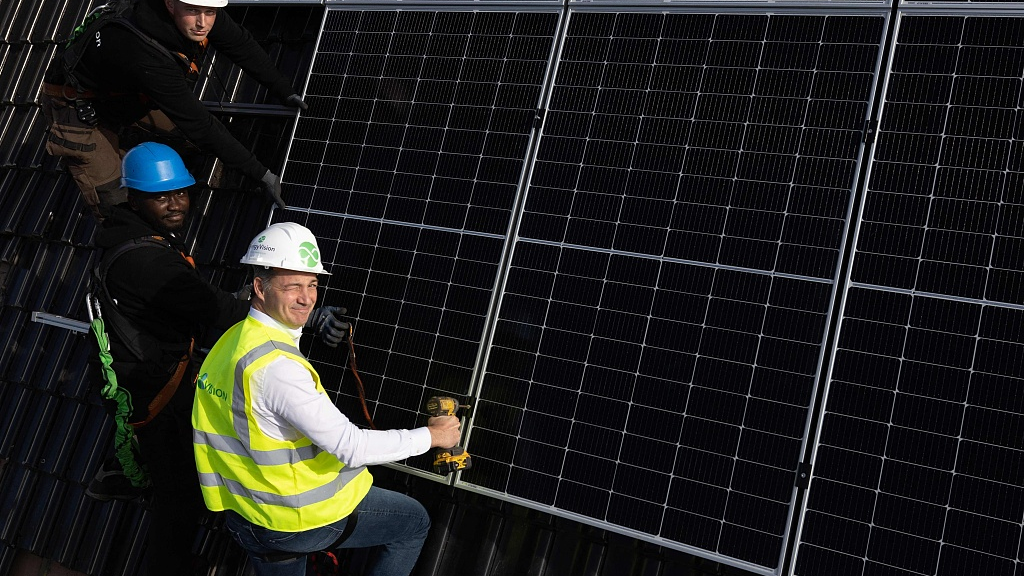
Photovoltaic panels are fastened to the roof of a care home facility, in Ipswich, Suffolk, UK, December 17, 2020. /CFP

Given the tense situation in their countries, due to high inflation and especially rising energy prices, it will be increasingly difficult for U.S. and European regulators to impose additional import duties on these products. China’s competitiveness and dominance in the entire solar energy value chain are so evident that even if someone succeeds in erecting new trade barriers, consumers will still prefer high-quality and price-competitive products. In this case, ordinary citizens will have to bear the new burden of new customs duties that may be introduced. And this will undoubtedly be a politically dangerous move by any government.

At the same time, it cannot be argued that the massive use of solar installations worldwide will be problem-free. During the construction of large-scale installations, serious problems will arise with allocating suitable and inexpensive land. The means of accumulating the generated electricity remain expensive. Rising prices for raw materials, especially polysilicon, and discriminatory measures in supply chains are also among the factors affecting the price of solar panels.

Realizing this, regulators and companies in leading countries have prioritized improving the supply chains for producing these systems and optimizing the extraction and enrichment of the necessary components. The International Energy Agency’s Special Report on Solar PV Global Supply Chains, published in July, argues that these problems will shortly require even more attention and additional efforts from politicians and regulators.

The countries’ political leaderships trying to put up barriers to fair competition should realize the futility of their attempts. Their actions to introduce discriminatory measures to restrict imports from other countries will not lead to price optimization nor the improvement of the final product quality.

Fair competition has always contributed to the economy’s development and humankind’s progress. It is no coincidence that all countries introduce regulatory bodies in their jurisdictions that promote competition rather than hinder it. All major players in the market of renewable solar installations should focus not on limiting competition but on technological and industrial cooperation. Achieving carbon neutrality goals by 2060 with joint efforts will be faster and more efficient.


Djoomart Otorbaev is the former prime minister of the Kyrgyz Republic, a professor of the Belt and Road School of Beijing Normal University, and a member of the Nizami Ganjavi International Center. The article reflects the author’s views and not necessarily those of The Southern African Times. 


Previous Post

Why are Indians cheering for the new British PM Rishi Sunak?

Next Post

Mukuru’s bulk payment platform poised to extend financial inclusion across Africa

SAT Reporter

Related Posts

How DRC President Leveraged Geopolitics to Secure Political Survival
Opinion

How DRC President Leveraged Geopolitics to Secure Political Survival

by Alex Ntung
June 9, 2026
Zimbabwe’s Child Online Safety Moment and Why It Matters Beyond 2030
Opinion

Zimbabwe’s Child Online Safety Moment and Why It Matters Beyond 2030

by Kundai Vambe
June 5, 2026
The Southern African Times Announces 2026 Editorial Recognition List (Shortlist Phase)
The Editorial Board

The Southern African Times Announces 2026 Editorial Recognition List (Shortlist Phase)

by The Editorial Board
June 2, 2026
Education and the Making of Responsible Citizens
Opinion

Education and the Making of Responsible Citizens

by Brendan Amadi
June 2, 2026
LONG READ | Zimbabwe Is Open for Business. But at What Price?
Opinion

LONG READ | Zimbabwe Is Open for Business. But at What Price?

by SAT Reporter
June 2, 2026
Next Post
Mukuru’s bulk payment platform poised to extend financial inclusion across Africa

Mukuru’s bulk payment platform poised to extend financial inclusion across Africa

Browse by Category

  • Africa AI
  • African Continental Free Trade Area
  • African Debt
  • African Start ups
  • Agriculture
  • AI Africa
  • Algeria
  • All News
  • Analysis
  • Angola
  • Arts / Culture
  • Asia
  • Botswana
  • BOTSWANA
  • BREAKING NEWS
  • BRICS
  • Burkina Faso
  • Burundi
  • Business
  • Business
  • Business Wire
  • Cameroon
  • Central Africa
  • Chad
  • China
  • Climate Change
  • Climate Changev
  • Community
  • Congo Republic
  • Conservation
  • Côte d’Ivoire
  • COVID 19
  • CRYPTOCURRENCY
  • Culture
  • Democratic Republic of Congo
  • Diplomacy
  • Eastern Africa
  • Economic Development
  • Economy
  • Education
  • Egypt
  • Elections 2024
  • Energy
  • Entertainment
  • Environment
  • Eritrea
  • Ethiopia
  • Europe
  • Fashion
  • Feature
  • Finance
  • Financial Inclusion
  • Food
  • Food and Drink
  • Foods
  • GABON
  • Ghana
  • Global
  • Global Africa
  • Guinea
  • Health
  • Humanitarian Aid
  • Immigration
  • in Southern Africa
  • International news
  • International Relations
  • Investment
  • Ivory Coast
  • Just In
  • Kenya
  • Lesotho
  • Libya
  • Life Style
  • Lifestyle
  • Literature
  • Malawi
  • Malawi
  • Mali
  • Markets
  • Mauritius
  • Middle East
  • Mining in Africa
  • Morocco
  • Mozambique
  • Namibia
  • Niger
  • niger
  • Nigeria
  • North Africa
  • North-Eastern Africa
  • Obituaries
  • Obituary
  • Opinion
  • PARTNER CONTENT
  • Politics
  • Property
  • Racism
  • Rwanda
  • Rwanda
  • SADC
  • SAT Interviews
  • SAT Investigation
  • SAT Jobs
  • Saudi Arabia
  • Senegal
  • Seychelles
  • Somaliland
  • South Africa
  • South Sudan
  • Sports
  • Startup Africa
  • STOCK EXCHANGE
  • Sudan
  • Sustainability
  • Sustainablity
  • Tanzania
  • Technology
  • Telecommunications
  • The Editorial Board
  • The Power Of She
  • Togo
  • Trade
  • Travel
  • Travel
  • Tunisia
  • Uganda
  • Uncategorized
  • Wealth
  • West Africa
  • World
  • World
  • ZAMBIA
  • Zambia
  • ZIMBABWE
  • Zimbabwe

Browse by Tags

#NewsUpdate #SouthAfrica #SouthernAfricanTimes #TheSouthernAfricanTimes AfCFTA africa African Continental Free Trade Area African development African Development Bank African economies African economy African Union Agriculture Angola Botswana China Climate change Cyril Ramaphosa Economic Development economic growth energy transition Ghana governance industrialisation Inflation Infrastructure Infrastructure Development International relations Investment Kenya Mozambique Namibia news Nigeria Regional Integration renewable energy Rwanda SADC South Africa Southern Africa sustainable development Tanzania United States Zambia Zimbabwe
ADVERTISEMENT

WHO WE ARE

The Southern African Times is a regional bloc digital newspaper that covers Southern African and world news. The paper also gives a nuanced analysis on news and covers a wide range of reporting which include sports, entertainment, foreign affairs, arts and culture.

Welcome Back!

Login to your account below

Forgotten Password?

Retrieve your password

Please enter your username or email address to reset your password.

Log In
  • Home
  • Southern Africa
  • Business
    • African Start ups
    • African Continental Free Trade Area
  • Technology
    • Lifestyle
      • Health
      • Culture
      • Food and Drink
      • Entertainment
  • Opinion
  • Sports
  • SAT Jobs
    • Events
  • About Us
    • Advertise with Us
    • Contact Us
Not enough quota to unlock this post
Unlock left : 0
Are you sure want to cancel subscription?