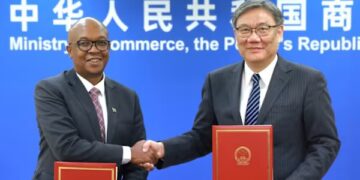

African countries have called on China to redirect its attention from extensive infrastructure projects to fostering local industrialisation. The appeal was made during a briefing on Tuesday by China’s top diplomat for Africa, Wu Peng, on the sidelines of the summit. This shift is seen as crucial, particularly in light of the Africa Continental Free Trade Agreement (AfCFTA), a pact established in 2021 to facilitate tariff-free trade among African nations.
China’s director-general of the department of African affairs at its foreign ministry, Wu Peng, revealed that African integration was on the rise and that numerous African nations had requested China to reevaluate its priorities. Wu emphasized the importance of aligning with the AfCFTA’s objectives, which are geared towards enhancing intra-African trade.
The impending discussions on African industrialisation are set to take place during a dedicated roundtable scheduled for Thursday. The meeting will be held on the sidelines of the BRICS summit, a platform that brings together leaders from Brazil, Russia, India, China, and South Africa. This meeting could pave the way for further collaboration between China and African nations in driving local industries forward.



Over the past two decades, Chinese state-owned banks extended loans totaling a staggering $160 billion to various African countries. This lending pattern experienced a surge after the initiation of the “Belt and Road Initiative” by Chinese President Xi Jinping in 2013, aimed at supporting infrastructure development in emerging economies. However, the loan commitments experienced a sharp decline from their peak of $28.4 billion in 2016 to $1.9 billion in 2020.

Wu Peng highlighted the urgency of addressing these concerns and stated that waiting until the next Forum for China-Africa Cooperation, a scheduled meeting between ministers from both regions next year, would not be sufficient. He also conveyed that Chinese companies, especially those of smaller and medium sizes, are expected to amplify their investments in Africa. Despite potential global and Chinese economic fluctuations, Wu asserted that the long-term trend is inclined towards Chinese companies taking calculated risks to tap into the African market.
The evolving dynamics between China and African nations underscore the intricate balance between infrastructure development and fostering local industries. As discussions unfold at the BRICS summit, all eyes are on the outcome of the roundtable and its potential to shape the future of economic cooperation between China and Africa.