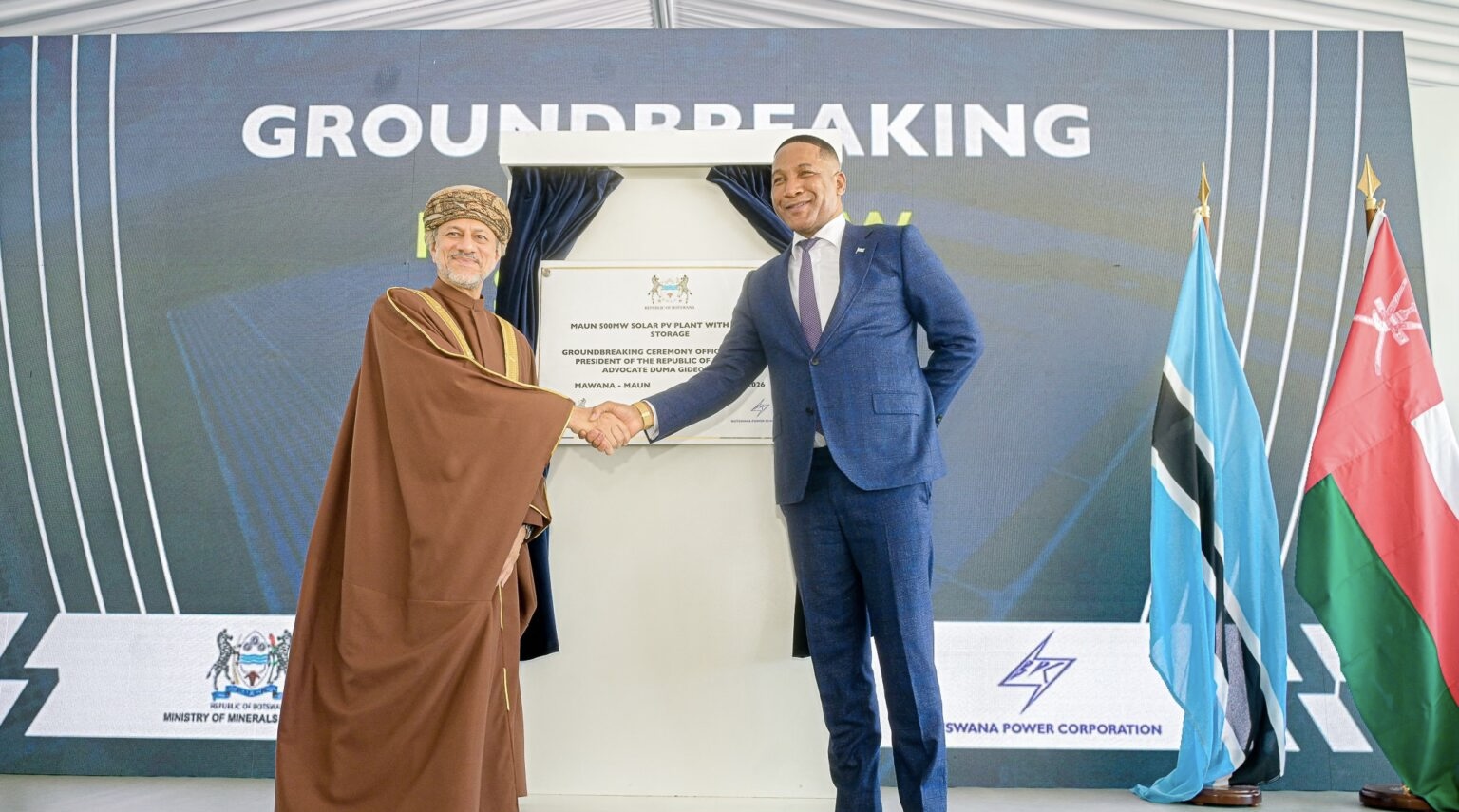
Botswana has commenced construction of a large scale solar and battery storage facility in Maun, marking a significant development in the country’s evolving energy landscape and its broader regional ambitions. The project, with a planned capacity of 500 megawatts of solar generation paired with 500 megawatt hours of battery storage, reflects a growing shift across southern Africa towards integrated renewable energy systems designed to address both supply and reliability constraints.
The Maun development is being implemented under an independent power producer framework by Okavango Solar, a company wholly owned by Oman based NAQAA Sustainable Energy, itself a subsidiary of the state backed O Green group. A 30 year power purchase agreement has been concluded with the Botswana Power Corporation, which will act as the offtaker. This structure aligns with wider trends across the continent, where public utilities increasingly partner with private and international investors to expand generation capacity while managing fiscal exposure.
According to official statements released during the groundbreaking ceremony, the integration of battery storage is expected to enable the delivery of solar generated electricity during peak demand periods, particularly in the early morning and evening when generation from photovoltaic systems would otherwise be limited. This approach reflects an emerging consensus within African energy planning that storage technologies are becoming central to improving grid stability and reducing reliance on dispatchable fossil fuel generation.



The Maun project forms part of a broader bilateral cooperation framework between Botswana and Oman, highlighting the diversification of energy partnerships beyond traditional financing centres. Such collaborations are increasingly shaping infrastructure development across Africa, with a growing emphasis on knowledge exchange, long term investment horizons, and locally grounded implementation.
In national terms, Botswana’s installed solar capacity remains relatively modest, estimated at approximately 181.5 megawatts, though this is expanding through projects such as the operational Mmadinare plant and the near completed Jwaneng facility. The government has set a target of achieving 50 percent renewable energy contribution to the national energy mix by 2030, a considerable increase from current levels of around 8 percent. The Maun initiative is therefore positioned not as an isolated intervention but as part of a structured transition within the country’s energy policy.

Regionally, the project also reflects a wider acceleration of solar plus storage deployment across southern Africa. Comparable developments are underway in neighbouring countries, including Zambia, where another large scale installation incorporating significant battery storage capacity has recently entered construction. These parallel investments suggest a shared regional response to persistent challenges including electricity shortages, ageing infrastructure, and exposure to climate variability.
While large scale renewable projects are often framed primarily in terms of capacity and investment value, their local implications remain equally significant. In the case of Maun, a town closely linked to the Okavango Delta and its surrounding communities, questions of land use, ecological sensitivity, and socio economic inclusion are likely to remain central as the project progresses. Balancing infrastructure expansion with environmental stewardship and community engagement continues to shape how such projects are experienced on the ground.
Botswana’s leadership has characterised the project as part of a broader ambition to position the country as a regional energy hub. Whether this vision materialises will depend not only on installed capacity but also on transmission integration, market development, and sustained policy coherence. Nonetheless, the Maun solar and storage project represents a notable step within an increasingly interconnected African energy transition that is being defined as much by regional priorities and local contexts as by global climate imperatives.