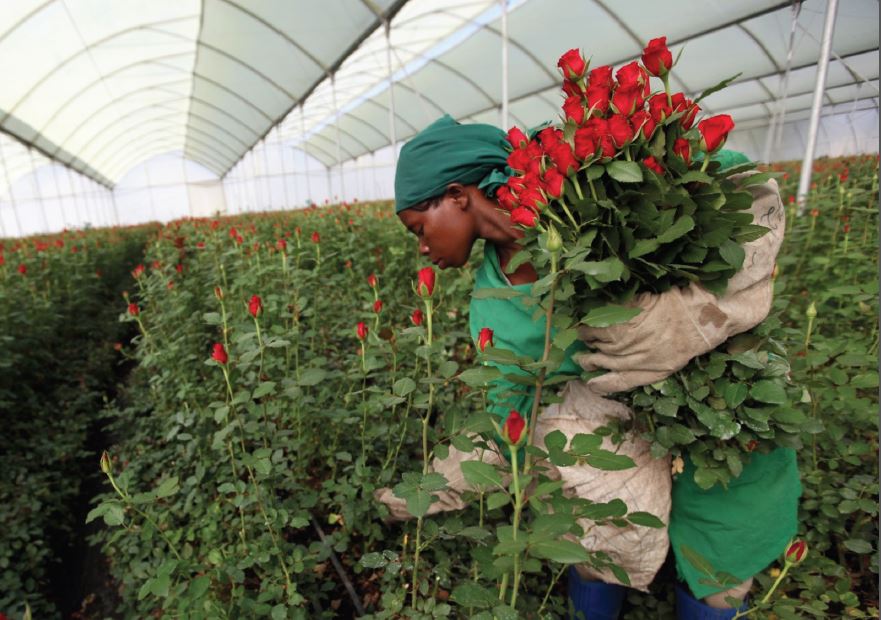
Kenya’s floriculture industry, one of the continent’s most prominent agricultural export sectors, is confronting logistical disruptions following the escalation of conflict in parts of the Middle East. Industry representatives report that restrictions and uncertainty in regional airspace have affected the movement of perishable cargo, prompting exporters to seek alternative routes and markets while absorbing rising operational costs.
According to the Kenya Flower Council, the Middle East represents a significant destination for Kenyan cut flowers, accounting for approximately 10 to 15 percent of the country’s total flower exports. Major markets include the United Arab Emirates and Saudi Arabia, which function both as consumer destinations and as logistics hubs linking African producers to wider Asian markets.
Kenya is widely recognised as Africa’s leading exporter of cut flowers, particularly roses cultivated in the high altitude regions surrounding Lake Naivasha and other horticultural zones. Data from the Kenya National Bureau of Statistics indicates that floriculture forms a central component of the country’s horticultural economy, generating substantial foreign exchange alongside tourism, tea, coffee, and diaspora remittances.



Industry estimates suggest that export disruptions during the past week alone may have resulted in losses or delayed shipments valued between 1.6 million and 1.8 million United States dollars. The sector’s reliance on rapid air freight to deliver highly perishable products means that even short interruptions to established flight corridors can have immediate commercial consequences.

Clement Tulezi, chief executive of the Kenya Flower Council, has noted that exporters are working closely with airlines, freight handlers, and public authorities to manage the situation. Efforts include rerouting cargo, identifying alternative logistics hubs, and redirecting some shipments toward other international markets, including Europe and parts of Asia. However, such diversions often lead to reduced prices and higher transport costs.
The vulnerability of the sector to aviation disruptions reflects the broader structure of the global flower trade. According to the International Trade Centre, Kenya accounts for a substantial share of global rose exports, with the European Union remaining the largest destination. The Middle East has increasingly developed into a complementary market, supported by expanding consumer demand and improved cargo connectivity through Gulf aviation networks.
Regional analysts also observe that the effects of supply chain interruptions extend beyond exporters alone. Floriculture is labour intensive, employing hundreds of thousands of workers across Kenya in cultivation, processing, logistics, and related services. Estimates cited by the Food and Agriculture Organization suggest that Kenya’s horticulture value chain supports over half a million livelihoods directly and indirectly.
Across the African continent, Kenya’s flower industry has often been viewed as a case study in the growth of high value agricultural exports. Countries including Ethiopia, Tanzania, Uganda, and Rwanda have expanded their own floriculture sectors in recent years, illustrating how specialised horticulture can contribute to export diversification and rural employment. Observers at the World Bank note that such industries rely heavily on stable transport infrastructure and predictable trade corridors.
Reports by outlets such as FreshPlaza and DW indicate that some cargo flights serving East African exporters have been rerouted due to heightened security concerns and shifting aviation advisories across the Middle East. Similar concerns have also been reported by Ecofin Agency, which noted that exporters are monitoring developments closely while assessing the financial implications of prolonged disruption.
Despite these challenges, stakeholders within Kenya’s horticulture industry emphasise that contingency planning and diversified export destinations remain central to maintaining stability. Producers and logistics partners continue to explore adaptive strategies that preserve market access while safeguarding the livelihoods that depend on the sector.
From a continental perspective, the episode underscores the interconnected nature of African export industries with global transport networks and geopolitical developments. It also highlights the resilience of agricultural value chains that have evolved across the continent, linking African producers with markets across Europe, the Middle East, and Asia while sustaining communities at the point of production.