For too long, the global conversation on climate action has been driven by a fundamental delusion. We talk about the Global South as if it were a sort of moral annex to the real world. “Spare a thought,” the narrative goes, “for the poor souls in low-lying countries.” It is a framing that turns the largest, youngest, and fastest-growing chunk of the planet into a charity case.
From a moral perspective, this is patronising. From a strategic perspective, it is insane.
If you were an alien advertising planner looking at Earth, you wouldn’t say, “Let’s focus our attention on those charming, aging legacy markets in Western Europe.” You would look at where the action is. You would look at where the people are being born, where the cities are being built, and where the first-time buyers of almost everything live. You would see that the Global South isn’t a side market. It is the main event.



The demographic reality check
Demographically, the shift has already happened. Almost all net population growth is coming from developing countries. The average human of 2050 is statistically more likely to be a young Nigerian, Indian, Bangladeshi, or Indonesian than a young Brit or American. Economically, the same story is unfolding. The marginal unit of global GDP – the extra slice of growth – is increasingly generated in places we used to call “emerging,” where average real GDP growth rates reached 4.3 percent in 2024, surpassing the global average of 3.3 percent and well above the 1.8 percent growth recorded in the industrialised economies of the North. China and India alone are turning into a double engine for the world economy.
When we add climate to this picture, the Western framing error becomes potentially lethal. When policymakers treat the South as a passive victim, they design policy that is essentially a disaster-relief brochure with a bit of carbon accounting stapled on, which is fundamentally limiting to growth in these regions. But if you flip the mental model; if you accept that the South is the dominant customer, the main growth driver, and the place where most future energy and infrastructure decisions will be made, everything changes. Sustainability stops being an act of noblesse oblige by the rich and starts looking like a joint product-development exercise with your biggest future client.
Decarbonise, don’t de-develop
The most important question is no longer “How much can we help these nations?” but “What kind of world do these billions of people actually want to live in, and how do we make that compatible with a finite atmosphere?”
Unsurprisingly, the people of the Global South are not queuing up for a smaller, darker, more precarious version of the life the West currently enjoys. Young people in Lagos, Lahore, or Luanda get the climate crisis viscerally. They have grown up with load-shedding, water cuts, and heatwaves as standard features. They are not impressed by pious lectures from countries that industrialised on a buy-now-pay-later plan and are only now quibbling about the bill.
They want growth, but they want it to be less stupid than the last century’s version. “Decarbonise but don’t de-develop” is not a slogan; it is a perfectly rational brief.
From a marketing perspective, what’s notable is that the Global North has been doing a terrible job at selling this transition to the majority world. They have offered sacrifice when they should be offering aspiration. They have talked about tonnes of CO₂ when they should be talking about fewer blackouts, cleaner air, better jobs, and cooler cities. The Global South doesn’t want to be the poster child for suffering; it wants to be the test bed for a better version of modernity.
The litmus test for inclusion: Power, payoff, and permanence
So, how do we move from “charity” to genuine inclusion? How do we ensure the “Just Transition” isn’t just a branding upgrade, the same old extraction curves garnished with fairness?
We need a rigorous litmus test for our projects and policies. I call it the Power, Payoff, and Permanence framework.
First, Power. Who actually sets the agenda? Too many “just transition” plans are written in capitals and international agencies, then presented to workers and communities as a fait accompli. Inclusion means answering: Who controls the money? Who owns the data? If communities, workers, and local institutions join only after the main decisions are made, we aren’t doing inclusion; we’re doing theatre.

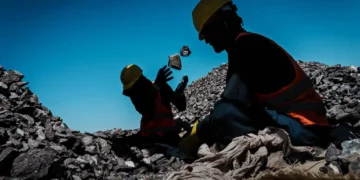
Second, Payoff. Who gets the concrete benefits? It is easy to talk about “green jobs” in the abstract. But in a coal town in Mpumalanga, the transition is specific and terrifying. It’s about whether a worker has a real bridge into another job, or whether a municipality can still fund clinics when the power station closes. If the main winners of the transition are Northern balance sheets and domestic elites, while the poor absorb the shocks of higher prices and less secure work, we have simply rebranded extraction as climate policy. If climate action feels like a downgrade in dignity and reliability, people will resist it, and this may jeopardise not just the imperative to decarbonise but political stability everywhere.
Third, Permanence. What exists in ten years’ time matters. Are we building stronger municipalities, robust skills systems, and local industries? Or are we leaving behind a handful of expired pilot projects and a shelf of unread reports? We need to map, in detail, who depends on the fossil economy and build visible ladders into new work. Inclusion requires legacy, not just activity.
Choosing a plan that works
If the global community can embrace these three anchors honestly, then we can stop designing climate policy as though we are doing the South a favour and admit that we are all junior partners in a project that will be led, numerically and energetically, by the people who live there.
We need to stop asking the Global South to sacrifice for a crisis they didn’t create, and start offering aspiration. We can roll up our sleeves and draw on the full resources of global alliances – whether university networks, development banks or climate clubs to co-produce research with cities and communities, translating evidence into real rules and curricula, and sharing methods and tools at scale.
The choice is not whether the Global South will dominate the future. That is already decided by birth rates and economics; the choice is whether we have the wit to treat that dominance as an opportunity to reinvent what “progress” looks like, before it’s too late. This is the only way we get to a climate resilience plan that actually works.
You can already see it in trade negotiations, in climate talks, in the way India, Brazil, South Africa and others are beginning to set their own terms, shifting from “non-alignment” to “multi-alignment,” and leveraging groups like BRICS+ to navigate between major global powers and maximize autonomy.
The global South’s voice is not a plaintive violin in the background; it’s the drum track. Ignore it, and your whole song is off-beat.

Jon Foster-Pedley is the dean of Henley Business School Africa and Associate Pro Vice-Chancellor of the University of Reading, Global Engagement (Sub-Saharan Africa). The University of Reading is the host of the Secretariat of the International Universities Climate Alliance (IUCA) from 2026 – 2028.